Quick answer: hair porosity is how easily hair absorbs and loses water, and it depends on the state of the cuticle. The float test is unreliable: residue, oil and thickness change the result. More reliable signs are drying time, how hair reacts to products and your chemical history. Porosity guides your routine: porous hair needs protection and sealing; low-porosity hair needs lightness.
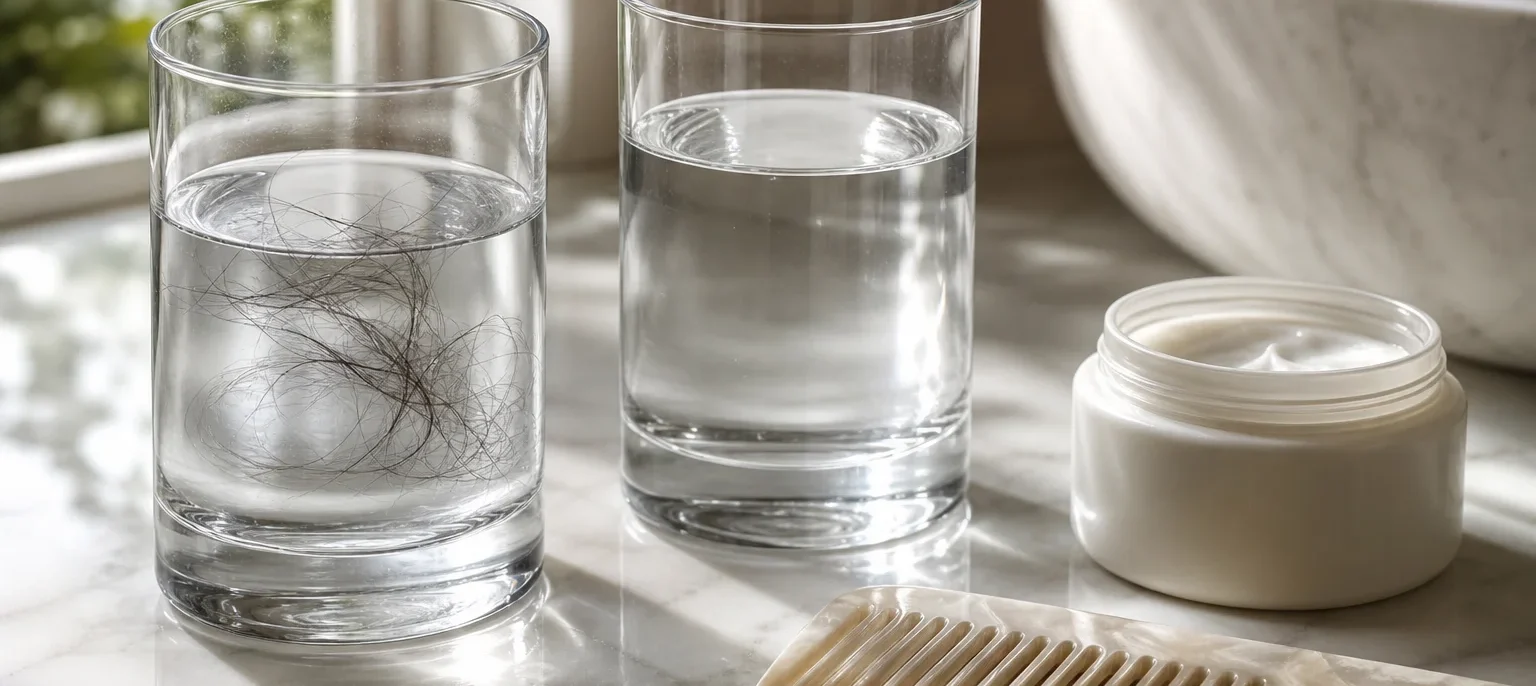
The float test has gone viral: drop a hair into water and see whether it sinks, floats or stays in the middle. It looks simple and scientific. The problem is that the result changes depending on the day, the shampoo and even the glass. Many people end up building a whole routine on a test that does not measure what it promises.
In this article I explain what hair porosity is, why the float test misleads, which signs are more reliable and how porosity changes your product choices and routine.
What is hair porosity?
Hair has three layers: the cuticle on the outside, made of overlapping scales; the cortex in the middle, which gives strength and colour; and, in some hairs, the medulla at the centre.
Porosity depends mainly on the cuticle:
- low porosity: tightly closed, aligned scales. Water enters and leaves slowly;
- medium porosity: a balance between absorption and retention;
- high porosity: open, lifted or damaged scales. Water enters fast and leaves fast.
Porosity can be natural, linked to genetics and hair structure, or acquired, caused by bleaching, relaxing, heat, sun, chlorine and friction.
In the lab, porosity is measured with specific methods, such as water uptake and calorimetry techniques. One example is a 2025 study in the International Journal of Cosmetic Science (abstract on PubMed), which used calorimetry to characterise the pores in hair. None of that fits in a glass of water.
Why the float test misleads
The test assumes porous hair absorbs water and sinks. But several factors interfere:
- Product residue: silicones, oils and styling products repel water and make hair float.
- Natural oil: hair with sebum tends to float.
- Surface tension: a dry hair can sit on the surface for minutes, regardless of porosity.
- Thickness and length: coarse and fine hairs behave differently.
- Observation time: almost any hair sinks if you wait long enough.
- Where the hair comes from: roots are usually less porous than ends, and the test uses a single hair.
The result: the same hair can "have" three different porosities on three different days.
Reliable signs of porosity
High porosity
- dries very quickly, sometimes in under 1 hour naturally;
- absorbs mask and leave-in but looks dry again soon after;
- frizzes easily in humidity;
- tangles and breaks easily;
- colour fades fast;
- a history of bleaching, relaxing or frequent heat.
Low porosity
- takes a long time to get wet in the shower;
- takes a very long time to dry;
- products seem to sit on top and weigh hair down;
- builds up residue easily;
- chemical services and colour "take" less easily.
Medium porosity
- dries in a reasonable time;
- responds well to most products;
- holds moisture and shape for a few days.
The practical touch test
Slide two fingers along a hair from the end towards the root. If you feel roughness and small "catches", the cuticle is probably lifted. If it slides smoothly, the cuticle is more closed. It is a simple test, but more useful than the glass, especially when done on several sections.
Hair porosity and product choice
| Porosity | Priority | Products that usually work | Care |
|---|---|---|---|
| Low | Lightness and penetration | Light conditioners, fluid leave-ins, conditioning with gentle warmth | Avoid build-up; clarify occasionally |
| Medium | Maintenance | A balanced moisture and nourishment routine | Protect from heat and sun |
| High | Protection and sealing | Richer masks, creamy leave-in, oils on the ends, heat protectant | Less heat and chemical work; trim damaged ends |
Porosity and your hair routine
Treatment rotations (moisture, nourishment, repair) should be adjusted to porosity. Low-porosity hair rarely needs frequent protein treatments, and too much can make it stiff. High-porosity hair usually benefits from nourishment and occasional repair, always watching how it responds.
Porosity and texture: do not confuse them
Porosity is not the same as curl pattern. Coily hair can be low porosity, and bleached straight hair can be high porosity. Curl pattern affects how sebum spreads and how dry hair gets, but porosity is about the cuticle. For routines by curl pattern, see afro haircuts for coily hair.
How to care for high-porosity hair
- Reduce damage: less heat, spaced-out bleaching, protection from sun and chlorine.
- Wash with a gentle shampoo and avoid very hot water.
- Always condition and use a mask 1 to 2 times a week.
- Seal the ends with oil or a creamy leave-in.
- Use heat protectant before a dryer or straightener.
- Trim the ends every 8 to 12 weeks to remove the most damaged part.
- Sleep on a satin pillowcase or tie your hair loosely.
How to care for low-porosity hair
- Choose light products and use small amounts.
- Use gentle warmth when conditioning, such as a thermal cap, to help penetration.
- Apply leave-in to very damp hair.
- Clarify periodically to remove build-up.
- Avoid layering products that weigh hair down and dull it.
A sample week for each porosity
The examples below are starting points, not recipes. Watch how your hair responds for 3 to 4 weeks before changing anything.
High porosity (bleached, straight to wavy hair):
- 2 to 3 washes a week, with a gentle shampoo;
- conditioner at every wash;
- a nourishing mask at 1 wash and a light repair mask every 15 days;
- creamy leave-in and heat protectant whenever you use heat.
Low porosity (coarse, coily or untreated straight hair):
- 1 to 3 washes a week, depending on scalp oiliness;
- light conditioner and a moisturising mask under a thermal cap for 15 to 20 minutes, once a week;
- a clarifying shampoo every 3 to 4 weeks if there is build-up;
- small amounts of styling product.
If, after a month, your hair still feels heavy, dull or brittle, adjust one item at a time. Changing everything at once makes it impossible to know what worked.
When porosity signals something more
If your hair breaks a lot, feels overly stretchy when wet, or your scalp itches and flakes, the problem may go beyond porosity. Poorly done chemical services, excessive heat and scalp issues need an assessment. A haircut helps too: with a bob haircut, for example, removing porous ends restores weight and shine.
Frequently asked questions
Not reliably. A hair can float or sink because of product residue, oil, the water’s surface tension and hair thickness. The result changes with the same hair at different times.
Common signs: it dries very quickly, absorbs product and soon looks dry again, frizzes easily, tangles and breaks easily. It is common in bleached, chemically treated or heat-exposed hair.
Hair with a tightly closed cuticle: it takes a long time to get wet and to dry, products seem to sit on top and build up easily. It usually responds better to light products and a little warmth when conditioning.
High porosity caused by damage cannot be reversed, because hair does not regenerate. Care improves its look and protects it, and gradual trims remove the most damaged parts.
A real professional assessment
Porosity is assessed by looking at the whole head of hair, its history and how it responds to products, not a single hair in a glass. In the Hair & Scalp Therapy Consultation, I assess hair and scalp, with trichoscopy, and build a routine according to porosity, texture and your chemical history.
Are you a hairdresser? In the Cutting Technology Course you learn to adapt the cut to wavy, curly and coily hair, taking into account how the hair really behaves.
Nelma Faleiro holds a postgraduate specialisation in Cosmetic Trichology (Faculdades Oswaldo Cruz) and a degree in Visagism and Hair Therapy from Universidade Anhembi Morumbi, where she lectured for 10 years.