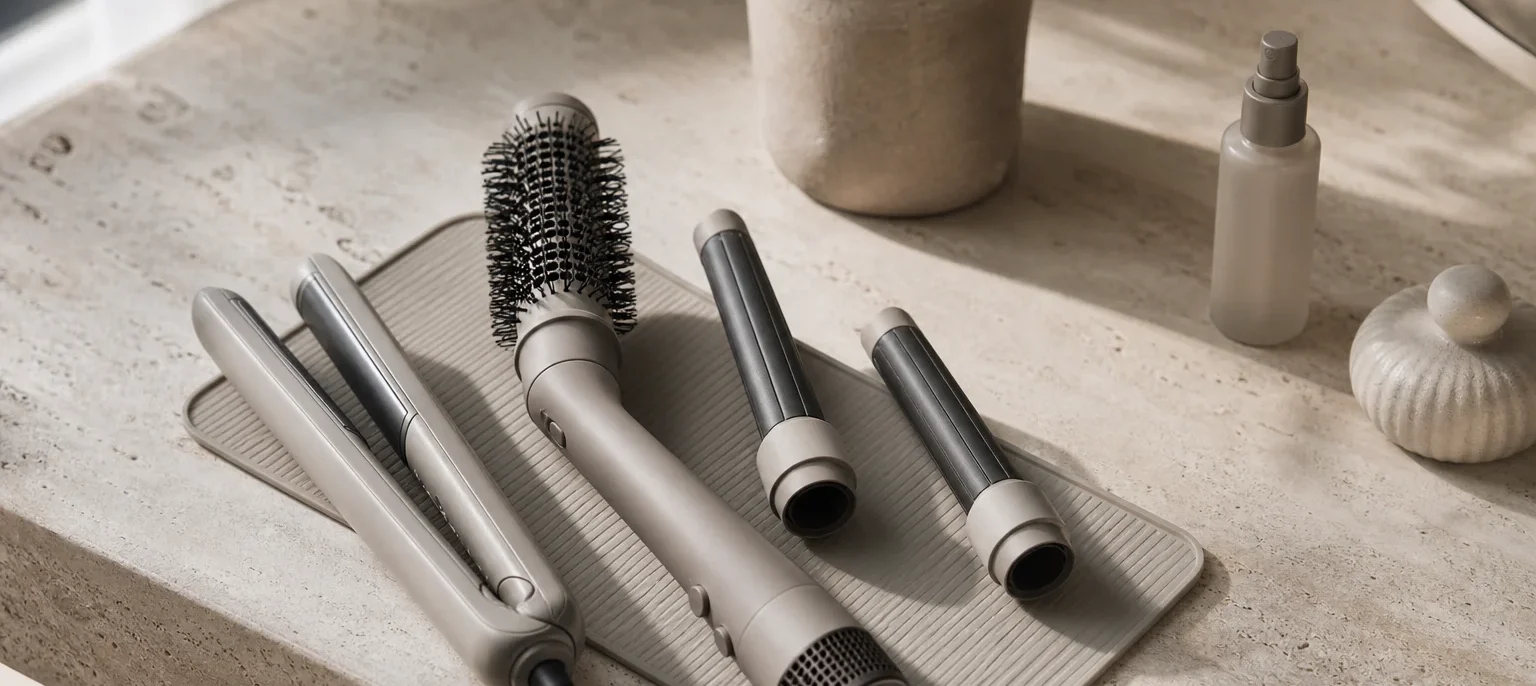
Quick answer: a hot air brush, a flat iron and an air styler do different things. The hot air brush dries and styles at the same time with hot air; the flat iron straightens with heated plates in direct contact; the air styler creates waves and blow-outs with airflow. To avoid damage, temperature, frequency, heat protectant and technique matter more than the brand.
When choosing a heat tool, the shelf seems to have one for every promise: "salon shine", "no frizz", "waves in minutes". The hot air brush, the flat iron and hot-air stylers have become objects of desire — and of doubt. Which should you choose? Which does less damage? Is the investment worth it?
This guide compares the three options honestly and shows how to use each with less damage to your hair.
How does heat act on hair?
A hair strand is made mainly of keratin, with an outer layer of scales, the cuticle. Heat:
- temporarily changes the hair’s hydrogen bonds, which lets you straighten or curl it as it cools in the new shape;
- in excess, dries it out, opens the cuticle and damages the protein, leaving hair rough, dull and brittle;
- applied to wet hair, can make internal water boil and form bubbles in the fibre.
A study in the Annals of Dermatology (Lee and colleagues, 2011) compared air-drying with a hairdryer at different distances and temperatures and found that using the dryer about 15 cm away, kept moving, caused less surface damage than higher temperatures held close.
Comparison: hot air brush, flat iron and air styler
| Hot air brush | Flat iron | Hot-air styler | |
|---|---|---|---|
| How it works | Hot air + a brush that may rotate | Heated plates in contact with the hair | Airflow that wraps and shapes the hair |
| Result | Blow-out with volume and flipped ends | Sleek and straight, or waves | Waves, loose curls, blow-out |
| Hair | Damp (drying + styling) | Dry | Damp or almost dry, depending on the model |
| Direct heat | Medium | High | Medium to low |
| Best for | Straight, wavy, fine to medium | Almost all, with adjusted temperature | Straight to wavy, fine to medium |
| Watch out | Bristle friction, tangling | High temperature, repeated passes | High cost, learning curve |
Hot air brush
It combines a hairdryer and a brush. It is practical for people who have not mastered a round brush and dryer at the same time. Things to watch: bristles that tangle long, fine hair, and use on soaking-wet hair, which increases heat time. Remove excess water first and work in medium sections.
Flat iron
The most powerful tool for straightening, and also the most aggressive when misused. What to look for:
- Temperature control with several settings — avoid models without it;
- Plate material: ceramic and tourmaline spread heat more evenly; titanium heats quickly and suits experienced hands;
- Plate width: narrower for short hair and waves; wider for long, thick hair.
Hot-air styler
It uses airflow to wrap the hair around the barrel and shape it, with less contact with very hot surfaces. It can be a good option for people who want waves often. On the other hand, it usually costs much more, needs practice and may give less lasting results on very thick, heavy or coily hair.
Which should you choose for your hair type?
- Fine, straight hair: a hot air brush on medium heat or an air styler; a flat iron only on low heat.
- Thick, straight hair: a flat iron with temperature control or a powerful hot air brush.
- Wavy hair: an air styler for defined waves; a hot air brush for a blow-out with movement.
- Curly and coily hair: to straighten, a dryer with a brush or comb attachment and a flat iron at controlled temperature; to keep curls, a diffuser. Frequent heat can change the curl pattern.
- Bleached or fragile hair: the least heat possible, spaced-out use and heat protectant every time.
If your question is about the hairdryer itself, see also how to choose a hairdryer.
How do you use them without damage?
- Always use heat protectant, applied along the lengths before heat;
- The lowest temperature that works — increase gradually;
- One pass per section with the flat iron, rather than several;
- Thin sections with the flat iron and medium ones with the hot air brush;
- Dry hair for the flat iron; damp but not dripping for the hot air brush;
- Frequency: space out flat-iron use, if possible, to 2 to 3 times a week at most;
- Clean the plates and bristles, so product residue does not burn onto the hair;
- Keep up with hydration and nourishment — adjust to what your hair needs, as I explain in does a hair treatment schedule work?.
Signs you are overdoing the heat
- whitish ends or ends with "knots";
- a burning smell during use;
- rough hair that does not respond to hydration;
- breakage along the lengths;
- curls that no longer return to their original pattern;
- frizz that increases even with styling products;
- colour that fades faster than usual.
When these signs appear, reduce heat and get an assessment. Sometimes the best treatment is trimming the damaged ends.
How much heat per week is reasonable?
There is no universal number, but some references help organise your routine:
| Situation | Suggested frequency |
|---|---|
| Healthy straight or wavy hair | Hot air brush up to 3 to 4 times a week, on medium heat |
| Flat iron on healthy hair | Up to 2 to 3 times a week, with protectant |
| Bleached or relaxed hair | 1 to 2 times a week, low heat |
| Hair showing damage | A 2 to 4 week break and an assessment |
A simple strategy is to "make the blow-out last": sleep with your hair in a loose bun on top, use a satin pillowcase and refresh only the fringe or front the next day. That way a good blow-out lasts 2 or 3 days, and the hair spends less time under heat.
Is it worth investing in expensive models?
Higher prices usually bring better temperature control, a more durable motor and better finish. But no tool makes up for daily use at maximum heat without protectant. Before buying, consider:
- how many times a week you will use it;
- your hair type and the result you want;
- whether there is technical support and a warranty;
- voltage and electrical safety.
Leave-in and heat protectant are not the same
Many people use a leave-in as if it protected against heat. Only products that claim heat protection and have been tested for it do that job — see the difference in leave-in conditioner: how to use it.
Frequently asked questions
Any heat tool can damage hair if used at high temperatures, often and without protection. A hot air brush tends to be gentler than a flat iron because it works with hot air, but the friction of the bristles and daily use also count.
It depends on the hair. As a general reference, fine, bleached or fragile hair needs lower temperatures, around 150 to 180 °C; thick, resistant hair tolerates a little more. Always use the lowest temperature that gets the result.
It can be for people who want waves and blow-outs with less direct heat and use it often. The cost is usually high, and results depend on hair type and technique. On very thick or coily hair it can be less effective.
No. Water inside the hair boils on contact with the hot plate and can form bubbles in the fibre, making hair brittle. Dry it thoroughly first, unless the tool is designed for damp hair and the manufacturer says so.
Heat with awareness
If your hair already shows signs of heat damage — breakage, porous ends, loss of shine — an assessment helps you understand what can be recovered and what needs cutting. In the Hair & Scalp Therapy Consultation, I assess your hair and scalp with trichoscopy and build a care and heat-styling routine that respects your hair type.
I want to care for my hair without giving up my blow-out →
A beauty professional? In the Cutting Technology Course, you learn cuts that work with less styling — one of the most effective ways to reduce your clients’ daily heat use.
Nelma Faleiro holds a specialisation in Cosmetic Trichology (Faculdades Oswaldo Cruz) and a degree in Visagism and Hair Therapy Technology from Anhembi Morumbi University, where she taught for 10 years.