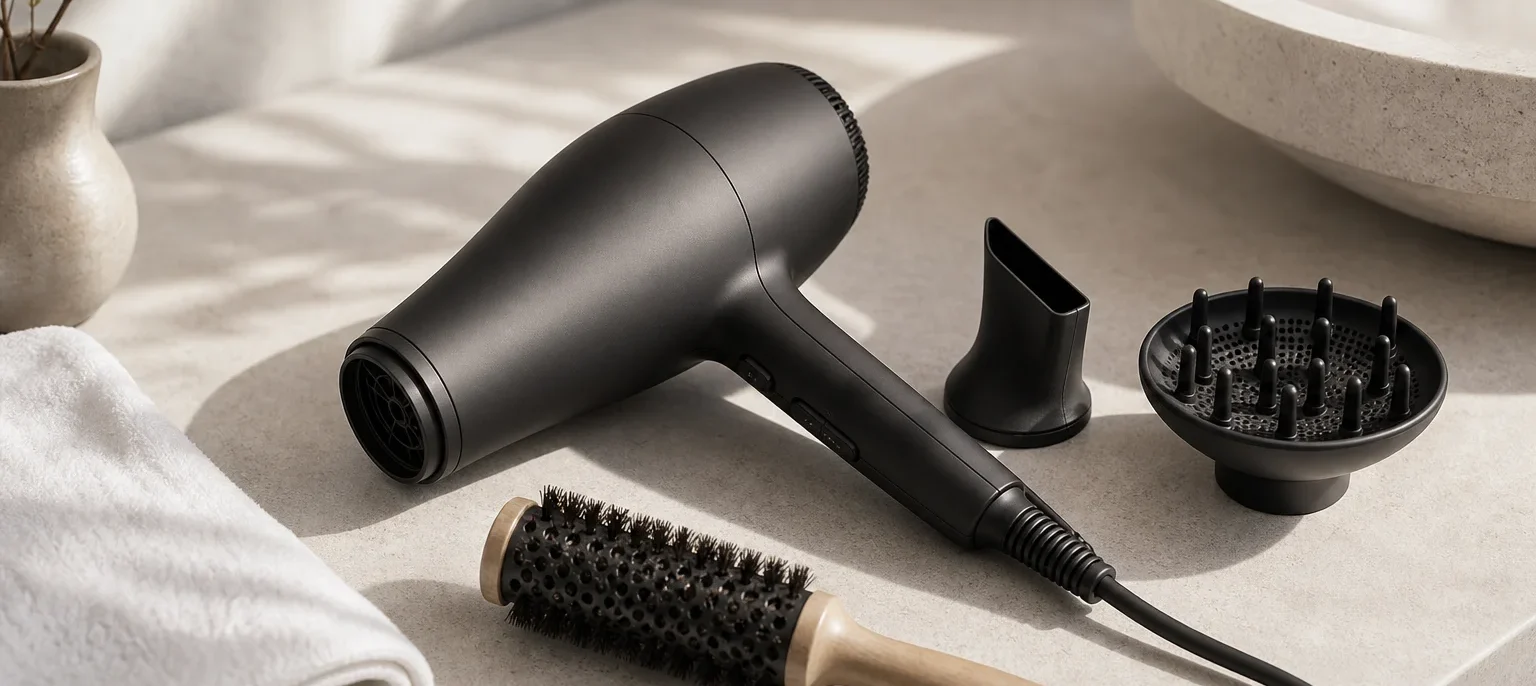
Quick answer: the best hair dryer combines a quality motor, good airflow, at least 2 heat settings with a cool shot and a narrow nozzle, at a weight your arm can handle. Watts show consumption, not results: 1,800 to 2,200 W is enough at home. Ions and ceramic are bonuses. For curly hair, a diffuser is essential.
Anyone who has bought a "2,600-watt" hair dryer and still had frizz knows the number on the box does not tell the whole story. The dryer is the heat tool we use most, and choosing well makes a difference to shine, drying time and hair health.
In this guide I explain what really matters when choosing the best hair dryer for you, what is just marketing and how to use it without damage.
Do watts matter? What power really tells you
Watts measure how much energy the appliance uses, not how well it dries. Two 2,000 W dryers can perform very differently depending on the motor and the nozzle design.
A practical reference:
| Power | Best for |
|---|---|
| up to 1,500 W | Travel, short or fine hair |
| 1,800 to 2,200 W | Home use, most hair types |
| above 2,200 W | Very long, dense hair, professional use |
More power without temperature control may simply mean more heat. And excess heat is the cuticle’s main enemy.
Which motor: AC, DC or digital?
The motor determines airflow strength, durability and weight.
- AC motor: heavier, more durable and with strong airflow. It is the salon standard because it copes with hours of use.
- DC motor: lighter and cheaper. It works well for occasional home use but tends to wear out sooner with heavy daily use.
- Brushless digital motor: very light, spins at high speed and dries quickly with less heat. It is the most expensive.
If you dry your hair every day and it is long, an AC or digital motor usually pays off in the long run.
Heat and speed: the controls that make a difference
The best hair dryer has at least 2 speeds and 2 to 3 heat settings, plus a cool shot.
- High speed, medium heat: removes water from the lengths with less stress.
- High heat: use sparingly and always on the move, only for styling.
- Cool shot: sets the blow-dry, locks the shape and adds shine at the end.
Some models have intelligent heat control, which measures the air and prevents heat spikes. It is useful technology for bleached or fine hair.
Ions, ceramic and tourmaline: are they worth it?
Negative ions: the idea is to reduce static and leave hair smoother. Many people notice a difference, especially in dry weather. Independent evidence is still limited, so treat it as a bonus.
Ceramic: helps spread heat more evenly, with fewer hot spots.
Tourmaline: a mineral associated with ion emission. In practice, its effect adds to that of ceramic.
None of these technologies makes up for a weak motor or too much heat. Choose motor and control first, then the extras.
Nozzle, diffuser and filter: the attachments that decide the result
Concentrator nozzle
The nozzle directs air into a narrow band. The narrower it is, the more precise the blow-dry and the smoother the cuticle. Openings of 6 to 9 mm are common on professional models. Without a nozzle, air scatters and frizz increases.
Diffuser for curly and coily hair
A diffuser spreads air at low speed, drying without breaking up curls. For curly hair, it matters more than any technology. Choose large diffusers with long "fingers" that reach the roots.
Removable filter
The rear filter collects dust and hair. A clogged filter overheats the motor and shortens its life. Clean it every 2 to 4 weeks.
Weight, cord and voltage: comfort counts
- Weight: 400 to 600 g is comfortable; above 700 g, your arm tires with long hair.
- Cord: 2.5 to 3 m gives freedom of movement.
- Voltage: check whether it is 110–127 V, 220–240 V or dual voltage. The wrong voltage can burn it out.
- Warranty and service: important for a dryer you use every day.
The best hair dryer for each hair type
| Hair type | What to prioritise |
|---|---|
| Fine and straight | Low to medium heat, light weight, narrow nozzle |
| Thick and voluminous | Strong motor (AC or digital), good airflow, narrow nozzle |
| Wavy | Diffuser + medium heat, cool shot |
| Curly and coily | Large diffuser, low speed, low heat |
| Bleached or chemically treated | Heat control, less heat, heat protectant |
If your hair is damaged or your scalp feels irritated, assess the condition of the hair first. A good reading of texture and porosity helps you choose the right tool and routine.
How to use a hair dryer without damaging your hair
A study published in 2011 in Annals of Dermatology (abstract on PubMed) compared air-drying with a dryer at different distances and temperatures. The researchers observed that:
- hair left wet for a long time showed damage to an inner layer of the hair;
- a dryer used about 15 cm away, in constant motion, caused less damage than air-drying;
- the higher the temperature and the shorter the distance, the greater the damage to the cuticle surface.
In practice:
- Remove excess water with a microfibre towel, without rubbing.
- Apply heat protectant to the lengths.
- Dry the roots first, on medium heat.
- Keep about 15 cm away and keep the dryer moving.
- Use the nozzle pointing downwards, in the direction of the cuticle.
- Finish with the cool shot.
Common mistakes
- drying on maximum heat "to save time";
- touching the hair with the nozzle;
- often going to bed with wet hair;
- never cleaning the filter;
- using a dryer on bleached hair without protectant.
Hair dryer, hot air brush or air styler?
Rotating brushes and air stylers combine drying and styling in one appliance. They are practical but often apply heat very close to the hair. For daily use, a dryer with a traditional brush still gives more control. Haircut trends play a part too: a well-cut style needs less heat to look good, as I show in women’s haircuts 2026.
How to look after your dryer so it lasts longer
A good hair dryer can last many years with a few simple habits:
- Do not wrap the cord around the body of the dryer. It strains the internal wires near the base and is one of the most common causes of failure.
- Store it away from moisture. A closed, steamy bathroom is not the best place.
- Switch it off before changing attachments and let it cool down.
- Pay attention to smell and noise. A burning smell or an unusual sound calls for a repair service, not for carrying on.
- Never use it with wet hands or next to a full sink.
When comparing models in a shop, hold the dryer for a few minutes with your arm raised to head height. It may seem excessive, but that is how you will use it every day. A dryer that looks great on paper but is too heavy will end up forgotten in a cupboard.
Frequently asked questions
For home use, around 1,800 to 2,200 W is usually enough. But watts measure energy consumption, not quality. Motor, airflow and temperature control matter more for the result.
Many users notice smoother hair, and the technology may help reduce static. Independent scientific evidence is still limited, so ions are a bonus, not the main criterion.
AC motors are heavier, durable and common in professional dryers. DC motors are lighter and cheaper but tend to wear out sooner with heavy use. Brushless digital motors are light, powerful and more expensive.
Not always. A 2011 study found that drying with a dryer held about 15 cm away and kept moving caused less damage to an inner layer of the hair than leaving it wet for a long time. Too much heat, however, damages the cuticle.
Summary to help you decide
- an AC or digital motor for daily use;
- 2 speeds, 2 to 3 heat settings and a cool shot;
- a narrow nozzle and, for curls, a diffuser;
- comfortable weight and the right voltage;
- ions and ceramic as bonuses.
Want more practical guides like this? Subscribe to the blog newsletter for hair, beauty and personal image updates. And if your hair keeps breaking or your scalp is irritated despite all your care with heat, an assessment in the Hair & Scalp Therapy Consultation is worth it.
Nelma Faleiro holds a postgraduate specialisation in Cosmetic Trichology (Faculdades Oswaldo Cruz) and a degree in Visagism and Hair Therapy from Universidade Anhembi Morumbi, where she lectured for 10 years. This content is not sponsored by any brand.