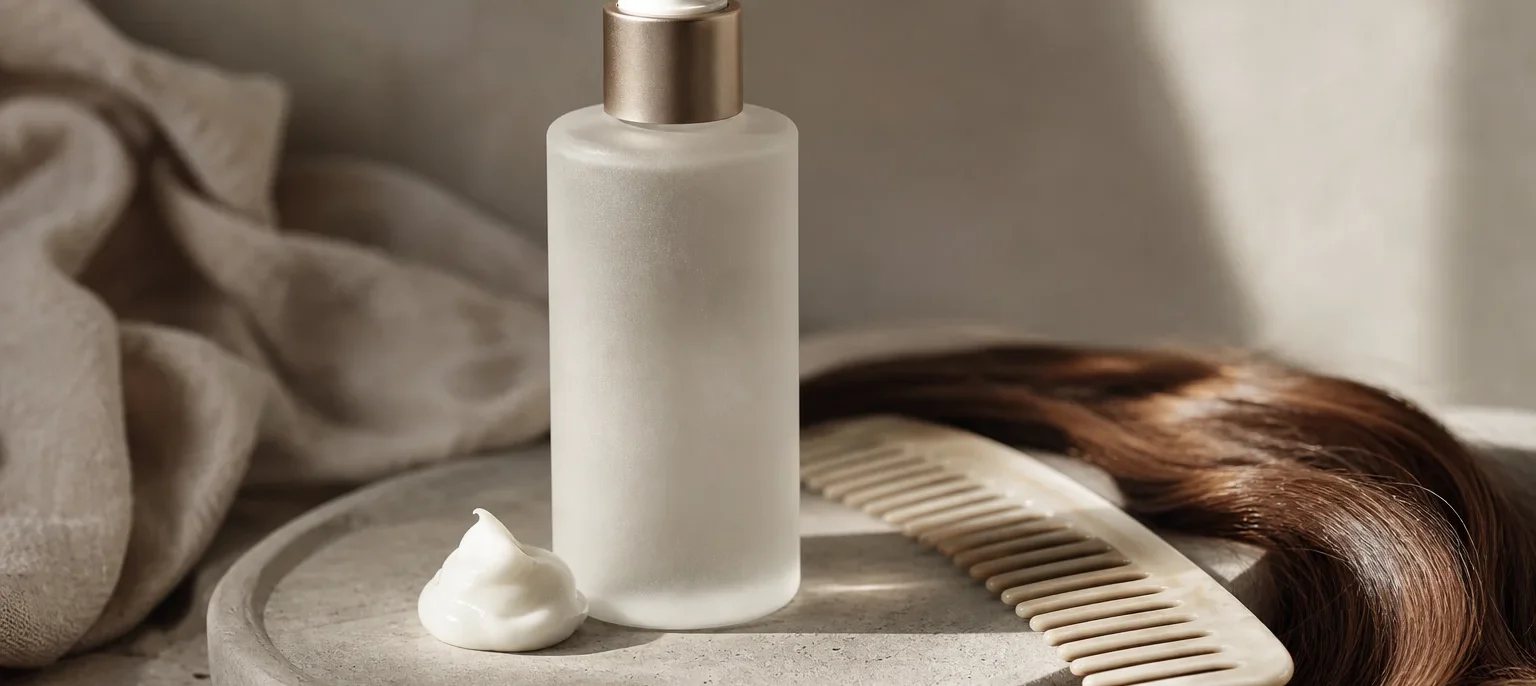
Quick answer: leave-in conditioner is a no-rinse product applied to damp or dry hair that detangles, reduces frizz and protects the cuticle from friction throughout the day. It goes from the mid-lengths to the ends, never on the scalp. Fine hair needs light sprays or serums; curly and coily hair needs richer creams and more product.
"My leave-in weighs my hair down" and "my leave-in disappears in an hour" are opposite complaints with the same cause: the wrong product, amount or timing for that hair. Leave-in conditioner is one of the most versatile products in a hair routine — and one of the most misused.
In this guide you will understand what it really does, how to choose the texture, how much to apply and when it is not the answer.
What is leave-in conditioner and what does it do?
A leave-in is any treatment product that stays on the hair after washing, with no rinsing. Most formulas combine three groups of ingredients:
- Conditioning agents (quaternary ammonium compounds such as behentrimonium chloride, and cationic polymers): they bind to the hair surface, which carries a negative charge, and reduce static and friction;
- Emollients (light oils, esters, silicones): they form a thin film that adds slip and shine;
- Humectants (glycerin, panthenol, propylene glycol): they attract water and help keep the strand flexible.
According to the review Hair cosmetics: an overview, published in the International Journal of Trichology, conditioners act mainly by reducing friction and static charge on the cuticle — in other words, a leave-in improves how the hair behaves, but it does not "rebuild" the fibre from the inside.
What leave-in conditioner does — and what it does not
| Does | Does not |
|---|---|
| Makes detangling easier and reduces breakage when combing | Repair split ends (only a trim does) |
| Controls frizz and static | Make hair grow |
| Adds shine and softness | Treat hair loss or dandruff |
| Helps define curls | Replace a heat protectant unless tested |
How do you use leave-in conditioner on your hair type?
The general rule is to apply it to damp hair, after rinse-out conditioner, from mid-lengths to ends. But texture and amount change a lot:
Fine, straight hair
Choose a light spray or serum. Spray from 20 cm away, focus on the ends and run a wide-tooth comb through. A pea-sized amount is usually enough for shoulder-length hair. Rich creams make fine, straight hair look greasy by the end of the day.
Wavy hair
A light creamy lotion. Apply with your hands in a "praying" position (palms flat, gliding from top to bottom) so you do not break up the wave. Avoid overdoing it: weight stretches the wave until it disappears.
Curly hair
A medium to rich cream, applied section by section, to very wet hair. Many people need one to two teaspoons, depending on length. Then scrunch the curls from the bottom up to encourage definition.
Coily hair
Rich creams and, when the hair asks for it, a layer of oil or butter on top to seal. Applying in sections, with the hair divided into four or six parts, makes sure the product reaches every strand.
Chemically treated hair (blonde, relaxed)
Bleached or relaxed hair has a more open cuticle and absorbs more. A leave-in with heat protection and colour filters helps, but the main care is reducing heat and repeated chemical services.
How much leave-in conditioner, and when?
Three variables decide the result:
- Amount: start small and add. A pea for short, fine hair; a hazelnut for medium; one to two teaspoons for long, thick or curly hair.
- Moisture: damp hair spreads product better and defines more. On dry hair, use a single drop on the ends to smooth frizz.
- Order in the routine: wash → condition → remove excess water with a microfibre towel or T-shirt → leave-in → styler (gel, mousse) if you use one → dry.
If your hair takes 5 hours to air-dry, a lighter leave-in avoids that sticky feeling until the evening.
Why does my leave-in weigh my hair down or disappear?
The most common causes I see in consultations:
- Too much product — always the first suspect.
- Applying it at the roots — the product slides onto the scalp, builds up and weighs hair down. In people prone to oiliness or flaking it can make things worse; read dandruff or seborrheic dermatitis.
- The wrong texture for the hair — a curl cream on fine straight hair, a spray on thick coily hair.
- Build-up — layer after layer with no wash that removes residue. A deeper cleanse every 2 to 4 weeks usually solves it.
- Weather — on very humid days, humectants like glycerin can pull water from the air and increase frizz.
When a leave-in "disappears" quickly, the hair is usually very porous, and what is missing is conditioning in the shower, not more styling product.
Leave-in, oil and heat protectant: what is the difference?
Many people use all three thinking they do the same thing:
- Leave-in conditioner: conditions and detangles; the base of styling.
- Hair oil: seals and adds shine; too much weighs hair down. Oil on the scalp is another conversation — see what is known about rosemary oil for hair.
- Heat protectant: contains polymers tested to reduce heat damage. Only a leave-in that claims this function and has been tested replaces it.
The American Academy of Dermatology’s tips for healthy hair include using conditioner and cutting down on heat and tension — habits where a leave-in is an ally.
How do you choose a leave-in by its label?
Marketing talks about "reconstruction" and "nourishment"; the ingredient list tells another story. Look at:
- The first five ingredients: they make up most of the formula. Water, cetearyl alcohol and a quat point to a classic conditioning cream.
- Light silicones (cyclopentasiloxane, amodimethicone): add slip without much weight. For fine hair, prefer volatile ones.
- Oils and butters near the top: a richer formula, better for curls and coils, heavy for fine straight hair.
- Fragrance high on the list: take care if your scalp is sensitive.
Test a product for at least three washes before deciding, noting how your hair looked at the end of the day.
Common leave-in mistakes
- Applying it to dripping-wet hair, which dilutes it and makes it run off;
- Applying it and then rubbing the hair with a towel, which undoes the protection and creates frizz;
- Switching products every week without time to judge (wait at least 3 washes);
- Using a leave-in to "treat" shedding or itching, which are scalp problems that need assessment.
Frequently asked questions
No. Rinse-out conditioner works in the shower and is washed away; leave-in conditioner stays on the hair after washing. They complement each other: the rinse-out does most of the detangling and the leave-in keeps the protection throughout the day.
Generally, no. It should go from the mid-lengths to the ends. On the scalp it builds up, weighs hair down and can worsen oiliness and flaking in people prone to them.
Only if the label claims heat protection and the manufacturer has tested it. A regular leave-in detangles and reduces friction, but it does not replace a heat protectant before a flat iron or a hot hairdryer.
As a starting point, a pea- to hazelnut-sized amount for short, fine hair and one to two teaspoons for long, thick or curly hair. Adjust by the result: if it feels heavy, use less; if frizz returns early, use a little more.
When the problem is not your leave-in
If no product seems to work — the hair breaks, the length never passes a certain point, the scalp itches or the roots turn oily within hours — the problem is probably not in your styling. In the Hair & Scalp Therapy Consultation I assess your scalp and hair with trichoscopy, identify what is going on and build a product routine with the right amounts and order for your hair, with medical referral when needed.
I want a routine made for my hair →
If you are a professional who wants to recommend products based on hair structure rather than marketing, the Practical Trichology e-book organises assessment, scalp disorders and protocols.
Nelma Faleiro holds a specialisation in Cosmetic Trichology (Faculdades Oswaldo Cruz) and a degree in Visagism and Hair Therapy Technology from Anhembi Morumbi University, where she taught for 10 years.