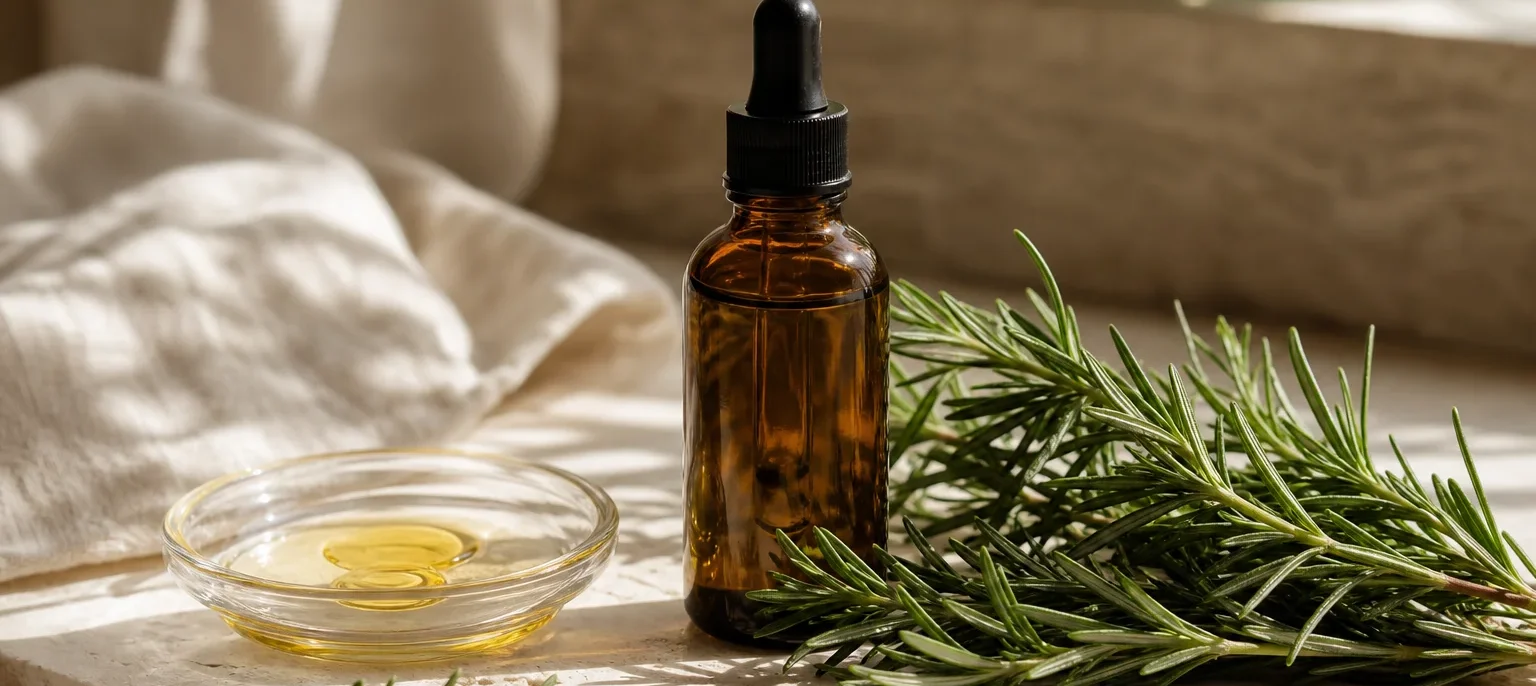
Quick answer: rosemary oil for hair has one promising clinical study: in 2015, 100 men with androgenetic alopecia used rosemary oil or 2% minoxidil for 6 months, and both groups saw a similar increase in hair count. That is limited evidence, for one type of hair loss only. If you use it, always dilute it, patch-test first and don’t replace medical treatment.
Few ingredients have gone as viral as rosemary. Videos promise "hair growing in weeks" with a spray bottle of tea or a few drops of essential oil. The reality is more interesting — and more modest. There is science behind it, but it doesn’t say what the marketing usually says.
In this article you will understand what the research actually showed, why rosemary might help, how to use rosemary oil for hair safely and when it isn’t the answer.
Where rosemary’s reputation comes from
Rosemary (Salvia rosmarinus, formerly Rosmarinus officinalis) has been used in folk tradition for centuries. Scientific interest grew for three reasons:
- Effect on local circulation — rosemary compounds appear to stimulate scalp microcirculation;
- Antioxidant and anti-inflammatory action — carnosic acid and rosmarinic acid reduce oxidative stress in lab studies;
- Possible anti-androgenic action — animal studies suggest rosemary extracts may interfere with 5-alpha-reductase, the enzyme involved in androgenetic alopecia.
These mechanisms come largely from lab and animal studies. In humans, the evidence is much more limited.
What the most cited study showed
The study behind the hype was published in 2015 by Panahi and colleagues in Skinmed (abstract on PubMed). The key data:
- 100 men with androgenetic alopecia;
- 50 used rosemary oil and 50 used 2% minoxidil;
- duration of 6 months;
- at 3 months, neither group showed a meaningful difference;
- at 6 months, both groups had an increase in hair count, with no significant difference between them;
- the rosemary group reported less scalp itching.
The limits almost nobody mentions
- It was one study, relatively small, in men only;
- it looked only at androgenetic alopecia, not effluvium, postpartum shedding or deficiency-related loss;
- it compared against 2% minoxidil, a low strength for male pattern loss;
- there was no placebo group;
- the product was a specific formulation — not the "rosemary tea" of social media.
In short: a promising signal that deserves more research, not proof that rosemary replaces medical treatment.
Oil, tea, tonic: which form to use
| Form | What it is | Pros | Cons |
|---|---|---|---|
| Pure essential oil | Concentrated, a few drops | Basis of the study (diluted) | Irritates if used neat |
| Essential oil diluted in carrier oil | 1% to 2% essential oil | Easy to make | Can weigh down an oily scalp |
| Ready-made tonic or lotion | Cosmetic formulation | Light, oil-free | Variable concentration |
| Home-made tea/infusion | Leaves in water | Cheap | Spoils in 2 to 3 days, no evidence |
How to use rosemary oil for hair safely
1. Always dilute
A common cosmetic dilution is 1% to 2%: roughly 3 to 6 drops of rosemary essential oil in 1 tablespoon (15 ml) of a light carrier oil (jojoba, grapeseed). On an oily scalp, choose ready-made, oil-free tonics.
2. Patch-test
Apply a little of the mix behind your ear or on your inner arm and wait 24 to 48 hours. Redness, burning or itching: don’t use it.
3. Apply to the scalp, not the lengths
Section the hair, apply a few drops directly to the scalp and massage with your fingertips for 2 to 3 minutes. Massage alone also stimulates circulation.
4. Contact time and frequency
With oil, leave it on for 30 minutes to a few hours and then wash — sleeping with oil at the roots encourages oiliness and, in prone people, dermatitis. Light tonics can be left in. Use 3 to 5 times a week, consistently.
5. Give it time
Hair grows about 1 cm a month. Assess with standardised photos after 3 and 6 months, not after 3 weeks.
Who should avoid it
- pregnant and breastfeeding women, without guidance;
- people with epilepsy — rosemary essential oil has been reported as a possible trigger;
- anyone allergic to plants in the Lamiaceae family (rosemary, sage, lavender);
- a scalp with sores, psoriasis or a dermatitis flare;
- young children.
Myths and facts about rosemary
"Rosemary works for any hair loss." Myth. The study was in androgenetic alopecia. If the cause is iron deficiency, thyroid or effluvium, rosemary doesn’t treat the root cause. See the most common causes in female hair loss.
"The more, the better." Myth. High concentrations raise the risk of irritation, and irritation inflames the scalp — the opposite of what you want.
"It’s natural, so it has no side effects." Myth. Essential oils are active substances and can cause contact dermatitis.
"It can replace minoxidil." Only a doctor can judge that. In androgenetic alopecia, lost time means lost hair.
"Massage helps." True. A small Japanese study of 4 minutes of daily scalp massage found increased hair thickness at 24 weeks. Massage plus a suitable active is a good combination.
Rosemary vs other hair-loss actives
Rosemary isn’t the only ingredient with some support. To compare honestly:
- Minoxidil — a medicine with decades of studies, prescribed by a doctor; the benchmark for androgenetic alopecia.
- Topical caffeine — lab studies show follicle stimulation; clinical evidence is still limited, but the safety profile is good.
- Pumpkin seed oil — a small study in men suggested a benefit when taken orally; topical use has little evidence.
- Peptides and plant extracts in tonics — many studied by the manufacturers themselves; good supporting players, rarely the lead.
- Castor oil — very popular, with virtually no evidence for growth; it does add shine to the lengths.
The practical rule: cosmetic actives are supporting players. The further hair loss progresses, the more important a medical diagnosis and well-supported treatment become.
How to tell if it’s working
Photograph your crown and parting on day one, in the same light and at the same distance, and repeat every 30 days. Positive signs: less hair in the brush, short new hairs along the hairline and a visibly tighter parting after a few months. If nothing has changed in 6 months, it’s time to review the strategy with a professional.
Where hair therapy comes in
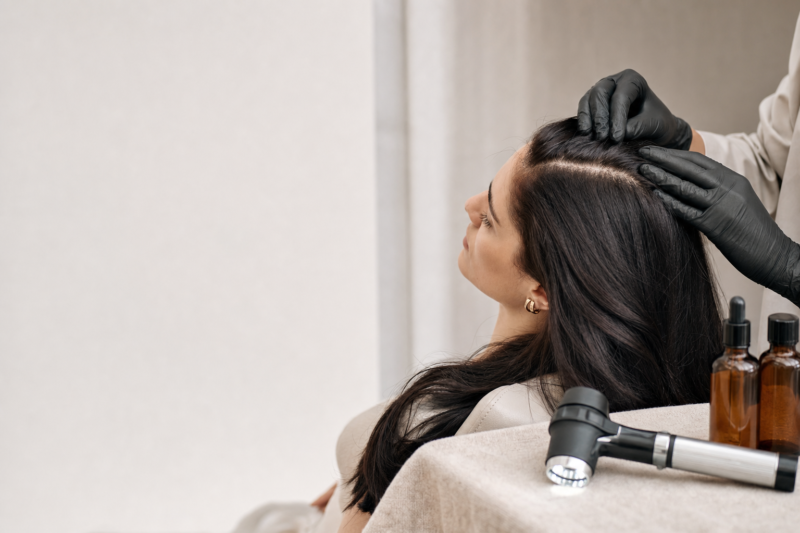
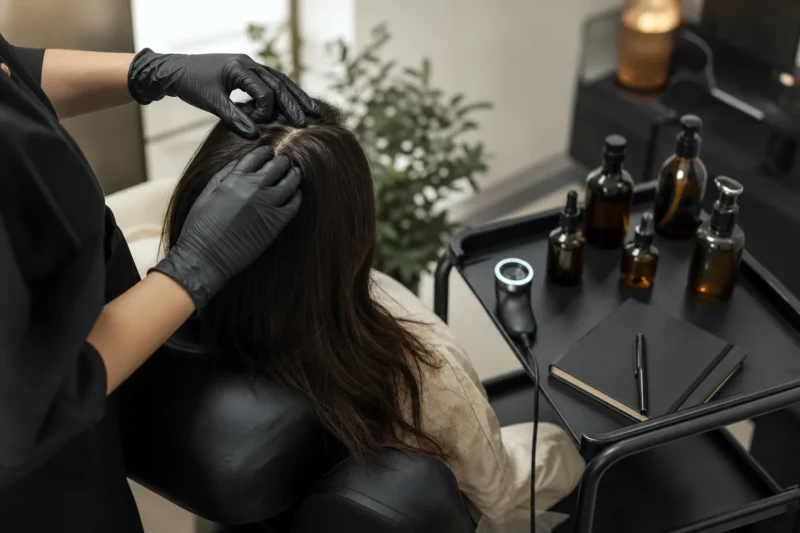
Before choosing any active — rosemary, caffeine, peptides or medication — you need to know what type of hair loss you have. In an assessment, trichoscopy shows whether there is miniaturisation (pattern loss), inflammation, oiliness or resting hairs (effluvium). Rosemary can then be part of a protocol, at a safe concentration, alongside proper cleansing and photo follow-up — or be ruled out if it doesn’t make sense for your case.
Frequently asked questions
A 2015 study of 100 men with androgenetic alopecia found an increase in hair count after 6 months with both rosemary oil and 2% minoxidil, with no statistical difference between the groups. It is interesting but limited evidence: it does not prove an effect for every type of hair loss.
No. Undiluted essential oil can irritate and sensitise the skin. It should be diluted in a carrier oil or used in a formulated tonic at a low concentration, and patch-tested on a small area first.
In the most cited study, the difference only appeared after 6 months of regular use. Since hair grows about 1 cm a month, any hair treatment needs at least 3 to 6 months to be judged.
Pregnant and breastfeeding women, people with epilepsy, anyone allergic to plants in the rosemary family and people with scalp sores or a dermatitis flare should avoid it or use it only with professional guidance.
Find out whether rosemary makes sense for you
If you want to treat hair loss based on what your scalp shows — not on this week’s video — the Hair & Scalp Therapy Consultation is the place to start: consultation, trichoscopy, an individual protocol with suitable actives and medical referral when needed.
A beauty professional? The Practical Trichology e-book (in Portuguese) covers how to recommend professional and natural products based on evidence, so you can guide clients without internet "recipes".
Nelma Faleiro is a specialist in Cosmetic Trichology and has worked as a hair therapist for more than two decades. Educational content: it does not replace medical advice.