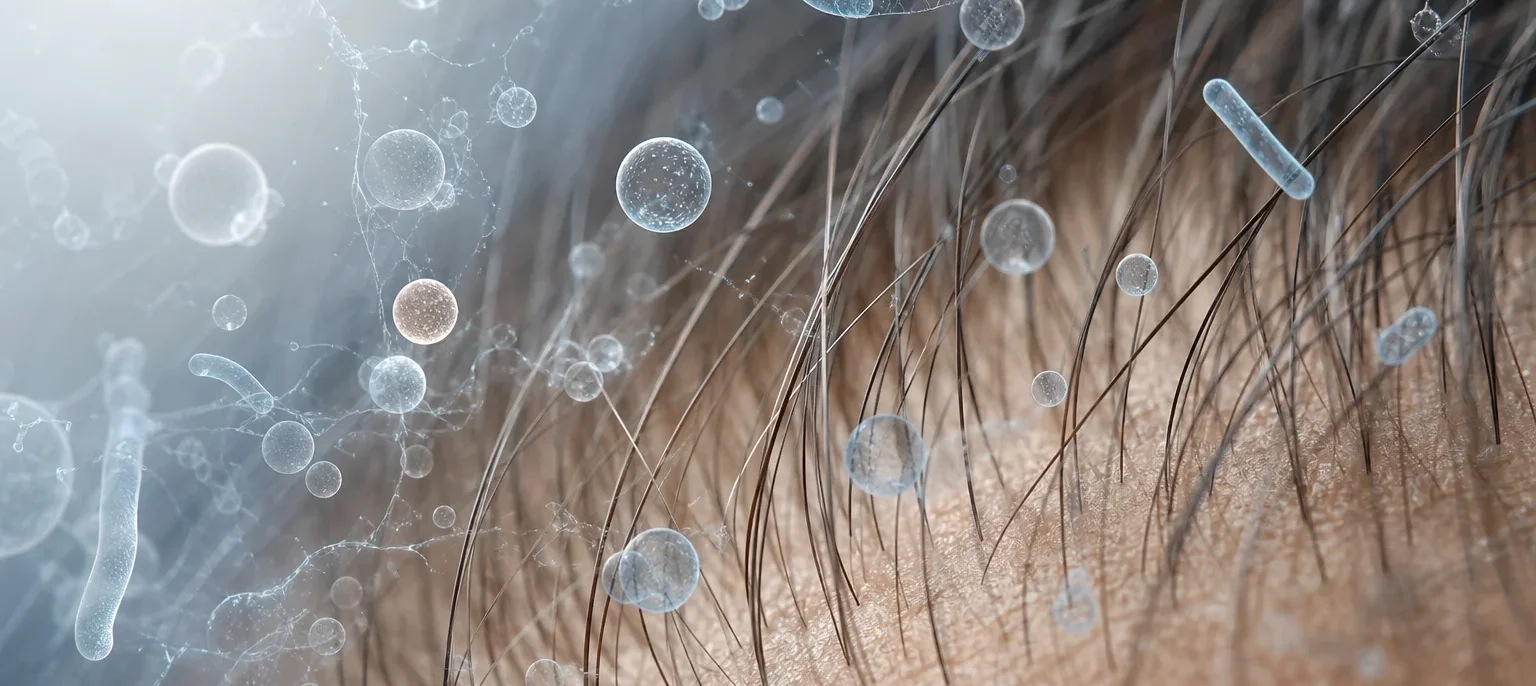
Quick answer: the scalp microbiome is the community of bacteria and fungi living on the skin of the head, mainly Cutibacterium, Staphylococcus and Malassezia. When this ecosystem is out of balance (dysbiosis), dandruff, itching and inflammation increase, which can harm the follicle’s environment. In practice, this changes recommendations: less aggression, more balance.
For decades, dandruff was treated as dirt: you just had to "clean it properly". Today we know the scalp is an ecosystem. It hosts microorganisms that live alongside the skin, compete with each other and respond to sebum, moisture, pH and the products we use.
For beauty professionals, understanding the scalp microbiome changes the conversation with clients and the choice of products. In this article I explain who lives there, what dysbiosis is, how it relates to dandruff and hair loss and how to apply this knowledge in practice.
What is the scalp microbiome?
A microbiome is the community of microorganisms living in an environment, together with their genes. On the scalp, the environment is unusual:
- it has many sebaceous glands, creating oily skin;
- it is warm and sheltered by hair;
- it has a slightly acidic pH;
- it frequently receives products.
This environment favours microorganisms that like lipids.
Who lives there
| Group | Main genera | Known role |
|---|---|---|
| Bacteria | Cutibacterium (formerly Propionibacterium) | Predominates on a healthy scalp |
| Bacteria | Staphylococcus | Increases in dandruff |
| Fungi | Malassezia (such as M. restricta and M. globosa) | Feeds on sebum; involved in dandruff |
These groups are not "villains". They are part of healthy skin. The problem is imbalance.
What is scalp dysbiosis?
Dysbiosis is a change in the composition and balance of the microbiome. On the scalp, it usually shows up as:
- more Staphylococcus and less Cutibacterium;
- greater Malassezia activity, breaking sebum down into irritating fatty acids;
- an inflammatory response in the skin, with flaking and itching.
A study published in 2016 in Scientific Reports (abstract on PubMed) analysed scalps with and without dandruff. The authors found that the two dominant bacteria, Cutibacterium and Staphylococcus, inhibit each other and that the balance between them was strongly associated with dandruff severity. Moisture and sebum levels were also related to the condition.
The practical conclusion: dandruff is not just fungus and not just oiliness. It is an interaction between the skin and microorganisms.
Microbiome, dandruff and seborrhoeic dermatitis
Malassezia depends on lipids. It uses the triglycerides in sebum and releases fatty acids that, in sensitive people, irritate the skin and speed up cell turnover. The result is visible flakes.
- Dandruff: flaking without significant inflammation.
- Seborrhoeic dermatitis: yellowish, greasy flaking with redness and itching, which may reach the brows and sides of the nose.
The difference between them and when to refer is covered in dandruff or seborrhoeic dermatitis. Dermatitis needs medical treatment.
What about hair loss?
The link between the microbiome and hair loss is less direct and still being studied. What we know:
- chronic scalp inflammation creates an unfavourable environment for the follicle;
- intense itching leads to friction and breakage;
- in some alopecias, research has found microbiome changes, but it is not clear whether they are a cause or a consequence.
So caring for scalp balance supports hair loss treatment; it is not a treatment in itself.
What throws the microbiome off balance
- washing too little on an oily scalp, allowing sebum to build up;
- washing with harsh products too often, disrupting the barrier;
- often sleeping with wet hair, keeping the scalp warm and damp;
- heavy oils on the roots, which feed Malassezia;
- too many styling products building up;
- stress, climate and hormonal changes, which alter sebum.
How this changes product recommendations
Thinking about the microbiome means swapping "kill everything" logic for balance.
Cleansing
- washing frequency adjusted to oiliness, not a fixed rule;
- shampoos with surfactants suited to the scalp, without unnecessary harshness;
- for dandruff, alternating with shampoos containing specific actives, as recommended.
Supporting actives
| Category | Example use | Note |
|---|---|---|
| Cosmetic antifungals | Mild dandruff | For dermatitis, a doctor prescribes |
| Sebum regulators | Oiliness | Do not solve the problem alone |
| Soothing actives | Itching and sensitivity | Useful after flare-ups |
| Prebiotics and postbiotics | Supporting balance | Evidence still limited |
Routine
- dry the roots after washing;
- avoid heavy oils on the scalp;
- exfoliate in moderation, never during inflammation;
- review product build-up.
A reasoning example: oily scalp with mild dandruff
Here is how the microbiome lens organises a common case, with no warning signs:
- Weeks 1 to 2: adjust washing frequency, usually to every other day or daily, with a suitable shampoo. Stop oils on the roots and go to bed with a dry scalp.
- Weeks 3 to 4: introduce a shampoo with a cosmetic anti-dandruff active twice a week, alternating with the usual shampoo.
- Weeks 5 to 8: keep the routine, assess itching and flaking on trichoscopy and, if there is sensitivity, add a soothing active.
- Review: compare standardised photos. With no improvement in 6 weeks, refer to a dermatologist.
Notice that the protocol starts with the routine, not with the strongest product. Often, simply changing washing frequency and removing oils already reduces flaking considerably.
What to avoid
- switching anti-dandruff shampoo every week;
- using antimicrobial actives every day for months without review;
- scrubbing hard to "get rid of the flakes";
- treating seborrhoeic dermatitis as ordinary dandruff.
Scalp probiotics: what to tell clients
The market has launched shampoos and serums with probiotics, prebiotics and postbiotics. The idea makes biological sense. However:
- many products contain no live microorganisms, but extracts or fragments (postbiotics);
- studies are small and often funded by manufacturers;
- there is no standardisation of concentration or results.
The honest message is: "it may help support balance, but it does not replace assessment or treatment".
Assessment: where trichoscopy helps
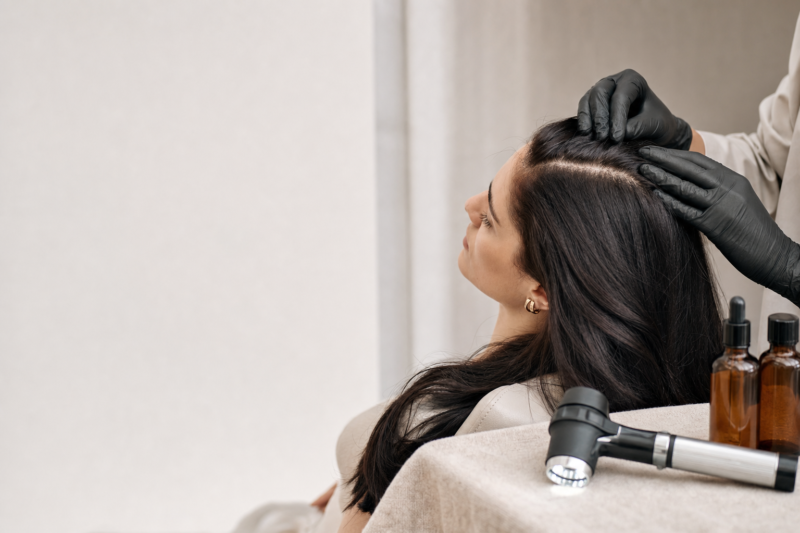
On trichoscopy you see indirect signs of imbalance: flaking, oiliness, redness and product build-up in the follicle openings. The examination does not show microorganisms, but it helps describe the condition and track progress. Read more in trichoscopy: what it is and what it reveals.
Refer to a dermatologist when there is:
- thick, adherent scale;
- intense redness, pain or sores;
- flaking spreading to the face, ears or body;
- no response after 4 to 6 weeks of appropriate cosmetic care.
A new look at an old problem
The concept of the scalp microbiome helps explain why harsh products sometimes make dandruff worse, why washing too little also makes it worse and why each client responds differently. Less aggression and more balance: that is the shift in thinking.
For clients, this is also a relief. Many arrive feeling guilty, convinced that dandruff means they are "dirty". Explaining the microbiome replaces guilt with understanding, and understanding improves adherence to the routine.
Frequently asked questions
It is the community of bacteria, fungi and other microorganisms living on the scalp skin. The main groups are bacteria of the genera Cutibacterium and Staphylococcus and fungi of the genus Malassezia.
It is an imbalance between these microorganisms, with some groups increasing and others decreasing. Studies link dysbiosis with dandruff, seborrhoeic dermatitis and discomfort such as itching and oiliness.
No. Dandruff is linked to oiliness, the skin’s response and an imbalance of microorganisms, especially Malassezia. Washing too little can make it worse, but the cause is not poor hygiene.
There are early studies on topical probiotics, prebiotics and postbiotics, but the evidence is still limited and often funded by manufacturers. They are promising supporting options, not treatment.
Deepen your reasoning with the e-book
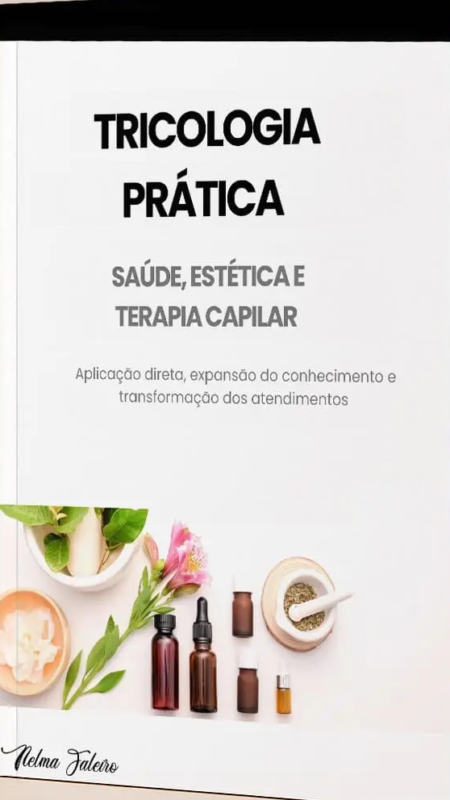
In the Practical Trichology e-book, I organise assessment, scalp disorders and protocols in 109 pages, including oiliness, flaking and hair loss, with criteria for choosing actives based on what you observe.
I want the Practical Trichology e-book →
If you are a client living with dandruff, itching or oiliness that does not improve, the Hair & Scalp Therapy Consultation starts with assessment and trichoscopy.
Nelma Faleiro holds a postgraduate specialisation in Cosmetic Trichology (Faculdades Oswaldo Cruz) and a degree in Visagism and Hair Therapy from Universidade Anhembi Morumbi, where she lectured for 10 years. Educational content for professionals; always respect the legal limits of your practice.