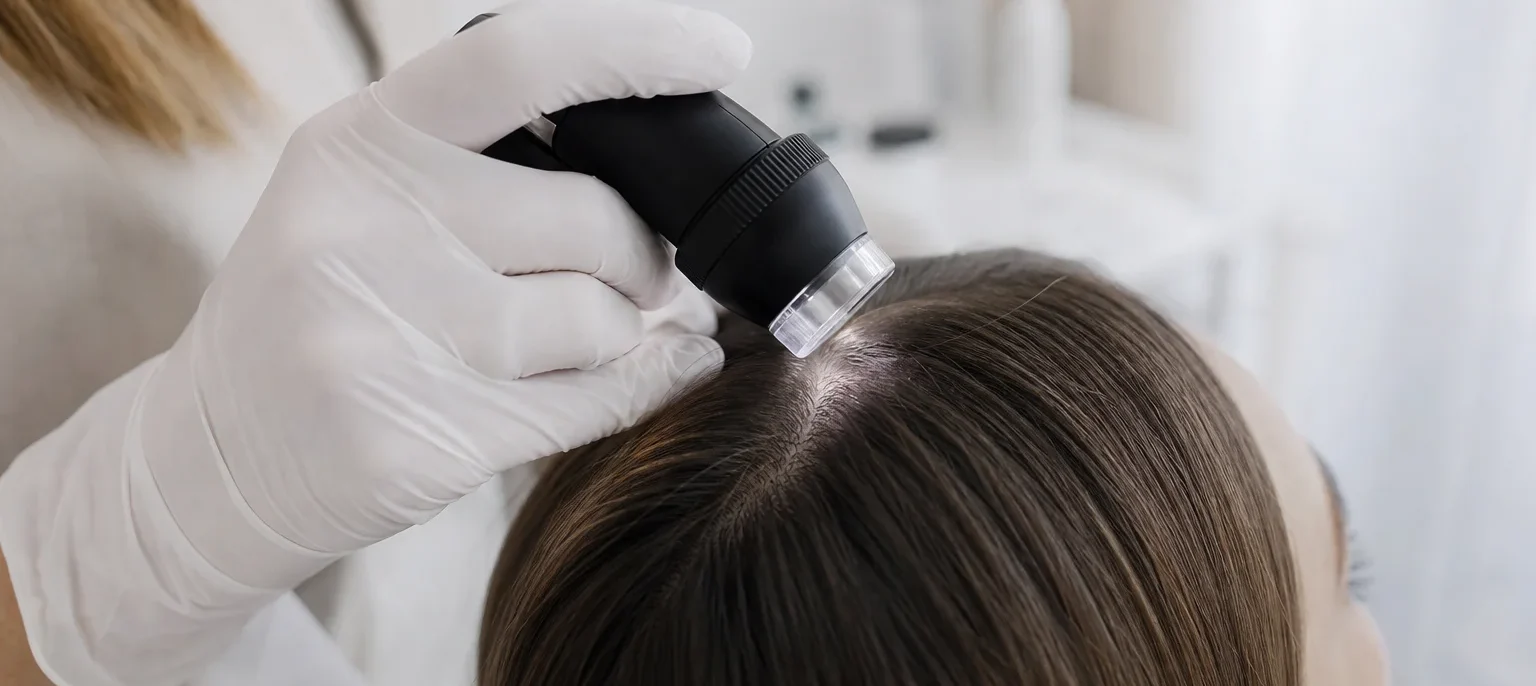
Quick answer: trichoscopy is the examination of the scalp and hair with a magnifying device, the trichoscope, which enlarges the image 10 to 200 times. It is painless and shows hair miniaturisation, oiliness, flaking, redness and shedding patterns. It guides reasoning and tracks progress, but it does not replace a dermatologist’s diagnosis.
To the naked eye, the scalp hides almost everything. You see thinner hair, feel itching or notice flakes on your shoulders, but you do not know what lies behind it. With trichoscopy, the conversation changes: guesswork becomes an image.
In this article I explain what trichoscopy is, how the examination is done, what it reveals, where its limits are and how medical use differs from use in hair and scalp therapy.
What is trichoscopy?
Trichoscopy is dermoscopy applied to the scalp and hair. The name comes from the Greek trichos (hair) and skopein (to look). The method was systematised in dermatology in the 2000s and is now a routine tool in clinics.
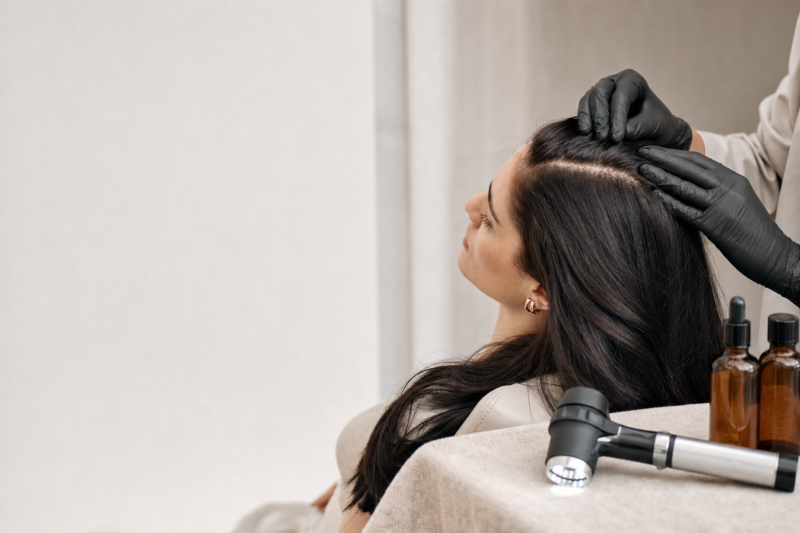
The device is called a trichoscope or dermatoscope. It combines a magnifying lens with its own light, polarised or not. This reduces skin glare and makes small structures visible: follicle openings, blood vessels, pigment and the diameter of each hair.
Types of device
| Type | Typical magnification | Most common use |
|---|---|---|
| Handheld dermatoscope | about 10x | Quick screening in clinic |
| Portable digital trichoscope | 20x to 60x | Hair therapy and photo follow-up |
| Videodermatoscope | 20x to 200x | Clinics, research and density measurement |
More magnification does not mean a better examination. What matters is sharpness, lighting and consistent photos over time.
How is trichoscopy done?
The examination takes 15 to 40 minutes, depending on the case. It usually follows this order:
- Initial conversation (consultation): shedding history, routine, chemical services, health and medication.
- Preparation: ideally, arrive with hair washed 1 to 2 days before and no styling product at the roots.
- Mapping: the professional takes images at fixed points such as the top, crown, temples and nape.
- Record: photos are filed with date, magnification and location for later comparison.
- Feedback: an explanation of what was seen and the next step.
Nothing is applied, cut or pulled out. Some people only notice a slight coolness when the lens touches the skin.
What does trichoscopy reveal about the scalp?
The magnified image shows signs that help explain what is going on. The main ones:
In the hair
- Variation in diameter: when more than 20% of hairs are much thinner than their neighbours, miniaturisation is suspected, typical of androgenetic alopecia.
- Follicular units with a single hair: normally 2 to 3 hairs emerge per opening; fewer hairs suggest thinning.
- Broken or exclamation-mark hairs: signs that need a medical check, because they appear in conditions such as alopecia areata.
- Short regrowing hairs: good news in recovery phases.
On the skin
- Oiliness: shine and sebum build-up in the follicle openings.
- Flaking: fine and white, or yellowish and greasy, as in seborrhoeic dermatitis.
- Redness and vessels: signs of inflammation.
- Scaling around the follicle: a sign that deserves medical attention.
- Yellow or black dots: findings the dermatologist interprets together with the clinical picture.
If flaking is your main concern, also read dandruff or seborrhoeic dermatitis: how to tell them apart.
What is trichoscopy used for in practice?
Trichoscopy serves three main purposes:
- Guiding reasoning: telling diffuse shedding apart from progressive thinning, for example.
- Choosing the approach: an oily, inflamed scalp needs different care from a dry, sensitive one.
- Tracking progress: comparing photos of the same point every 30, 60 or 90 days shows whether the protocol is working.
That last point is the most underrated. Without a record, assessment depends on memory and anxiety. With standardised photos, decisions are objective.
Medical trichoscopy versus trichoscopy in hair therapy
This is an important difference, and I always make it clear.
A dermatologist uses trichoscopy to diagnose diseases of the scalp and hair. They can order blood tests and a biopsy and prescribe treatment.
A hair and scalp therapist uses trichoscopy to describe what they see, build a cosmetic protocol and document progress. They do not diagnose disease or prescribe medication. When the image shows warning signs, the right step is to refer.
In my practice, the magnified image is also an educational tool. When a client sees her own scalp on the screen, she understands why she needs to wash more often or why she should see a doctor.
The dermatology site DermNet has a good review of the main trichoscopic findings.
An example of how the image changes the approach
Picture two clients with the same complaint: "my hair is falling out a lot". The first shows, on trichoscopy, hairs of similar thickness, many short hairs regrowing and a scalp with no inflammation. The picture suggests diffuse shedding that is already recovering. The focus becomes protecting the new hair and following up with photos.
The second shows hairs of very different diameters on the top, few hairs per opening and heavy oiliness. Here the image suggests progressive thinning, and referral to a dermatologist comes before any cosmetic protocol. The complaint was the same; the approach was completely different.
What to ask the professional
- At which points on the scalp will the images be taken?
- Are the photos stored for comparison?
- How often will the examination be repeated?
- In which situations do you refer to a doctor?
What trichoscopy does not do
- It does not make a diagnosis on its own. It is one piece of the puzzle, together with history, clinical examination and lab tests.
- It does not measure hormones or deficiencies. Low iron or thyroid changes only show up in blood tests.
- It does not replace a biopsy when scarring alopecia is suspected.
- It is not a "hair strength test". Devices that promise to measure everything in 5 minutes usually sell more than they deliver.
How much does it cost and who should have it?
Prices vary by city and professional. In hair therapy, trichoscopy is usually included in the first assessment. See price ranges and what to expect in scalp therapy: what it is and how much it costs.
It is worth having if you:
- notice thinner hair on the top or along the parting;
- have been shedding for more than 2 months;
- have itching, oiliness or flaking that does not improve;
- want to follow a treatment with data rather than impressions.
How to prepare for the examination
- wash your hair 24 to 48 hours before;
- do not use oil, pomade or spray on the roots on the day;
- bring a list of your medication and recent tests;
- bring older photos, if you have them, to compare volume.
Frequently asked questions
No. Trichoscopy is non-invasive: the device only touches or approaches the scalp to magnify the image. There is no cutting, no needle and no product applied.
No. Trichoscopy guides reasoning and tracks progress. In some cases the dermatologist needs a biopsy and blood tests to confirm the diagnosis.
Dermatologists use trichoscopy to diagnose. Hair and scalp therapists use the magnified image to describe the scalp, build a cosmetic protocol and document progress, without diagnosing disease.
When following hair loss, images are usually repeated every 30 to 90 days, always at the same points and magnification, so the comparison is fair.
See your scalp up close
Trichoscopy turns doubt into information. With it, you understand what is happening and follow every stage of care without relying on the shock of a full drain.
In the Hair & Scalp Therapy Consultation, I carry out a consultation, trichoscopy with a photo record and an individual protocol. When the image shows signs that need a diagnosis, I refer you to a dermatologist.
Book your assessment with trichoscopy →
Beauty professional? The Practical Trichology e-book teaches you to read the main findings and build protocols safely.
Nelma Faleiro holds a postgraduate specialisation in Cosmetic Trichology (Faculdades Oswaldo Cruz) and a degree in Visagism and Hair Therapy from Universidade Anhembi Morumbi, where she lectured for 10 years. Educational content: it does not replace medical advice.