
Quick answer: the most common form of stress hair loss is telogen effluvium: a period of intense stress pushes many hairs into the resting phase, and they fall out 2 to 3 months later. Shedding is diffuse and usually improves within 6 months once the trigger is under control. Stress can also trigger alopecia areata and trichotillomania. Shedding that lasts more than 3 months needs an assessment.
"Life has calmed down and now my hair decides to fall out." I hear this often — and it makes perfect sense. Stress hair loss usually appears when the worst is over, because the hair cycle runs on a delay. Understanding that delay is the first step to stop blaming yourself, investigate properly and give your hair time to recover.
In this guide you will see how stress affects hair, the types of hair loss linked to it, warning signs and the routine that helps break the cycle.
How does stress affect hair?
Each hair goes through phases: growth (anagen, lasting years), transition (catagen, weeks) and rest (telogen, about 3 months), at the end of which it falls. Normally only a small share of hairs is resting at any one time, and we lose on average 50 to 100 hairs a day.
Intense stress — physical or emotional — can signal to the body that hair growth is not a priority. Many follicles move into the resting phase at the same time. About 2 to 3 months later, those hairs fall out together.
Situations that often act as triggers:
- bereavement, separation, redundancy, sudden change;
- burnout and prolonged overload;
- illnesses with high fever, infections and hospital stays;
- surgery;
- childbirth;
- very restrictive diets and rapid weight loss.
Which types of hair loss are linked to stress?
| Condition | How it appears | Link to stress |
|---|---|---|
| Telogen effluvium | Diffuse shedding, full-length hairs, 2 to 3 months after the trigger | A classic trigger |
| Alopecia areata | Round, smooth bald patches | Stress may trigger flares in predisposed people |
| Trichotillomania | Hairs broken at different lengths, irregular areas | Hair-pulling behaviour, linked to anxiety and tension |
| Worsening of existing conditions | Seborrheic dermatitis, androgenetic alopecia | Stress can aggravate them |
Telogen effluvium
The most common one. The shedding is frightening — a full brush, a blocked drain — but the follicles remain active. The American Academy of Dermatology explains that this kind of shedding usually improves on its own as the body readjusts. See all the details in telogen effluvium: how long does it last.
Alopecia areata
An autoimmune condition in which round bald patches appear. Stress is not the cause, but it is cited as a possible trigger for flares. Learn more in alopecia areata: causes and treatment.
Trichotillomania
This is the repeated urge to pull out your own hair, often automatically, in moments of tension or boredom. It belongs to the body-focused repetitive behaviours and deserves support, not judgement. The TLC Foundation for Body-Focused Repetitive Behaviors offers information and support. Treatment involves psychotherapy, especially behavioural approaches, and medical follow-up.
How do you recognise stress hair loss?
Some signs suggest stress-related telogen effluvium:
- Diffuse shedding all over the head, with no defined patches;
- Full-length hairs, with a small white bulb at the root;
- Onset 2 to 3 months after a significant event;
- A scalp without significant inflammation;
- A thinner ponytail, but without a progressively widening part.
These signs help but do not make a diagnosis. Anaemia, thyroid changes, nutritional deficiencies and androgenetic alopecia can cause similar pictures — and sometimes coexist. See the most common causes in female hair loss: 9 causes.
How long does it last?
In acute telogen effluvium:
- 2 to 3 months after the trigger: shedding starts;
- 3 to 6 months: shedding tends to decrease if the trigger is under control;
- 6 to 12 months: volume recovers gradually, with new hairs growing about 1 cm a month.
If shedding lasts more than 6 months, there may be chronic effluvium or another associated cause that needs investigating.
How do you break the cycle?
The cycle is familiar: stress makes hair fall, the shedding creates more anxiety, anxiety keeps the stress going. Breaking it involves caring for body, mind and scalp.
1. Investigate the cause
A visit to a dermatologist rules out other causes and brings reassurance. Knowing it is effluvium, and that it tends to pass, already reduces anxiety a great deal.
2. Look after your sleep
Sleep is when the body recovers. Regular hours, less screen time at night and a dark room help.
3. Eat well
Enough protein, iron, zinc and calories are the foundation for the follicle. Avoid restrictive diets during this period — see hair nutrition.
4. Move
Regular physical activity helps regulate stress and sleep.
5. Seek psychological support
Therapy is not a luxury when stress is high enough to affect the body. For trichotillomania, it is an essential part of treatment.
6. Stop counting hairs
Counting hairs in the drain and checking the mirror several times a day feeds anxiety. Take standardised photos every 30 days instead.
7. Be gentle with your scalp
Wash it as often as it needs, without fear — washing does not increase hair loss. Avoid very tight styles and harsh chemicals while shedding is intense.
Myths about stress and hair
"If my hair is falling out, I’ll go bald." Not with telogen effluvium. The follicles remain active and produce hair again.
"Cutting my hair short will stop the shedding." It does not change the shedding, which happens at the root. It can, however, make hair look fuller while it recovers.
"Washing less keeps my hair in." No. The hairs that come out in the shower were already loose.
"A supplement will fix it." Only if there is a proven deficiency. Without one, a supplement is unlikely to change things.
"Good stress doesn’t cause hair loss." A wedding, moving house and having a baby are also intense events for the body and can act as triggers.
What can scalp therapy do?
Scalp therapy plays a supporting role:
- a detailed history that helps identify the trigger and how long ago it happened;
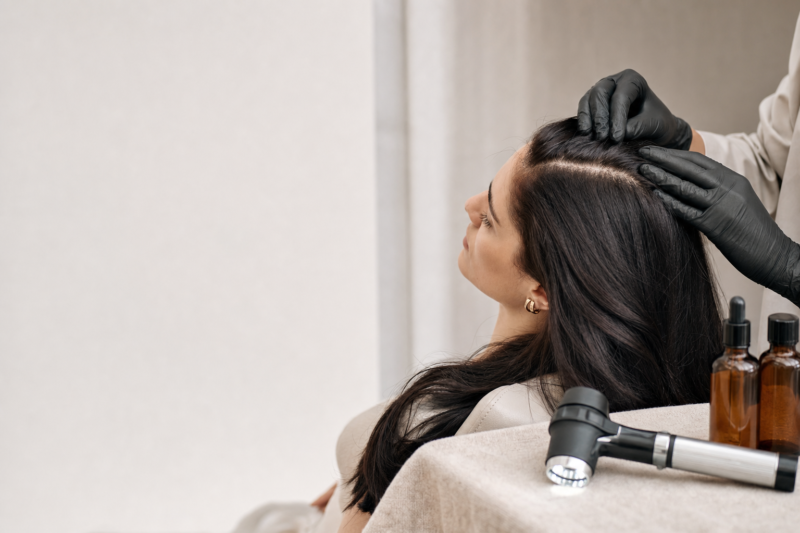
- trichoscopy to assess the scalp and signs that call for referral;
- scalp-health protocols, such as cleansing, massage and LED, when indicated;
- photo follow-up, which shows recovery and calms anxiety;
- advice on cuts and styling that disguise lost volume while hair grows back.
Scalp therapy does not diagnose or treat disease and does not replace a psychologist or doctor.
When should you see a doctor?
- shedding that lasts more than 3 months;
- bald patches, a widening part or a receding hairline;
- shedding with fatigue, pallor, very heavy periods or weight changes;
- an uncontrollable urge to pull out your hair;
- significant emotional distress.
Frequently asked questions
It can. Intense physical or emotional stress is one of the most common triggers of telogen effluvium, a diffuse, temporary shedding. It can also trigger alopecia areata flares in predisposed people and behaviours such as trichotillomania.
With telogen effluvium, shedding usually starts 2 to 3 months after the stressful event. That is why many people do not connect the hair loss to the cause, which has already passed.
With telogen effluvium, yes: the follicles remain active and hair tends to recover within a few months once the trigger is under control. With other related conditions, such as alopecia areata, the course is more variable and needs medical follow-up.
Only a full assessment can tell. Anaemia, thyroid problems, diets, medication and androgenetic alopecia can cause similar shedding. A dermatologist investigates with a clinical exam, trichoscopy and, when needed, blood tests.
Caring for your hair is caring for yourself
If your hair is falling out after a difficult period, you do not have to go through it alone. In the Hair & Scalp Therapy Consultation, I take a careful history, perform trichoscopy and photo follow-up, build a scalp-support protocol and refer you to a doctor or psychologist when needed — with care and without promises.
I want to understand my hair loss →
A beauty professional? The Practical Trichology e-book shows how to take a history that identifies shedding triggers and when to refer.
Nelma Faleiro holds a specialisation in Cosmetic Trichology (Faculdades Oswaldo Cruz) and a degree in Visagism and Hair Therapy Technology from Anhembi Morumbi University, where she taught for 10 years. Educational content: it does not replace medical or psychological advice.