Quick answer: alopecia areata is an autoimmune condition in which the immune system attacks hair follicles, causing round, smooth bald patches on the scalp, in the beard or elsewhere. It is not contagious and has no permanent cure, but hair often grows back. Diagnosis and treatment belong to the dermatologist; scalp therapy plays a supporting role, with no promise of regrowth.
Finding a round, smooth bald patch — often noticed by a hairdresser or a family member — is a shock. Alopecia areata is frightening because it appears suddenly, without pain, and because nobody can say at first whether the hair will grow back or whether the patch will spread. Good information and medical follow-up are what help most through this phase.
In this guide you will understand what it is, its types, what is known about its causes, the treatments and how scalp therapy can support you — with clear limits.
What is alopecia areata?
It is an autoimmune disease: for reasons not yet fully understood, the immune system starts attacking hair follicles in the growth phase. The follicle is not destroyed — it "goes to sleep". That is why, in many cases, hair can grow back.
According to a systematic review and meta-analysis in the Journal of the American Academy of Dermatology (Lee and colleagues, 2020), the estimated lifetime prevalence is around 2% of the population. It can appear at any age, including childhood, and affects men and women.
The types of alopecia areata
| Type | What it looks like |
|---|---|
| Patchy (the most common) | One or more round or oval, smooth patches |
| Ophiasis | Band-like loss at the nape and sides, above the ears |
| Totalis | Loss of all scalp hair |
| Universalis | Loss of all body hair |
| Diffuse | Diffuse thinning that can be mistaken for other types of shedding |
Alopecia areata can also affect the beard, eyebrows and eyelashes. Nail changes, such as small pits, appear in some patients.
What are the signs and how is it diagnosed?
The most typical signs:
- A round or oval patch of smooth skin, with no flaking or scarring;
- Rapid onset, over days or weeks;
- "Exclamation mark" hairs at the edges of the patch — short, thicker at the tip and tapering at the base;
- No pain, although some people report tingling or mild itching beforehand.
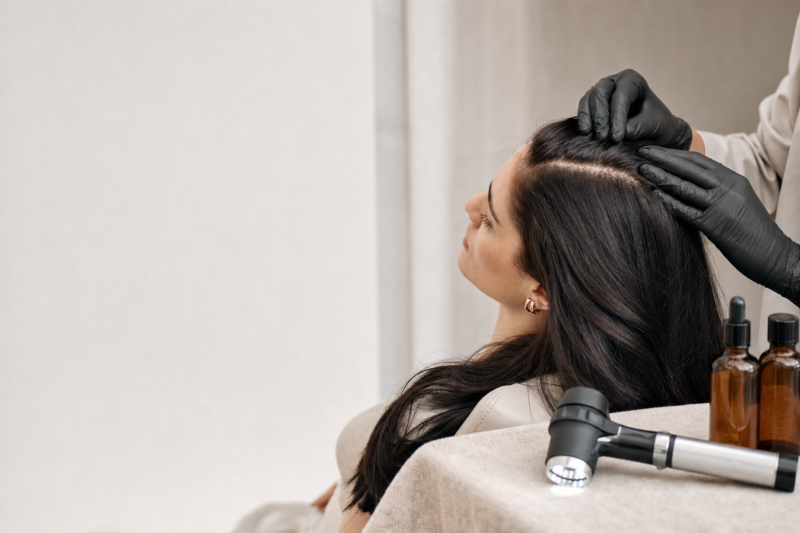
A dermatologist makes the diagnosis, usually through clinical examination and trichoscopy, which shows characteristic signs. In some cases the doctor orders tests to look for thyroid disease and other associated autoimmune conditions. Learn about the exam in trichoscopy: what it is and what it is for.
Do not confuse it with other hair loss
Patches also appear with scalp ringworm (a fungal infection, with flaking), trichotillomania (hairs broken at different lengths), traction alopecia and scarring alopecias (where the scalp is shiny with no follicular openings). Diffuse shedding may be telogen effluvium — see telogen effluvium: how long does it last. That is why a medical diagnosis is essential.
What causes alopecia areata?
The exact cause is still being studied. What we know:
- Genetic predisposition: it is more common in people with relatives who have the condition or other autoimmune diseases;
- Autoimmune response: immune cells attack the follicle;
- Association with other conditions: thyroid disease, vitiligo, atopic dermatitis and other autoimmune diseases are more frequent;
- Possible triggers: intense stress, infections and other events are mentioned by patients, but they are not the cause itself.
What are the treatments?
Treatment is medical and depends on extent, age and how long the disease has been present. The options dermatologists use most include:
- Topical corticosteroids or injections into the patches, for patchy cases;
- Topical immunotherapy, in selected cases;
- Minoxidil, as an adjunct;
- JAK inhibitors, newer oral medicines already approved in several countries for severe, extensive cases;
- Systemic corticosteroids and other immunomodulators, in specific situations.
In mild cases, with one or a few patches, some people regrow hair spontaneously within a few months. The American Academy of Dermatology explains the types and treatment options in accessible language.
How long does it take for hair to come back?
There is no guaranteed timeline, and that uncertainty is one of the hardest parts. Some general references:
- Small, single patches: in some people, hair starts to return within 3 to 6 months, with or without treatment;
- With medical treatment: the first hairs usually appear after 4 to 12 weeks, depending on the technique;
- Extensive forms (totalis or universalis): the response is slower and less predictable, and follow-up often lasts years.
The first hairs may grow in fine and light and gain colour and thickness over time. Relapses are common: new patches can appear months or years later. Recording progress with photos every 4 weeks helps you notice changes that the daily mirror hides.
What can scalp therapy do — and not do?
Here it is important to be very clear: scalp therapy does not treat the autoimmune disease and does not promise regrowth. The hair therapist’s role is supportive:
- recognising a typical patch and referring to a dermatologist as soon as possible;
- caring for scalp health during medical treatment (hygiene, sensitivity, oiliness);
- applying gentle cosmetic procedures, when cleared by the doctor;
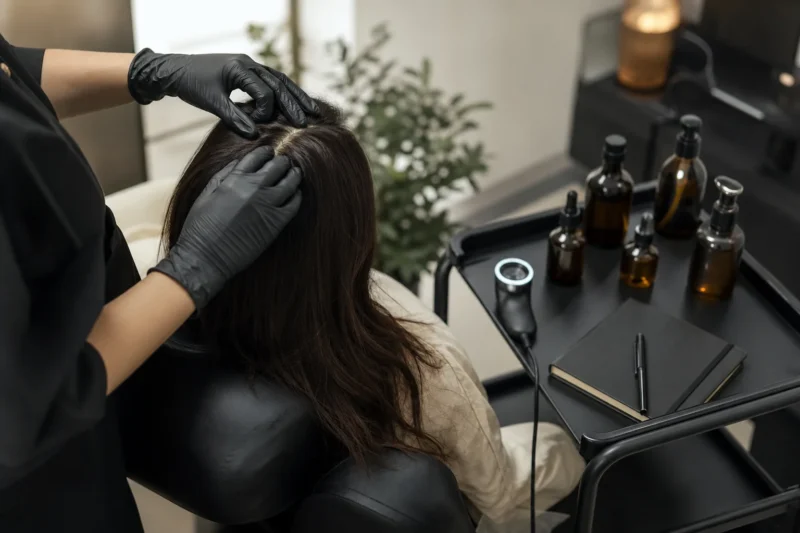
- recording progress with standardised photos and trichoscopy, which helps both patient and doctor see change;
- advising on cuts, styles and alternatives to disguise patches;
- listening, welcoming and never judging.
Any professional who promises to "cure" alopecia areata with a tonic, device or protocol is going beyond what science allows.
How do you live with alopecia areata?
Living with the condition involves self-esteem, relationships and routine. Some strategies that help:
Camouflage and style
- Strategic cuts: changing the part or length can cover small patches;
- Hair powders and fibres in your hair colour disguise thinner areas;
- Scarves, turbans and hats can be a style choice, not a hiding place;
- Good-quality wigs and hair systems are alternatives for extensive cases;
- Brow micropigmentation, by a qualified professional, can help when eyebrows are affected.
Emotional health
Alopecia areata can deeply affect self-esteem, especially in teenagers and people with extensive loss. Psychological support and patient groups make a difference. Talking openly about the condition with friends, family and colleagues often reduces anxiety.
Caring for exposed skin
A scalp without hair is exposed to the sun: use sunscreen or a hat on hairless areas.
When should you see a dermatologist?
Whenever a round, smooth patch appears for no obvious reason. Also see one if patches grow quickly, if you lose eyebrows or eyelashes, notice nail changes or have intense diffuse shedding. Children with patches should be seen by a paediatrician or dermatologist. For other causes of hair loss, see female hair loss: 9 causes.
Frequently asked questions
There is no permanent cure, but many people regrow hair spontaneously or with treatment. It is unpredictable: patches can regrow, reappear elsewhere or, in more extensive cases, persist. Follow-up with a dermatologist defines the best treatment for each phase.
No. It is an autoimmune condition in which the immune system attacks the hair follicles. It does not spread from person to person and has nothing to do with poor hygiene.
Stress is cited as a possible trigger in some people, but it is not the cause. Alopecia areata involves genetic predisposition and an autoimmune response. Managing stress is part of overall care, but it does not replace medical treatment.
Sometimes the first hairs to grow in the area are fine and light or white. Over time they often regain colour and thickness, but this varies from person to person.
Careful follow-up, no promises
If you are living with alopecia areata and want close scalp follow-up during medical treatment, the Hair & Scalp Therapy Consultation offers trichoscopy assessment, photo records of progress, scalp care and guidance on cuts and alternatives — always in partnership with your dermatologist and without promising results.
A beauty professional? The Practical Trichology e-book helps you recognise alopecia areata during assessment and handle the referral safely and supportively.
Nelma Faleiro holds a specialisation in Cosmetic Trichology (Faculdades Oswaldo Cruz) and a degree in Visagism and Hair Therapy Technology from Anhembi Morumbi University, where she taught for 10 years. Educational content: it does not replace medical advice.