Quick answer: a hair therapy protocol is the care plan built from the assessment: complaint, consultation, trichoscopy, cosmetic hypothesis, goals, in-salon treatment, home care and a review every 30 to 45 days. It is not a fixed sequence of products. An initial cycle usually has 6 to 10 sessions, always with a photo record and medical referral when there are warning signs.
I get many messages from professionals that start like this: "what is the protocol for hair loss?". The question is understandable, but it starts from a mistake. There is no hair loss protocol. There is a protocol for that client, with that shedding, on that scalp.
In this guide I show how to build a hair therapy protocol from scratch, step by step, with reasoning models for shedding, oiliness and flaking. It is the method I taught for years in the classroom and still use with clients today.
What is a hair therapy protocol?
A hair therapy protocol is a documented plan that links what you observed to what you will do and what you expect to measure. It rests on four pillars:
- Hypothesis: what is probably happening, within the limits of cosmetic practice.
- Treatment: in-salon procedures and home care.
- Review: dates and criteria to measure the response.
- Records: everything noted, photographed and dated.
Without these four pillars, what you have is a sequence of products. It may improve how the hair looks, but it does not let you learn from the case or prove results.
Step 1: a complete assessment
Every protocol starts before the first product.
Consultation
The interview covers when and how the complaint started, health history, medication, pregnancy, diet, stress, chemical services, washing routine and products in use. A detailed template is in the complete trichology consultation form.
Visual examination and trichoscopy
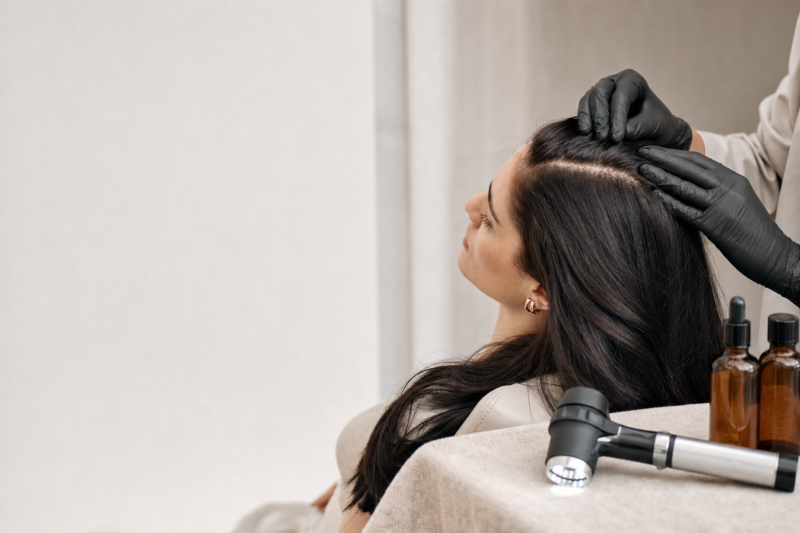
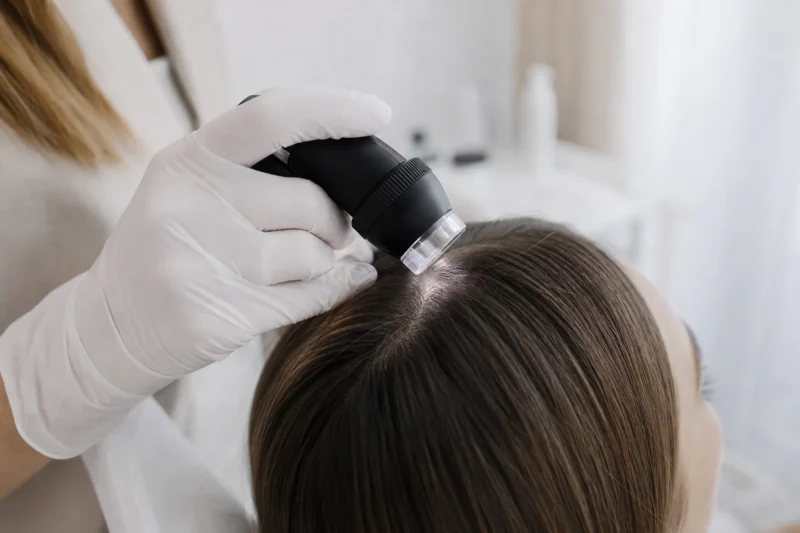
Look at oiliness, flaking, redness, sensitivity, density and hair diameter. Trichoscopy with photos at fixed points is what allows comparison later. See what each finding means in trichoscopy: what it is and what it reveals.
Screening for warning signs
Before going further, check whether there is a reason to refer:
- bald patches, scarring or loss of follicle openings;
- pain, burning, sores or pus;
- thick, adherent scale with red plaques;
- heavy shedding for more than 6 months;
- general symptoms, such as extreme tiredness or weight changes.
In these cases, the first step is referral to a dermatologist. Therapy can continue afterwards as support.
Step 2: hypothesis and goals
With the data in hand, write a cosmetic hypothesis in one sentence. For example:
- "Oily scalp with fine flaking and mild itching, no warning signs."
- "Diffuse shedding that started 3 months after a fever, no apparent miniaturisation."
Then set measurable goals:
- reduce perceived oiliness from "daily" to "every 2 days" within 6 weeks;
- reduce visible flaking on crown trichoscopy within 30 days;
- record regrowing hairs along the front hairline within 90 days.
Clear goals protect both you and your client. They avoid vague promises and show real progress.
Step 3: in-salon treatment
A typical session follows a logical structure. Not every protocol uses every step.
- Cleansing: a shampoo suited to the condition, with massage.
- Preparation: physical or chemical exfoliation, if indicated and with no active inflammation.
- Treatment: cosmetic actives chosen according to the hypothesis.
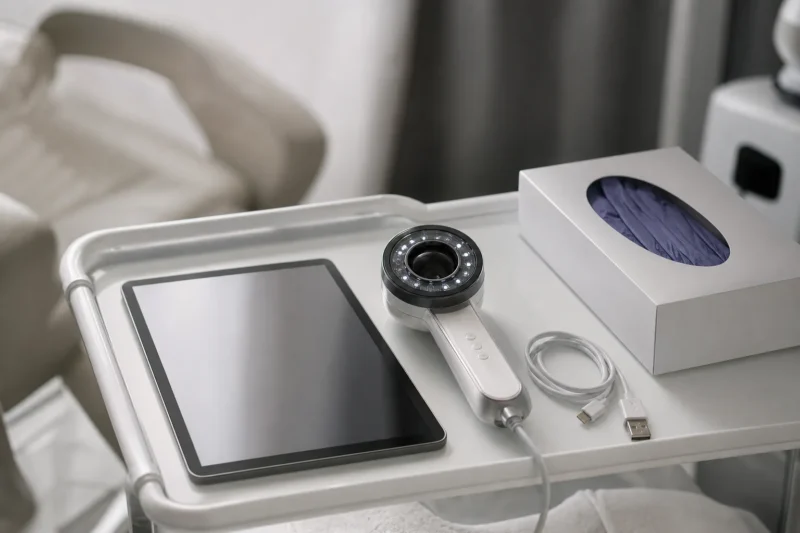
- Supporting devices: equipment such as high frequency, LED or steam, when indicated and when you are trained to use it.
- Finishing: drying the roots and giving guidance.
A session usually lasts 45 to 75 minutes. Record every product, the amount, the contact time and the skin’s reaction.
Beware of doing too much
More steps do not mean more results. A sensitised scalp gets worse with weekly exfoliation and many actives. Sometimes the best protocol is the simplest one.
Step 4: home care
What the client does at home between sessions matters as much as the salon work. A good home care plan has:
- no more than 3 to 4 products, to ensure adherence;
- a written washing frequency;
- application explained in practice;
- what to stop (oils on the roots, tight hairstyles, very hot water);
- a channel to report irritation.
Step 5: frequency and number of sessions
There is no magic number, but there is a starting pattern:
| Phase | Frequency | Typical length |
|---|---|---|
| Intensive | 1 session a week | 4 to 6 weeks |
| Consolidation | 1 session every 15 days | 4 to 8 weeks |
| Maintenance | 1 session a month | as needed |
Oiliness and flaking usually respond faster. Shedding needs more time, because the hair cycle is slow: hair grows about 1 cm per month.
Step 6: review and records
Book the review before you start, every 30 to 45 days. At the review:
- repeat the photos at the same points, with the same light and magnification;
- compare against the goals set in Step 2;
- listen to the client’s perception, but decide based on the data;
- adjust, continue or refer.
If there is no improvement after two review cycles, revisit the hypothesis. A lack of response is also information.
Reasoning models by complaint
The table below shows the reasoning, not a recipe. Always adapt it to the case.
| Complaint | Hypothesis focus | In-salon treatment | Home care | Watch out for |
|---|---|---|---|---|
| Diffuse shedding | Recent trigger, no scalp inflammation | Cleansing, massage, supportive actives | Regular washing, less tension | Refer if it lasts over 6 months |
| Oiliness | Excess sebum, washing too little | Cleansing, moderate exfoliation, sebum-regulating actives | Suitable shampoo, wash more often | Rebound from harsh products |
| Flaking | Dry versus oily, itching present | Gentle cleansing, soothing actives, no exfoliation during flare-ups | Washing routine, no oil on roots | Thick plaques need a doctor |
For the difference between dry and oily flaking, also read the article on dandruff and seborrhoeic dermatitis.
Common mistakes when building a protocol
- Copying another client’s protocol. Two similar cases of shedding can have different causes.
- Starting with the device. Equipment is a supporting tool, not the starting point.
- Not photographing the first session. Without a documented "before", there is no way to measure the "after".
- Changing everything at once. If you switch five products together, you cannot tell which one worked.
- Promising a growth timeline. Promise follow-up and clear criteria, not centimetres.
- Forgetting home care. One session a week cannot make up for six days of an unsuitable routine.
The limits of our practice
Hair therapists do not diagnose disease or prescribe medication. That includes minoxidil, finasteride, prescription antifungals and supplements. Our work is cosmetic and supportive. Respecting that limit is what gives the profession credibility and keeps clients safe.
The American Academy of Dermatology keeps a good page on types of hair loss, useful for guiding referrals.
Documents that protect your work
- a signed consultation form;
- a consent form for procedures and photos;
- a record of products and batches used;
- a referral letter, when needed.
Frequently asked questions
An initial cycle of 6 to 10 sessions, weekly or fortnightly, with a review every 30 to 45 days is common. The real number depends on the complaint, the scalp’s response and adherence to home care.
No. Hair therapists work with cosmetics and aesthetic procedures. Minoxidil, finasteride, prescription antifungals and supplements are prescribed by a doctor.
Complaint, consultation, assessment findings, cosmetic hypothesis, measurable goals, treatment at each session, products and batches, home care instructions, standardised photos, reviews and referrals.
When the review shows no improvement within the agreed time, when irritation appears or when warning signs show up. In that last case, the next step is referral to a doctor.

Go deeper with the Practical Trichology e-book
Building safe protocols requires knowing the disorders, knowing how to assess and having criteria to choose actives and equipment. That is why I wrote the Practical Trichology e-book: 109 pages on assessment, scalp disorders and protocols you can apply in the chair, with instant download.
I want the Practical Trichology e-book →
If you are a client looking for an individual protocol based on your own assessment, see the Hair & Scalp Therapy Consultation.
Nelma Faleiro holds a postgraduate specialisation in Cosmetic Trichology (Faculdades Oswaldo Cruz) and a degree in Visagism and Hair Therapy from Universidade Anhembi Morumbi, where she lectured for 10 years. Educational content for professionals; always respect the legal limits of your practice.