Quick answer: hair therapy pricing starts from your real costs: monthly fixed costs divided by productive hours give your cost per hour; add session supplies, equipment depreciation, taxes and margin. The assessment is charged separately, and packages are only built after it. A competitor’s price is a reference, not a starting point.
"I charge the same as the salon down the road" is the fastest way to work hard and earn little. Hair therapy pricing has its own particularities: long sessions, expensive supplies, equipment that needs paying for and assessment time that many professionals forget to charge for.
This guide shows how to price the session, the assessment and packages, with a worked example and the most common mistakes.
Why is the maths different for hair therapy?
Unlike a haircut, hair therapy involves:
- a detailed assessment, with history-taking and trichoscopy;
- sessions of 60 to 90 minutes, sometimes more;
- technical supplies (actives, ampoules, exfoliants, disposables);
- equipment such as a trichoscope, high frequency and LED;
- follow-up with photos and reassessments;
- time outside the session: preparing protocols, answering questions, recording progress.
If the price only covers minutes in the chair, the rest of the work comes out of your pocket. To see how the service looks from the client’s side, read scalp therapy: what it is and what it costs.
Step 1: list your monthly fixed costs
- rent or your share of the space;
- electricity, water, internet, phone;
- accountant, booking system, software;
- marketing;
- courses and updating;
- equipment depreciation;
- your own salary (what you need to take home).
How to calculate depreciation
Divide the equipment’s price by its estimated useful life in months. A device that cost 6,000 (in your currency) and should last 5 years (60 months) adds 100 a month to fixed costs.
Step 2: work out your productive hours
Of the hours you work each month, how many are paid client time? Allow for breaks, cleaning, admin and marketing. It is common for only 50% to 70% of your time to be billable.
Cost per hour = monthly fixed costs ÷ productive hours.
Step 3: calculate the session’s variable cost
List everything used in a session:
| Item | Example |
|---|---|
| Shampoo and cleansing products | Dose per session |
| Exfoliant, actives, ampoules | Dose per session |
| Disposables | Gloves, caps, paper, cotton |
| Laundry | Towels and capes |
| Payment fee | Card percentage |
Work out each item’s cost by the amount used (for example, a 500 ml bottle that lasts 25 sessions costs 1/25 of its price per session).
Step 4: add taxes and margin
Apply the tax rate for your business type and your profit margin. If you are just starting out in Brazil, you can look into registering as a MEI on the Portal do Empreendedor; elsewhere, check your local rules for small businesses.
A complete example (illustrative numbers)
The figures below only illustrate the maths, in any currency:
- Monthly fixed costs, including salary and depreciation: 8,000
- Productive hours per month: 80 hours
- Cost per hour: 8,000 ÷ 80 = 100
- A 1.5-hour session: 150
- Session variable cost: 45
- Subtotal: 195
- Taxes and margin (for example, 30% of the final price): 195 ÷ 0.70 ≈ 279
With this calculation, any price below 195 means a loss. The final figure can be adjusted for positioning and demand, but now based on real numbers.
The hair assessment has its own price
The assessment is a technical service: history, trichoscopy, analysis, explanation and proposal. It should be charged for and, if you wish, part of the fee can be credited towards a package. This filters out the merely curious and values your knowledge. A good form template is in the trichology consultation form.
How do you build packages?
- Only after the assessment: the number of sessions comes from the protocol, not from the wish to sell;
- Sessions with a defined goal, for example 8 weekly sessions for oiliness, with reassessment at the 4th and 8th;
- A moderate discount (for example, 5% to 15%) in exchange for commitment and upfront payment;
- Clear written rules on validity, rescheduling and missed appointments;
- Reassessment included, with comparison photos.
Learn how to structure protocols in hair therapy protocol.
The service format changes the maths
Inside a salon (partnership or commission)
When you work in a salon, part of the fee goes to the space, as commission or room rent. Include that percentage: if the salon keeps 30% to 40% of the session, your price must cover it and still pay for your supplies and time. Agree in writing who pays for products and equipment.
Your own practice or studio
Fixed costs are higher, but you have full control over your diary and positioning. Here, occupancy is decisive: a practice with 50% of its diary booked has a much higher cost per hour than one at 80%.
Home visits
Add travel time and cost, carrying equipment and the risk of delays. It is common to charge a separate travel fee or a higher session price.
Online guidance
A remote assessment with photos and video can be an entry-level product. It does not replace in-person trichoscopy, but it helps guide routines and indicate when to see a doctor. The price reflects analysis time and producing a report.
Different protocols, different prices
Not every session costs the same. A protocol for oiliness with cleansing and high frequency uses fewer supplies than a session with high-cost actives and LED. Build a table with two or three session tiers — for example "maintenance", "treatment" and "intensive" — each with its calculated cost. This makes presenting easier and stops you absorbing the difference on pricier sessions. Review the table whenever you change supplier or add new equipment, as I explain in high frequency scalp treatment.
How do you present the price?
- explain the protocol before the price;
- show what is included: assessment, sessions, photos, reassessment, home guidance;
- offer payment options;
- never promise results to justify the price.
Common mistakes
- Copying a competitor’s price without knowing your own costs;
- Not charging for the assessment;
- Forgetting equipment depreciation;
- Selling a package before assessing;
- Not raising prices every 12 months;
- Discounting at every "that’s expensive";
- Not tracking how many sessions each package actually used;
- Absorbing card fees instead of building them into the price.
When should you raise prices?
Review your numbers at least 1 time a year and whenever supplies or rent go up. Give 30 days’ notice and honour the price of packages already sold. Clients usually accept a reasonable increase when they see the value of the service and are told in advance.
Frequently asked questions
There is no single figure: the price depends on your cost per hour, the supplies used, session length, equipment, taxes and margin. Calculate your real cost first; only then compare with your local market.
Yes. The assessment involves a history, trichoscopy, analysis and explaining the findings, and it is a technical service with its own value. Offering it free tends to attract people who will not do the treatment and undervalues your work.
Yes, as long as the package is defined after the assessment, with a number of sessions consistent with the protocol and clear rules on validity, rescheduling and reassessment. A package sold without an assessment is a promise, not a protocol.
Through depreciation: divide the equipment’s price by its estimated useful life in months and add that amount to your monthly fixed costs. That way each session helps pay back the investment.
Technical grounding supports your price
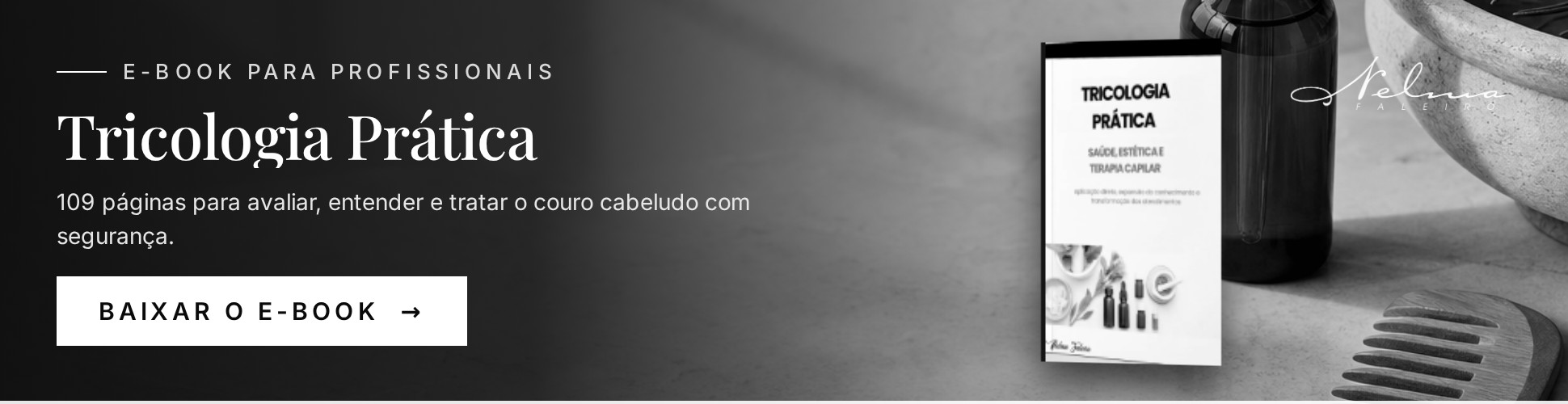
Clients pay with confidence when they sense technical security: a well-run assessment, a coherent protocol and honesty about limits. The Practical Trichology e-book brings together, in 109 pages, assessment, scalp disorders and evidence-based protocol building — the foundation for a fair price.
I want the Practical Trichology e-book →
Want to broaden your service with image reading? The Visagism & Personal Image Course complements hair therapy work. To price image consultations, see also visagism consultation pricing.
Nelma Faleiro holds a specialisation in Cosmetic Trichology (Faculdades Oswaldo Cruz) and a degree in Visagism and Hair Therapy Technology from Anhembi Morumbi University, where she taught for 10 years. The figures shown are illustrative.