Quick answer: female hair loss almost always has an identifiable cause — stress, childbirth, crash dieting, iron deficiency, thyroid problems, hormonal changes, scalp inflammation, traction or harsh chemical treatments. Losing 50 to 100 hairs a day is normal. If your shedding pattern has changed, find the cause before you buy any tonic.
Female hair loss is frightening in a very particular way: the clogged drain, the hairbrush full of strands, the ponytail that suddenly feels thinner. The most common reaction is to buy the first "anti-hair-loss" shampoo on the pharmacy shelf. The problem is that hair loss is a symptom, not a diagnosis — and every cause calls for a different approach.
In this guide you will learn the 9 causes I see most often in consultation, how to tell them apart and what to do in each case, including when the right path is a doctor’s office.
How much hair is normal to lose each day?
We have around 100,000 hairs on the scalp, and each one follows a cycle: it grows (anagen phase, 2 to 7 years), stops (catagen, about 3 weeks) and rests until it falls out (telogen, about 3 months). On a healthy scalp, roughly 85% to 90% of hairs are growing at any given time.
That is why losing 50 to 100 hairs a day is expected, according to the American Academy of Dermatology. More important than counting strands is noticing change:
- your ponytail has less volume;
- your parting looks wider or the scalp shows under light;
- there are round bald patches or a receding hairline at the temples;
- the shedding comes with itching, burning, flaking or pain.
The 9 most common causes of female hair loss
1. Telogen effluvium (the "sudden" shedding)
This is the most frequent cause of diffuse shedding. A trigger — high fever, surgery, intense stress, childbirth, a crash diet — pushes many hairs into the resting phase at once. The shedding shows up 2 to 3 months after the event, which is why almost nobody connects the dots. It usually lasts up to 6 months and resolves once the trigger is gone.
What to do: identify the trigger, correct deficiencies with medical guidance and look after the scalp so new hairs grow in a healthy environment.
2. Postpartum shedding
During pregnancy, high oestrogen keeps hairs in the growth phase. After birth, those hairs enter the resting phase together and fall between the 2nd and 4th month. It is a form of effluvium and usually settles by the baby’s first birthday.
3. Iron and other nutrient deficiencies
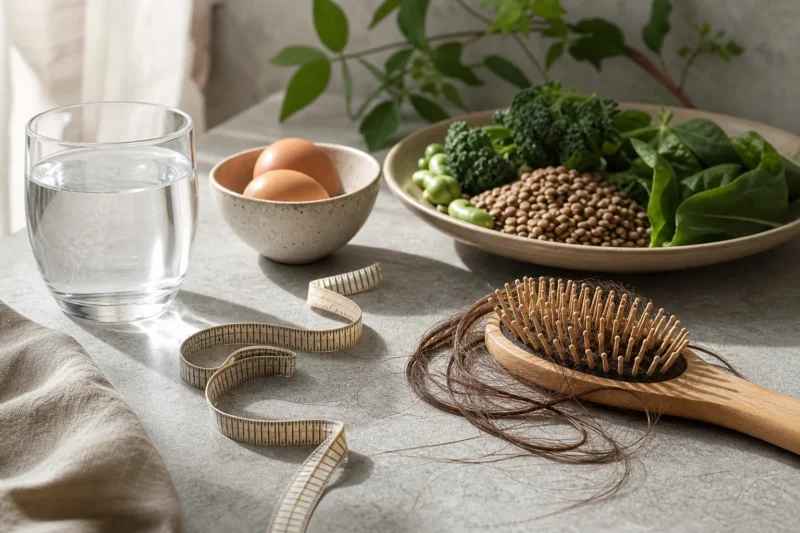
Low ferritin is one of the changes most associated with hair loss in women, especially with heavy periods or a poorly planned vegetarian diet. Vitamin D, B12 and zinc are also investigated. Supplementing without tests is not a good idea: too much iron, vitamin A or selenium can also cause harm — including to your hair.
4. Restrictive diets and rapid weight loss
Losing a lot of weight quickly — through very restrictive diets, bariatric surgery or injectables such as semaglutide and tirzepatide — is a classic trigger for effluvium. We cover this in detail in hair loss on Mounjaro and Ozempic. Enough protein is non-negotiable.
5. Thyroid
Both hypothyroidism and hyperthyroidism can cause diffuse shedding and drier or finer hair. If you also have fatigue, weight changes or skin and bowel changes, ask your doctor about TSH and free T4.
6. Female pattern hair loss (androgenetic alopecia)
Here shedding is not the main sign: what stands out is progressive thinning on the top of the head, with a widening parting. There is a genetic and hormonal component, and it progresses slowly. It is chronic, but it can be controlled — the earlier you start, the more hair you keep. Treatment is medical; hair therapy supports the scalp environment and tracks progress with images.
7. An inflamed scalp
Seborrhoeic dermatitis, severe dandruff, psoriasis and folliculitis create an inflamed environment around the follicle. Itching, redness, flaking and excessive oiliness are clues. Treating the scalp is an essential part of treating hair loss.
8. Traction and tight hairstyles
A ponytail always in the same spot, tight braids, heavy extensions and tight buns can cause traction alopecia, usually at the temples and nape. Early on it is reversible; if the habit continues, it can become permanent.
9. Too much chemistry and heat (breakage, not shedding)
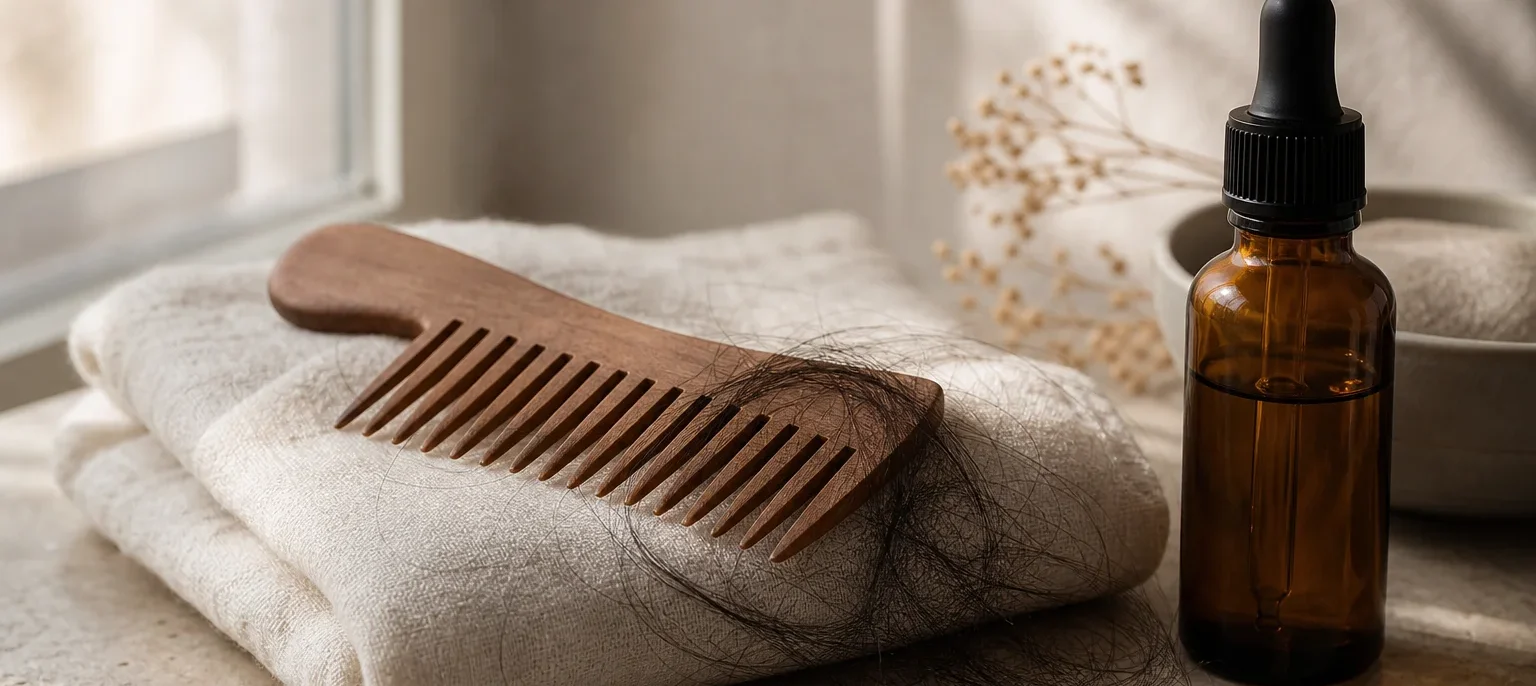
Much "hair loss" is actually breakage: the strand snaps along its length. Repeated bleaching, layered straightening treatments and flat irons without heat protection weaken the shaft. The difference is simple: a shed hair has a small white bulb at the root; a broken hair does not.
Shedding or breakage: a comparison table
| Sign | Shedding (root) | Breakage (shaft) |
|---|---|---|
| End of the strand | Visible white bulb | Uneven tip, no bulb |
| Length of hairs | Long, whole strands | Pieces of different lengths |
| Where you see it | Pillow, drain, brush | Brush, clothes, when combing |
| Main cause | Hair cycle, health, hormones | Chemicals, heat, friction |
| Who can help | Doctor + hair therapist | Hair therapist + hairdresser |
When to see a doctor
See a dermatologist without waiting if you have:
- smooth, round bald patches (possible alopecia areata);
- pain, sores, pus or scarring on the scalp;
- heavy shedding for more than 6 months;
- hormonal signs such as sudden acne, facial hair or irregular periods;
- hair loss with unexplained weight loss or extreme tiredness.
Hair therapy does not replace a medical diagnosis. A good therapist knows exactly where their role ends — and refers you on.
What hair therapy does for female hair loss
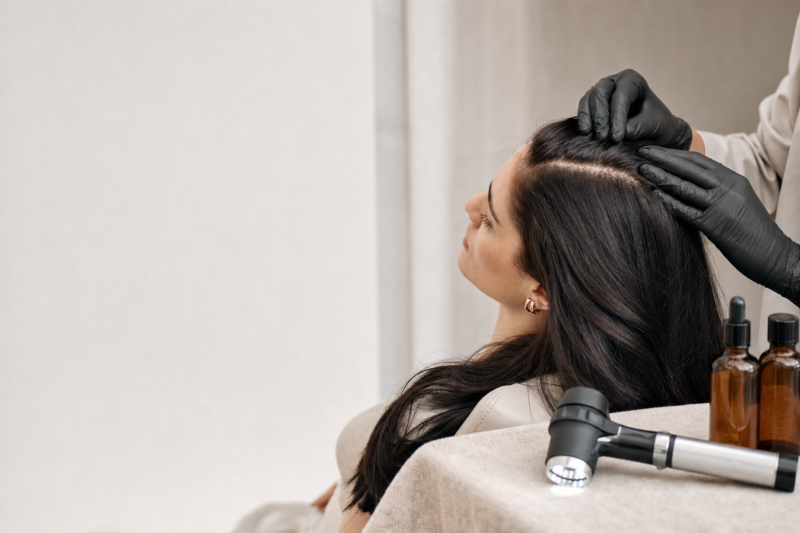
A hair and scalp therapy consultation starts with a detailed history — health, routine, chemical treatments, diet, medication — and with trichoscopy, which magnifies the scalp up to 200 times. This makes it possible to see:
- miniaturised hairs (a sign of a pattern process);
- oiliness, flaking and redness;
- hair density per area and resting hairs;
- shaft damage from chemicals or heat.
From there, an individual protocol is built: correct cleansing, control of inflammation and oiliness, scalp actives, home-care guidance and comparison photos at each stage. When the assessment suggests an internal cause, medical referral is part of the protocol.
A basic routine while you investigate
- Wash your scalp as often as it needs — an oily scalp usually needs frequent washing.
- Massage with your fingertips, never your nails.
- Loosen your hairstyles and change where you tie your ponytail.
- Cut back on heat and chemicals until you understand the cause.
- Eat protein at every meal and keep your check-ups up to date.
- Do not start supplements or medication on your own.
Frequently asked questions
Losing 50 to 100 hairs a day is considered normal, according to the American Academy of Dermatology. On wash days it looks like more because loose hairs build up. The warning sign is change: a thinner ponytail, a wider parting or clumps in your hand.
It depends on the cause. Telogen effluvium from stress, dieting or childbirth usually resolves within a few months once the trigger is addressed. Female pattern hair loss is chronic and needs ongoing medical management, with hair therapy as support.
Doctors commonly order a full blood count, ferritin, vitamin D, vitamin B12, zinc and thyroid function (TSH and free T4). Other tests may be added if a hormonal cause is suspected. Only a doctor should order and interpret them.
Hair therapy uses trichoscopy to identify signs on the scalp, treats inflammation, oiliness and flaking and tracks progress with photos. When the cause is internal or a disease, the therapist refers you to a dermatologist and works alongside them.
I want to understand why my hair is falling out
If you have read this far, you have probably tried shampoos, tonics and vitamins — and still don’t know why your hair is falling out. That is exactly where my Hair & Scalp Therapy Consultation begins: a full consultation, trichoscopy, a clear explanation of what is happening on your scalp and a protocol designed for you, with medical referral whenever needed.
Are you a beauty professional who wants to handle hair-loss complaints with confidence? The Practical Trichology e-book (in Portuguese) brings together scalp assessment, the main disorders and protocol building in 109 pages — the same reasoning I have used for more than two decades in the classroom and in the chair.
Nelma Faleiro holds a postgraduate specialisation in Cosmetic Trichology (Faculdades Oswaldo Cruz) and degrees in Visagism and Hair Therapy and in Aesthetics and Cosmetics (Universidade Anhembi Morumbi), where she lectured for 10 years. This content is educational and does not replace medical advice.