Quick answer: laser hair growth devices and low-level LED (photobiomodulation) have evidence of benefit in androgenetic alopecia. A 2025 meta-analysis of 38 studies and more than 3,000 patients showed increased hair density compared with placebo over 4 to 26 weeks of use. It is not a cure, it requires consistency and it works best as part of a plan with medical follow-up.
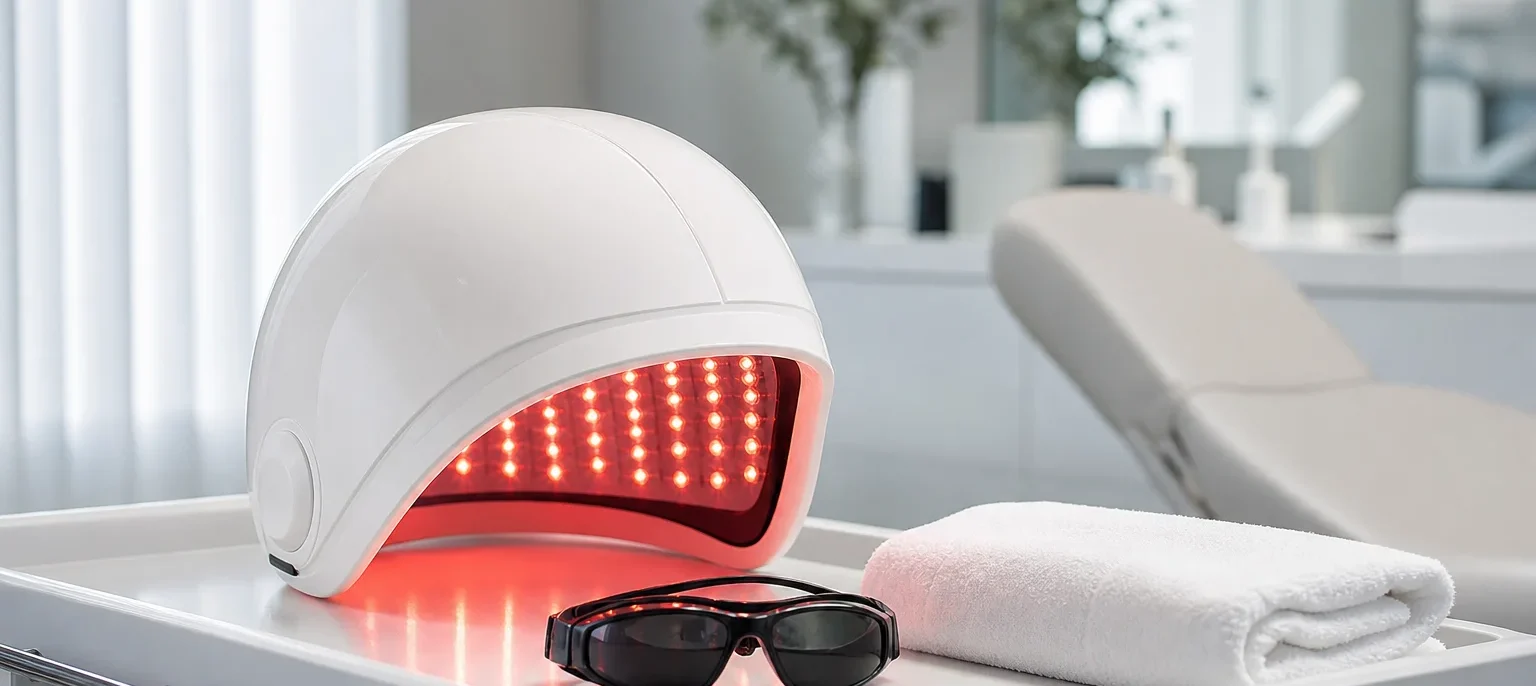
Photobiomodulation has become a fixture at trade fairs and clinics. Helmets, caps, combs and LED panels promise everything, and clients arrive asking whether "that light cap works". As a professional, you need an honest answer: yes, there is evidence, but under specific conditions and with realistic expectations.
In this article I bring together what science shows about laser hair growth and LED therapy, the wavelengths used, session frequency, contraindications and how to talk to clients without selling miracles.
What is photobiomodulation?
Photobiomodulation is the use of low-power light at specific wavelengths to stimulate cellular processes without heating or damaging tissue. It used to be called LLLT (low-level laser therapy). Today the term covers both laser and LED.
The most widely accepted mechanism is this:
- red and near-infrared light are absorbed by cytochrome c oxidase, an enzyme in the mitochondria;
- this increases production of ATP, the cell’s energy;
- nitric oxide is released and inflammatory processes are modulated;
- the proposed result is a longer growth phase (anagen) and stimulation of miniaturising follicles.
This mechanism explains why the technique makes more sense on living, still-active follicles, and not on scarred areas.
What do studies say about laser hair growth and LED?
The 2025 meta-analysis
A systematic review and meta-analysis published in Dermatologic Surgery (abstract on PubMed) pooled 38 studies and 3,098 patients. The main findings:
- 2,930 patients had androgenetic alopecia;
- in this group, hair density increased significantly compared with placebo, both in treatments shorter than 20 weeks and longer than 20 weeks;
- heterogeneity between studies was high, meaning results vary considerably;
- for alopecia areata, telogen effluvium, scarring alopecia and chemotherapy-induced hair loss, the data were insufficient for meta-analysis.
Wavelengths
Another meta-analysis, from 2022, assessed different light bands and found an effect of red and infrared light in androgenetic alopecia. In practice, the most studied devices work in bands such as:
| Band | Typical wavelength | Note |
|---|---|---|
| Red | about 630 to 680 nm | The most used in helmets and combs |
| Near-infrared | about 800 to 850 nm | Deeper tissue penetration |
| Combined | red + infrared | Common in professional panels |
Blue light and other colours are usually used for other purposes, such as oil control and antimicrobial action, with different and more limited evidence for hair loss.
What we still do not know
- the ideal dose (energy per area) is not yet standardised;
- many studies are funded by manufacturers;
- long-term results after stopping treatment are poorly studied;
- head-to-head comparisons between devices are rare.
Laser or LED: which to choose?
| Feature | Low-level laser | LED |
|---|---|---|
| Type of light | Coherent, concentrated | Non-coherent, diffuse |
| Area treated | Points or bands | Wide areas |
| Equipment cost | Usually higher | Usually lower |
| Eye protection | Mandatory | Recommended |
| Evidence | Larger body of studies | Growing, often grouped with laser |
For the client, the key question is not "laser or LED?" but: is the device registered, with clear technical specifications and a study-based protocol?
Session frequency and response time
Protocols vary by device, but a common pattern is:
- sessions of 10 to 30 minutes;
- about 3 times a week, on alternate days;
- assessment from 16 weeks onwards and a review at 6 months;
- ongoing maintenance, because the effect tends to fade when use stops.
In the salon, this means photobiomodulation rarely works on its own in weekly sessions. It usually forms part of the protocol, with a home-use device or more frequent appointments. See how to structure this in hair therapy protocol.
Home device or in-salon sessions?
Both options exist. Each has advantages.
A home device makes frequency easier. The client uses it at home, three times a week, with no travel. The problem is adherence. Many people start enthusiastically and give up after a few weeks. Quality is another issue: not every product sold online states its wavelength, power and registration.
In-salon sessions guarantee technique and records. The professional controls time, distance and the treated area. On the other hand, frequency is usually lower. That is why the salon works well for assessing, advising and following up.
A common combination is this: assessment and follow-up in the salon, with guided home use between sessions. The client gets consistency. You get data to decide whether it is worth continuing.
Signs the protocol is working
- less hair on the brush after 8 to 12 weeks;
- short regrowing hairs along the parting and on top;
- more uniform diameter on trichoscopy after 4 to 6 months;
- a sense of volume in standardised photos.
Who it makes sense for
Most suitable:
- early to moderate androgenetic alopecia, with follicles still active;
- people already on medical treatment who want a supporting therapy;
- people who cannot tolerate or use certain medication, always with medical guidance.
Unlikely to help:
- areas with no visible follicles at all;
- scarring alopecias;
- hair loss whose cause has not been treated, such as iron deficiency or an uncontrolled thyroid.
Contraindications and precautions
- suspicious lesions on the scalp: refer before any application;
- photosensitising medication and photosensitivity disorders;
- pregnancy, due to the lack of safety data;
- eye protection when using lasers;
- a significantly inflamed scalp: treat or refer first.
It is also essential to check that the device is registered with your country’s regulator and to know the limits of your professional scope for each technology.
How to set client expectations
Frustration with photobiomodulation almost always comes from overpromising. A few phrases that help the conversation:
- "Light can help stabilise and improve density, but it cannot grow hair where the follicle no longer exists."
- "The response is slow. We will compare photos after 4 and 6 months."
- "It works best alongside the treatment your dermatologist recommends."
- "If you stop, the effect tends to fade over time."
Record everything
Document the device, wavelength, session time, frequency and standardised photos. Without records, there is no way to tell whether the technology is working for that client.
Equipment is a tool, not a protocol
Photobiomodulation has a legitimate place in scalp therapy, as long as it is indicated by the assessment and followed with clear criteria. The most expensive device cannot make up for a wrong diagnosis. To see how assessment changes the approach, read trichoscopy: what it is and what it reveals.
Frequently asked questions
There is evidence of benefit in androgenetic alopecia. A 2025 meta-analysis of 38 studies found increased hair density with low-level laser or LED compared with placebo over 4 to 26 weeks. For other types of hair loss, the data are still insufficient.
Both emit light at similar wavelengths, usually red and near-infrared. Laser is coherent and more concentrated; LED is non-coherent and covers larger areas. Studies group both technologies as photobiomodulation.
Common protocols use sessions of 10 to 30 minutes, about 3 times a week, for at least 16 to 26 weeks. Consistency matters more than the intensity of each session.
People with suspicious scalp lesions, photosensitising medication or photosensitivity disorders, and pregnant women, given the lack of data, should avoid it or get medical clearance.
Go deeper into assessment and protocols
Knowing when to recommend, when to refer and how to measure results is what separates technical use from commercial use of equipment. In the Practical Trichology e-book, I organise assessment, scalp disorders and protocols in 109 pages, with criteria for choosing actives and in-salon tools.
I want the Practical Trichology e-book →
If you are a client and want to know whether photobiomodulation makes sense for you, the Hair & Scalp Therapy Consultation starts with a trichoscopy assessment.
Nelma Faleiro holds a postgraduate specialisation in Cosmetic Trichology (Faculdades Oswaldo Cruz) and a degree in Visagism and Hair Therapy from Universidade Anhembi Morumbi, where she lectured for 10 years. Educational content for professionals; always respect the legal limits of your practice.