Quick answer: premature grey hair, or premature canities, is grey hair appearing before age 20 in white people, 25 in Asian people and 30 in Black people. Genetics is the main cause, but oxidative stress, smoking, nutritional deficiencies and thyroid problems can contribute. In most cases colour cannot be restored, and embracing it may be the most visagist decision of all.
Finding your first grey hair at 22 usually comes with a question: "am I ageing too early?". The answer is almost always no. Premature grey hair says far more about your family history than about your general health. But there are situations where it deserves investigation, and it is important to tell them apart.
In this article I explain why hair turns grey, the causes of premature grey hair, what can and cannot be prevented and how to turn grey hair into a style choice.
Why does hair turn grey?
Hair colour comes from melanin, produced by cells called melanocytes in the hair bulb. With each new hair cycle, stem cells renew these melanocytes.
Over time, two processes take place:
- melanocyte stem cells run out, and the follicle stops receiving pigment-producing cells;
- oxidative stress increases: hydrogen peroxide builds up in the follicle, together with lower levels of antioxidant enzymes, and this impairs melanin production.
The result is a hair without pigment. It looks white because it reflects light, not because it contains a "white dye".
What counts as premature grey hair?
The criteria most often cited in the dermatology literature are:
| Group | Reference age for premature greying |
|---|---|
| White people | before age 20 |
| Asian people | before age 25 |
| Black people | before age 30 |
These figures are population references. They do not mean something is wrong if you are only just past them.
Causes of premature grey hair
Genetics
This is the main cause. If your parents or grandparents went grey early, you are likely to follow the same path. In that case, premature grey hair is not a sign of disease.
Oxidative stress
Pollution, ultraviolet radiation, smoking and chronic inflammation increase the oxidative load on the follicle. Observational studies link smoking with earlier greying.
Emotional stress
A study published in 2020 in Nature (abstract on PubMed) showed, in mice, that intense stress activates sympathetic nerves and rapidly depletes melanocyte stem cells. In humans the link is plausible, but it has not been proven in the same way.
Nutritional deficiencies
Some studies link premature greying with low levels of vitamin B12, iron (ferritin), vitamin D, copper and zinc. An association does not prove cause, but it justifies investigation when there are other signs.
Diseases and conditions
- thyroid problems, especially hypothyroidism;
- vitiligo, which can cause localised white streaks;
- pernicious anaemia (lack of B12);
- alopecia areata, where white hairs may grow back in recovering areas.
When to see a doctor
See a dermatologist or GP if:
- grey hairs appear very quickly, within a few months;
- localised white streaks or pale patches on the skin appear;
- there is tiredness, tingling, pallor or weight change;
- there is hair loss together with greying;
- there is no family history of premature greying.
The most common tests include a full blood count, B12, ferritin, vitamin D and thyroid function, depending on the medical assessment.
Can premature grey hair be prevented?
Honestly: genetics cannot be prevented. What you can do is avoid speeding the process up and look after your general health:
- do not smoke;
- protect your hair from the sun with a hat during long exposure;
- eat a varied diet, with protein, fruit and vegetables;
- treat diagnosed deficiencies, with medical guidance;
- look after sleep and stress as far as possible.
"Anti-grey" supplements sold without assessment usually promise more than the science supports. If there is no deficiency, there is no proven benefit.
Myths about grey hair
"Pluck one grey hair and seven grow back." Myth. Each follicle produces one hair. Plucking does not multiply them, but it can inflame and damage the follicle.
"Hair dye makes you go grey faster." Myth. Colouring does not affect the melanocytes in the bulb.
"Grey hair is coarser." Partly. Grey hair can have a different texture, rougher or more unruly, but this varies from person to person.
"Vitamins can reverse it." Only when there is a deficiency, and even then the response is uncertain.
Caring for grey hair
Hair without pigment has its own needs:
- yellowing: pollution, hard water, smoke and heat can turn grey hair yellow. Violet toning shampoos used once a week help neutralise it;
- dryness: regular conditioning and heat protectant;
- sun protection: grey hair lacks the natural protection of melanin;
- unruly texture: styling creams and light products help smooth it.
If you also notice shedding or thinning, it is worth understanding the causes in female hair loss: the 9 most common causes.
If you prefer to colour: how to cause less damage
Embracing grey is not an obligation. Colouring is a legitimate choice too. What matters is doing it with care:
- a patch test 48 hours before every colour service, especially with permanent dyes;
- root touch-ups only, every 4 to 6 weeks, without pulling colour through the whole length;
- glosses and ammonia-free colour if you have only a few grey hairs, lasting a few weeks;
- a shade slightly lighter than your natural colour, so regrowth shows less;
- weekly conditioning and heat protectant, because coloured hair becomes more porous.
Intense itching, burning, swelling or sores after colouring are signs of allergy. In that case, rinse immediately and seek medical care. Anyone who has had a reaction should talk to a dermatologist before colouring again.
How to embrace grey hair with style
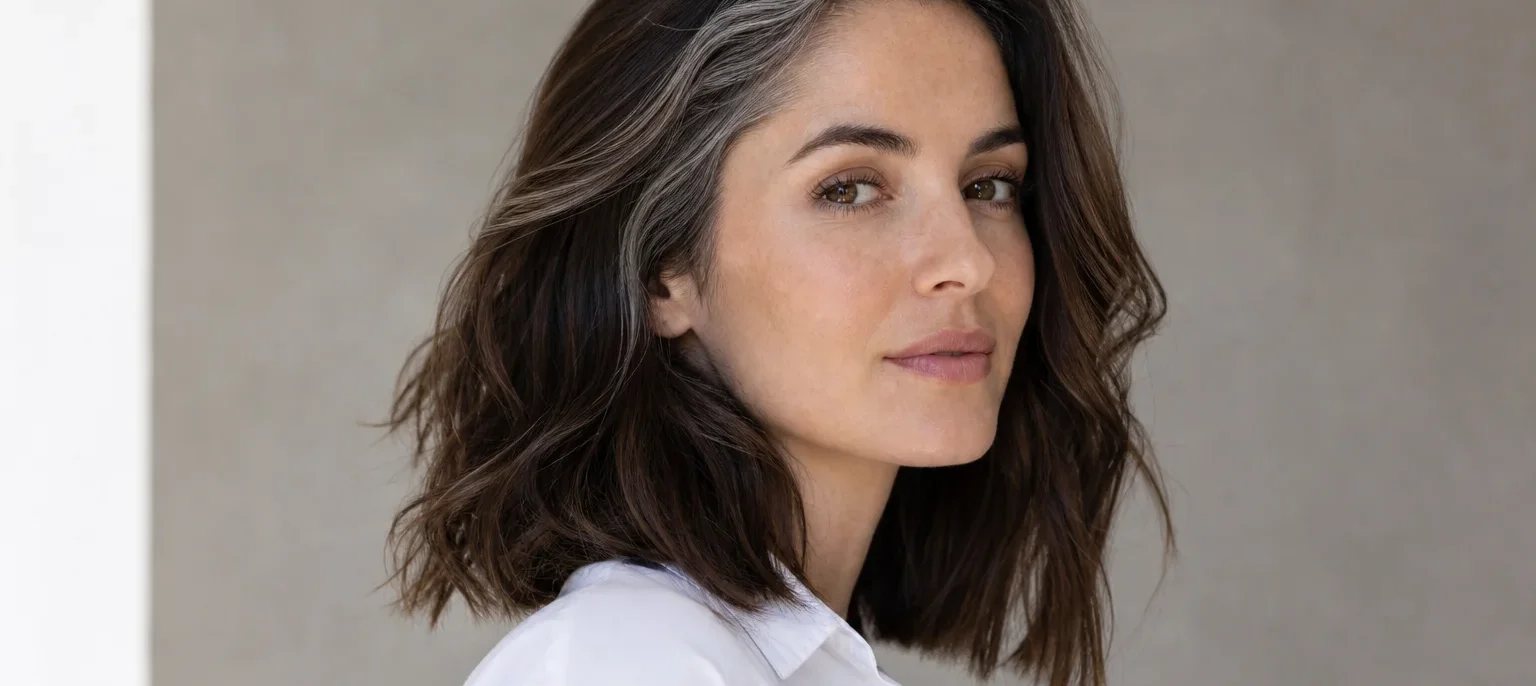
Embracing it can be the most visagist decision, because grey hair changes the contrast of the face, and that can be very flattering.
Transition strategies
| Strategy | How it works | Best for |
|---|---|---|
| Short cut | Removes dyed hair faster | A quick transition |
| Highlights and lowlights | Disguise the regrowth line | Light or medium natural base |
| Blending | Mixes grey and natural colour | A gradual transition |
| Growing out slowly | Lets it grow with frequent trims | Patience and short to medium hair |
What changes in your image
- lower contrast between hair and skin: make-up and clothes may need adjusting;
- cooler or more intense clothing colours often flatter grey hair;
- brows may benefit from a little definition to keep the face’s structure;
- a shaped haircut is essential: grey without a cut looks neglected, grey with a cut looks like a choice.
The principles of contrast and line are in what visagism is and how it works.
Frequently asked questions
In the dermatology literature, grey hair is usually considered premature when it appears before age 20 in white people, before 25 in Asian people and before 30 in Black people.
In most cases the cause is genetic and no treatment restores the colour. When greying is linked to deficiencies or thyroid problems, treating the cause may reduce new grey hairs, with variable results.
A 2020 study in Nature showed in mice that intense stress activates nerves that deplete the stem cells responsible for hair colour. In humans the link is plausible but still being studied.
No. Each follicle produces one hair at a time. Plucking does not multiply grey hairs, but it can inflame and, over time, damage the follicle.

Your grey hair can be a choice
Premature grey hair is not a sign of ageing or neglect. It is a trait, often inherited, that can be treated as an aesthetic choice. What matters is deciding with information: investigating when there are warning signs and, if you choose to embrace it, doing so with a plan.
In the Visagism Consultation, I analyse your face, contrast and style and build your transition strategy, with cut, colour, make-up and clothing that flatter grey hair.
I want to embrace my grey hair with style →
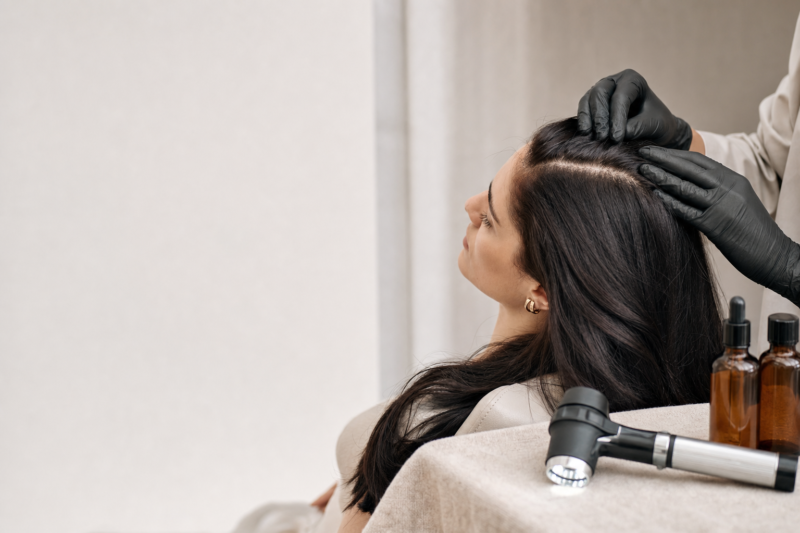
If your grey hairs came with shedding, thinning or scalp changes, start with the Hair & Scalp Therapy Consultation, with trichoscopy and medical referral when needed.
Nelma Faleiro holds a postgraduate specialisation in Cosmetic Trichology (Faculdades Oswaldo Cruz) and a degree in Visagism and Hair Therapy from Universidade Anhembi Morumbi, where she lectured for 10 years. Educational content: it does not replace medical advice.