Quick answer: visagism is the art of creating a personal image that communicates who you are. It starts from your face shape, the lines of your features, your skin colour and your personality to define haircut, colour, makeup and accessories. The goal is not to follow an "ideal face" rule, but to make your appearance tell the same story you do.
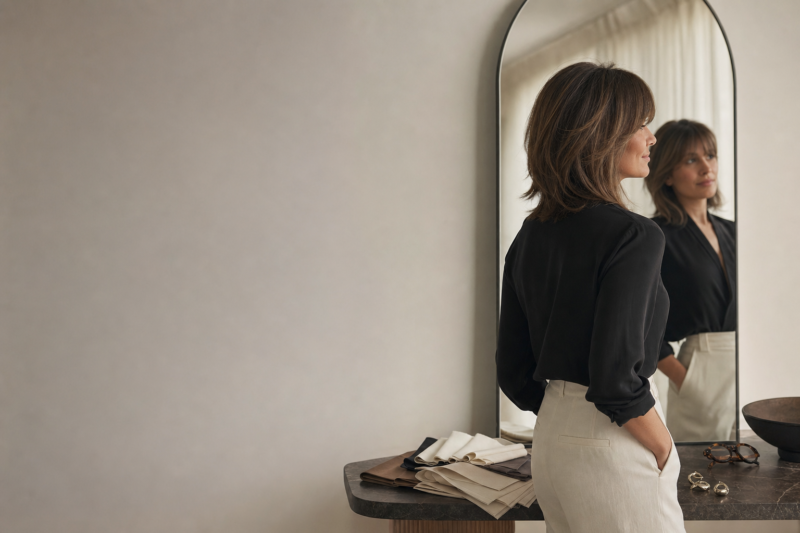
Many people know visagism from the phrase "haircut for a round face". It is a start, but it is not enough. Visagism is a way of reading the face and the person and translating that reading into intentional image choices. When the image matches the personality, the feeling is recognition: "yes, this is me".
In this guide you will learn what visagism is, where it comes from, how to find your face shape and how a visagism consultation turns that reading into practical decisions.
What is visagism and where does the concept come from?
The term comes from the French visage (face). It was coined by French makeup artist and hairdresser Fernand Aubry in the mid-twentieth century. In Brazil, artist and researcher Philip Hallawell deepened the method, combining the visual language of fine art with the study of temperaments, and brought it into the training of hairdressers and makeup artists.
The central idea is simple: every image communicates. Straight lines convey firmness; curves, softness; sharp angles, dynamism; horizontals, stability. Warm colours draw people in; cool colours create distance. A visagist uses this "vocabulary" so that your look says what you want to say.
Visagism is not a beauty rule
A common misconception is that visagism aims to bring everyone closer to a "perfect oval" face. Contemporary visagism does the opposite: it values individuality. A strong chin can be softened — or highlighted, if the person wants to convey strength. The decision depends on the message, not on a standard.
That is why the process always starts with questions: who are you, what do you do, how do you want to be perceived, how much time do you have for your hair in the morning.
How to find your face shape
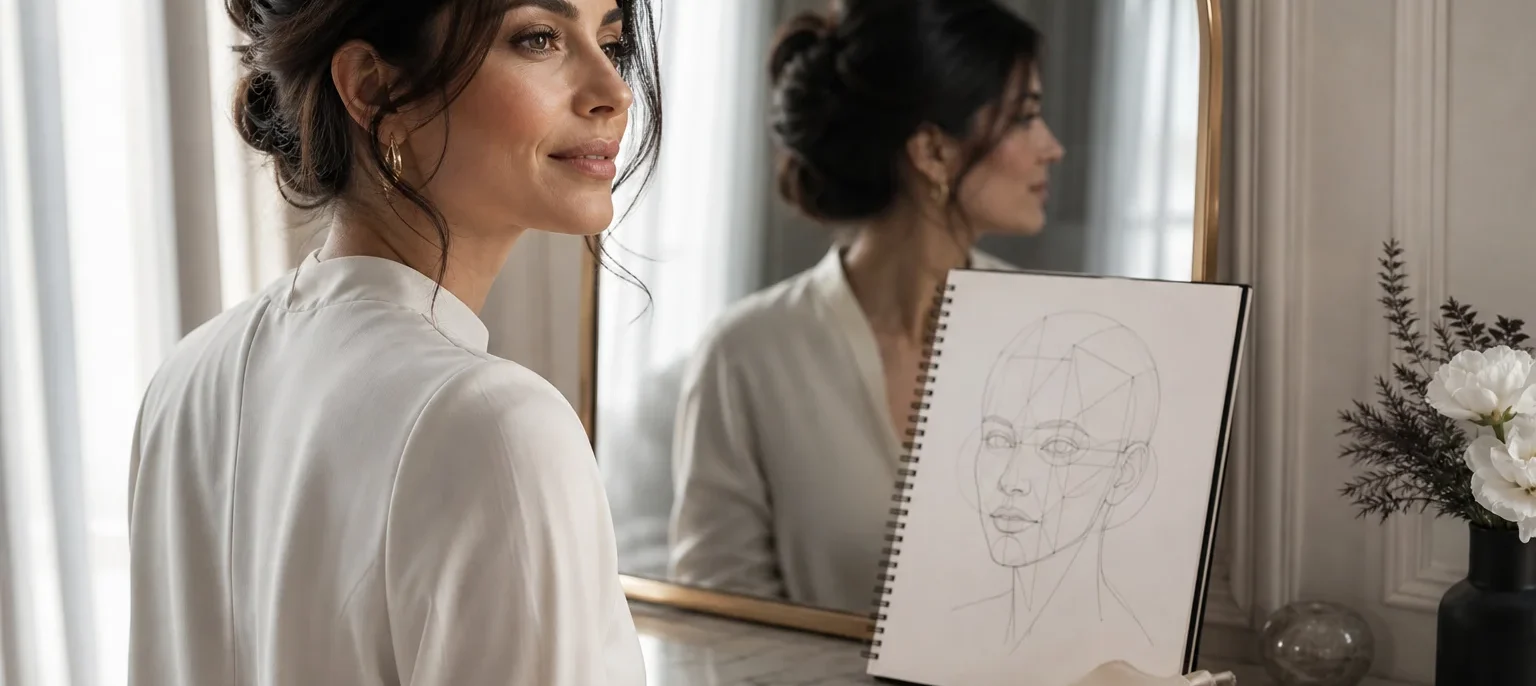
Tie your hair back, stand in front of a mirror or take a photo with your phone at eye level, without tilting your head. Look at four measurements:
- Forehead width — from temple to temple;
- Cheekbone width — the widest point below the eyes;
- Jaw width — from one angle of the jaw to the other;
- Face length — from the hairline to the chin.
Compare the measurements and see which description fits best:
| Shape | Main feature | Haircut tendency |
|---|---|---|
| Oval | Length ~1.5 times the width, forehead slightly wider than the chin | Versatile; watch volume and texture |
| Round | Similar width and length, soft contours | Vertical lines, height on top, ends below the chin |
| Square | Forehead, cheekbones and jaw of similar width, defined angles | Curves and soft layers near the jaw |
| Rectangular (long) | Length much greater than width | Fringe and side volume to "shorten" |
| Triangular | Jaw wider than forehead | Volume on the upper part |
| Heart (inverted triangle) | Wide forehead, narrow chin | Volume from the chin down, side fringe |
| Diamond | Wide cheekbones, narrow forehead and chin | Volume at forehead and nape, soften the cheekbones |
Important: almost nobody has a pure shape. Most faces mix features — oval with a strong jaw, round with a wide forehead. That is why app tests or the "lipstick on the mirror" trick often get it wrong: they reduce the face to a geometric shape and ignore the features.
Features matter too
Beyond the outline, a visagist looks at the eyebrows, eyes, nose and mouth. Features dominated by straight lines and angles call for a different approach from rounded features. A round face with straight brows and an intense gaze, for example, can carry a geometric cut that the "round face" rule would forbid.
What lines communicate
This is the most powerful part of visagism, because it applies to hair, makeup, glasses and clothing.
- Vertical lines lengthen and add elegance and authority.
- Horizontal lines widen and convey stability and calm.
- Curved lines soften, draw people in and communicate warmth and sensuality.
- Straight lines and angles convey firmness, objectivity and dynamism.
- Diagonal lines bring movement and energy.
Visagism in practice: cut, colour, makeup and accessories
Cut
The haircut defines the main lines: where the length ends, where the volume sits, whether there is a fringe. A cut that ends exactly at the jawline, for example, highlights the jaw. See a practical example in haircuts for round faces.
Colour
Contrast between hair and skin, temperature (warm or cool) and brightness change how the face reads. Lighter pieces around the face brighten; dark, even tones add weight and seriousness.
Makeup and brows
The brow frames the expression: a higher arch opens the eyes; a straight brow conveys serenity and firmness.
Accessories
Glasses, earrings and necklaces repeat or break the lines of the face. A square frame on a round face creates contrast; a round frame reinforces softness.
How a visagism consultation works
A complete visagism consultation usually follows five stages:
- Interview — personality, profession, routine, references and what the person wants to communicate;
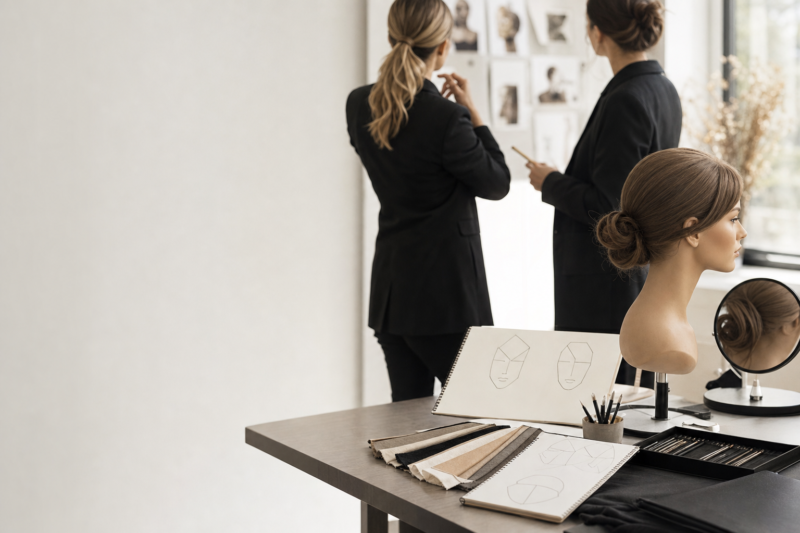
- Face analysis — proportions, shape, features and hair texture, with standardised photos;
- Colour analysis — skin, eyes, hair and contrast;
- Proposal — cut, colour, makeup, brows and accessories, each recommendation with its reason alongside;
- Execution and follow-up — in the salon or with the client’s trusted professional.
The result is autonomy: you understand why a choice works and stop relying on trial and error.
5 common mistakes when applying visagism on your own
- Following the face-shape rule and ignoring personality. A cut that is "right" for your face can be wrong for who you are — and you will never feel at ease in it.
- Bringing a celebrity photo without reading the context. The photo has studio lighting, professional makeup and a hair texture that may not be yours.
- Forgetting your routine. A cut that needs a daily blow-dry does not work if you have 10 minutes in the morning.
- Changing everything at once. Cut, colour and fringe on the same day make it hard to know what worked. Changes in stages are safer.
- Trusting an app alone. Apps measure proportions, but they cannot see expression, texture, style and message — which are the heart of visagism.
For more on the history and schools of thought, the profile of Philip Hallawell by PUCRS Online (Portuguese) summarises the work of the man who systematised the method in Brazil.
Frequently asked questions
Visagism is the creation of a personal image that expresses someone’s identity, using the lines, shapes, colours and textures of hair, makeup and accessories. The concept was created by Fernand Aubry and developed in Brazil by Philip Hallawell.
No. Face shape is one piece of data. Visagism also considers personality, lifestyle, profession, the message the person wants to convey, hair texture and maintenance routine.
Colour analysis looks at which colours harmonise with your skin, eyes and hair. Visagism is broader: it works with shapes, lines and the message of the image, and may use colour analysis as one of its tools.
Yes. With standardised photos, a video interview and a lifestyle questionnaire, the analysis can be done remotely and delivered as a dossier with cut, colour, makeup and accessory recommendations, each with its reason.
Discover what your image can communicate
If you feel the mirror is not showing who you are — or you are about to change phase, role or city — the Visagism Consultation is the shortest route between that feeling and a coherent image. I read your face, your personality and your routine and deliver recommendations for cut, colour, makeup and accessories with the reason for each choice. In person or online.
Book my visagism consultation →
Are you a hairdresser, makeup artist or image consultant? In the Visagism & Personal Image Course you learn to make this reading, lead the interview and sell visagism as a service — not as a detail of the haircut.
Nelma Faleiro holds a degree in Visagism and Hair Therapy from Universidade Anhembi Morumbi, where she lectured for 10 years, and received the SINVISA 2025 Award at the 3rd International Visagism Seminar for "education, ethics and intention through Visagism".