
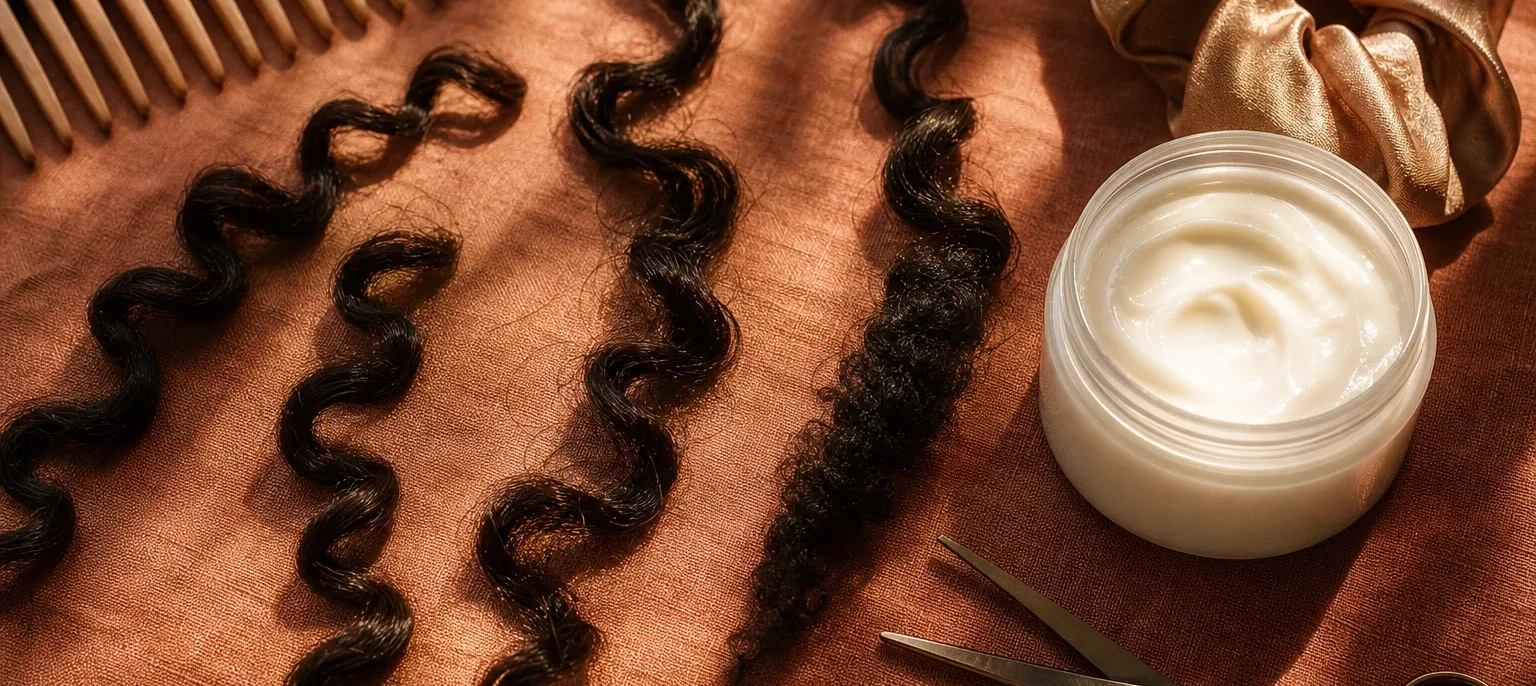
Quick answer: transitioning to natural hair is the period in which you stop using relaxers or straightening treatments and let your natural texture grow. The hardest phase is the one with two textures and a fragile line of demarcation. You can shorten it with a big chop or trim gradually every 2 to 3 months. Supportive cuts, styles that blend the difference and care against breakage make the transition possible.
People who decide to return to their natural hair are usually driven by a strong wish — freedom, identity, hair health, fewer chemicals. Even so, many give up halfway. Transitioning to natural hair takes patience and strategy, especially in the phase when the mirror shows two different textures on the same head.
This guide covers the stages, cutting options, care and styling that help you get through this period.
What is transitioning to natural hair?
It is the process of stopping chemicals that change the hair’s structure — relaxers, straightening treatments, keratin treatments with a straightening action — and waiting for your natural hair to grow, gradually cutting off the treated part. The chemical permanently changes the hair’s internal bonds: treated hair does not "go back" to curling. Only new hair growing from the root has your original texture.
The review Hair cosmetics: an overview, in the International Journal of Trichology, describes how straightening procedures modify the fibre and why it becomes more fragile — which helps explain breakage during the transition.
What are the stages of the transition?
| Stage | What happens | Main challenge |
|---|---|---|
| 1. Decision (0 to 3 months) | Natural roots start to show | The urge to "touch up" |
| 2. Two textures (3 to 12 months) | Curly or coily roots, straight lengths | Line of demarcation, breakage, frizz |
| 3. Mostly natural (12 to 24 months) | Little chemical left at the ends | Learning to style your curls |
| 4. 100% natural hair | All chemical cut off | Discovering your own pattern and routine |
Timelines vary with the length you want and your cutting strategy. Hair grows, on average, about 1 cm a month.
Big chop or long transition?
Big chop
This means cutting off all the treated hair at once. Advantages: it ends the two-texture phase, eliminates breakage at the demarcation line and lets you get to know your curls straight away. Challenge: the hair is short, sometimes very short, and adapting to the new image can be hard.
Long transition
Gradual trims every 2 to 3 months, removing a few centimetres of treated hair each time. Advantage: you keep length. Challenge: living with two textures and the line of demarcation for longer.
Which should you choose?
There is no right or wrong. Ask yourself: how much does length matter to you? How healthy is the treated part? How much time are you willing to spend styling? A conversation with a professional who knows how to cut curly and coily hair helps a lot with this decision.
Supportive cuts for the two-texture phase
The right cuts disguise the difference and give shape:
- Strategic layers: remove some of the treated hair and add movement, bringing the two parts closer in appearance;
- A rounded shape, planned for the natural volume that will emerge;
- A fringe or layers at the front, where natural hair often shows first and where the eye goes;
- A bob or long bob, which shortens the transition without being drastic.
The cut should be planned with the hair in its natural form, not stretched. See ideas in afro haircuts for coily hair.
Styles that blend the two textures
Techniques that "unify" the look while the hair grows:
- Raking in cream and gel: defines the curl at the root and helps shape the lengths;
- Temporary texturising: braid-outs, bantu knots, twist-outs and flexi rods, done on damp hair and undone when dry, create waves in the straight lengths that come closer to the root texture;
- Protective styles: braids, buns and head wraps reduce handling and breakage;
- Accessories: scarves, headbands and clips help on difficult days.
Avoid very tight braids and styles that pull at the roots: constant tension can cause traction alopecia, especially at the temples.
Caring for your hair during the transition
Keep up with moisture and nourishment
Natural curly and coily hair tends to be drier, and the treated part is more porous. Adjust your routine to what the hair asks for — see does a hair treatment schedule work?. Too much protein can make hair stiff and brittle.
Detangle with care
- Always on wet hair, with conditioner;
- From the ends upwards, section by section;
- With your fingers or a wide-tooth comb;
- With extra care at the line of demarcation.
Leave-in and styler
A good leave-in conditioner is the base of your styling, followed by a cream or gel to define.
Scalp
The transition is also a time to look after your scalp. If there is itching, flaking or shedding, get an assessment — not everything is "just the transition".
A suggested weekly routine for the two-texture phase
A starting point to adjust to your hair:
| Day | Care |
|---|---|
| Wash 1 | Mild shampoo on the roots, conditioner and hydration; style with leave-in and gel |
| Next day | Refresh with water and a little cream on the ends |
| Wash 2 | Mild shampoo or co-wash, nourishment on the ends; texturising (braids or knots) to even out the lengths |
| Night | Satin pillowcase or bonnet, hair loosely piled on top |
| Every 2 to 3 months | Trim a few centimetres of treated hair |
If your scalp is oily, the roots may need more frequent washing while the lengths stay protected with conditioner. On very dry coily hair, a pre-wash with oil or conditioner (pre-poo) reduces the friction of shampoo on the ends.
How do you keep going?
The emotional side matters as much as the technique:
- Take photos every month and compare — progress shows;
- Follow people with a texture like yours, not only "perfect" curls;
- Accept difficult days and have an emergency hairstyle;
- Do not compare your curls with anyone’s: each person has more than one pattern on the same head;
- Talk to a professional with experience in natural hair;
- Remember why you started — write down your reason and reread it on days you feel like relaxing your hair.
Common transition mistakes
- Touching up the roots "just this once";
- Using a flat iron and hot blow-dry every day to match the textures;
- Doing a protein treatment every week;
- Very tight braids;
- Cutting at a salon with no experience in curly and coily hair.
Frequently asked questions
It depends on the length you want with your natural hair and on whether you do a big chop. Since hair grows about 1 cm a month, a transition without a drastic cut to shoulder-length hair usually takes 1 to 2 years, with regular trims of the chemically treated part.
No. The big chop — cutting off all the chemically treated hair at once — shortens the transition, but it is not compulsory. Many people prefer to trim gradually, every 2 to 3 months, until all the chemical is gone.
The line of demarcation is where natural hair meets chemically treated hair. There are two different structures there, and the meeting point is fragile. Gentle detangling, moisture and avoiding tension help reduce breakage.
You can, but frequent heat can change your natural curl pattern and increase breakage at the line of demarcation. If you use one, choose a moderate temperature, heat protectant and long gaps between uses.

A cut that respects your texture
The right cut shortens the transition and brings back the pleasure of looking in the mirror. If you are a hairdresser who wants to master cuts for wavy, curly and coily hair — including transition cuts and big chops — the Cutting Technology Course offers 16 hours of practice with visagism applied to cutting.
I want to learn to cut natural hair →
Transitioning and your scalp itches, flakes or you are losing more hair than you should? The Hair & Scalp Therapy Consultation assesses scalp and hair and builds a routine for this phase.
Nelma Faleiro holds a degree in Visagism and Hair Therapy Technology from Anhembi Morumbi University, where she taught for 10 years, and a specialisation in Cosmetic Trichology (Faculdades Oswaldo Cruz).