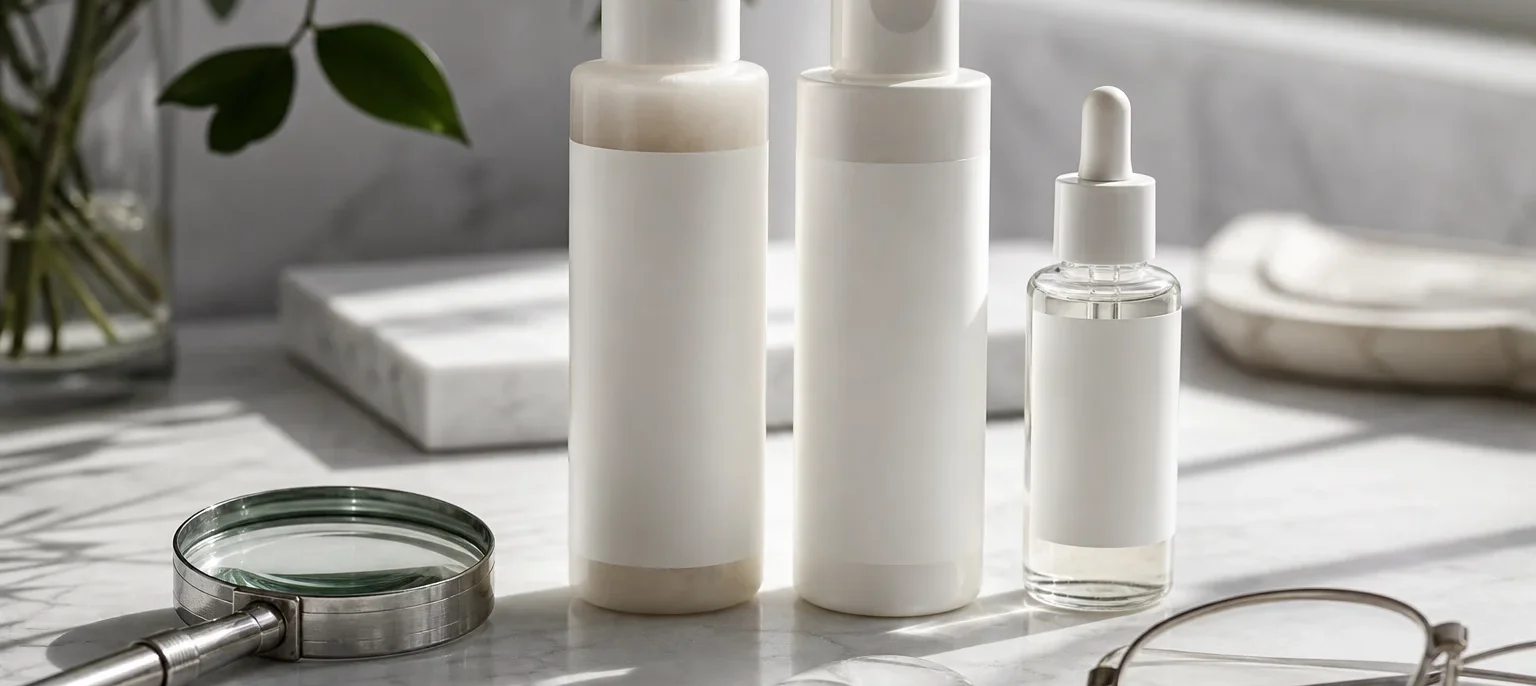
Quick answer: to read hair product labels, start with the INCI list: ingredients generally appear from most to least concentrated, so the first five tell you what the product really is. Then identify their function: cleansers (sulphates and similar), conditioners (quats, silicones), humectants, oils, preservatives and fragrance. The active in the advert is often near the end of the list.
The bottle promises "reconstruction with keratin and argan oil". You turn it over and find keratin in 18th place, after the fragrance. Hair product labels tell the truth that marketing does not always tell — and learning to read the ingredient list is one of the cheapest ways to spend better and get your routine right.
In this guide you will learn to read the INCI list, recognise the main ingredient groups and identify what to avoid in your case.
What is INCI and where do you find it?
INCI (International Nomenclature of Cosmetic Ingredients) is the international naming system used to list cosmetic ingredients. That is why lists come in English or Latin — "Aqua" for water, "Parfum" for fragrance, "Butyrospermum Parkii Butter" for shea butter.
In Brazil, cosmetic labelling is regulated by Anvisa; in Europe, by the European Commission. To look up what an ingredient does, the European Commission’s public CosIng database is a free and reliable tool.
How do you read the order of ingredients?
The most useful rule: ingredients are generally listed in descending order of concentration. Ingredients present in very small amounts (below about 1%) can appear in any order at the end.
In practice:
- The first 5 form the base and most of the formula — usually water, the main cleanser or the main conditioner;
- From 6th to 10th come the supporting ingredients: thickeners, humectants, oils;
- After the fragrance ("Parfum"), almost everything is below 1%. If the advertised active appears after "Parfum", the amount is small.
This does not mean a low-concentration ingredient cannot work — some actives work at low doses. But it helps separate the base from the "marketing seasoning".
The main ingredient groups
Cleansers (surfactants) — in shampoo
| Type | INCI examples | Characteristic |
|---|---|---|
| Strong anionics | Sodium Lauryl Sulfate, Ammonium Lauryl Sulfate | Intense cleansing, lots of lather |
| Moderate anionics | Sodium Laureth Sulfate | Efficient cleansing, slightly milder |
| Mild | Cocamidopropyl Betaine, Decyl Glucoside, Sodium Cocoyl Isethionate | Gentle cleansing, less lather |
Oily scalps usually do well with more efficient cleansers. Curly, coily, chemically treated hair or sensitive scalps may prefer milder formulas.
Conditioners
- Quaternary ammonium compounds: Behentrimonium Chloride, Cetrimonium Chloride — detangle and reduce static;
- Cationic polymers: Polyquaternium-10, Guar Hydroxypropyltrimonium Chloride — form a film and add softness;
- Silicones: names ending in -cone, -conol or -siloxane (Dimethicone, Amodimethicone, Cyclopentasiloxane) — slip, shine and protection.
Humectants
Glycerin, Panthenol, Propylene Glycol, Sodium PCA, Aloe Barbadensis Leaf Juice. They attract and hold water.
Oils, butters and emollients
Latin botanical names (Argania Spinosa Kernel Oil, Cocos Nucifera Oil), fatty alcohols (Cetyl Alcohol, Cetearyl Alcohol — which, despite the name, do not dry hair) and esters.
Proteins and amino acids
Hydrolyzed Keratin, Hydrolyzed Wheat Protein, Arginine. Useful for damaged hair, but too much makes hair stiff — see the balance in does a hair treatment schedule work?.
Preservatives
Phenoxyethanol, Sodium Benzoate, Potassium Sorbate, parabens (Methylparaben, Propylparaben), Methylisothiazolinone. They are needed to prevent contamination by fungi and bacteria. A water-based product with no preservative is a risk.
Fragrance and allergens
"Parfum" or "Fragrance" is a blend. Some components, such as Limonene, Linalool and Geraniol, may be listed separately because they are potential allergens.
What to avoid — it depends on you
There is no universal list of "forbidden ingredients" for everyone. There is what does not suit your case:
- Sensitive scalp or dermatitis: watch for fragrance high on the list, some preservatives (such as methylisothiazolinone) and very strong cleansers;
- Oily scalp: avoid heavy oils and butters in products that go on the roots;
- Fine hair: silicones and heavy oils near the top of the list can weigh it down;
- Curls and coils: strong cleansers every day can dry them out;
- Blondes and chemically treated hair: watch for excess protein, which can stiffen the hair;
- Known allergy: always read the full list, even on products you already use, because formulas change.
Common label traps
- "With keratin" — it may contain very little keratin, at the end of the list.
- "Sulphate-free" — it may contain other equally strong cleansers.
- "Natural" — not regulated the way a specific active is; read the list.
- "Hypoallergenic" — reduces risk but does not eliminate reactions.
- "Strengthens the roots" or "makes hair grow" — cosmetics do not treat hair loss; be wary of such promises. For shedding, see female hair loss: 9 causes.
How to read a label in 1 minute
A quick routine for the shop shelf:
- Read the first 5 ingredients — what is the base?
- Find the main cleanser or conditioner;
- Locate "Parfum" and see what comes after it;
- Find the advertised active — where is it?
- Check for ingredients you need to avoid;
- Check the expiry date and period after opening (the open-jar symbol with an "M").
A practical example
A conditioner listing "Aqua, Cetearyl Alcohol, Behentrimonium Chloride, Dimethicone, Glycerin, Parfum, Argania Spinosa Kernel Oil…" is, in essence, a classic conditioner with silicone and glycerin. The argan oil comes after the fragrance, in a small amount. It is not a bad product — it is just not an "argan treatment".
Expiry, period after opening and storage
Besides the ingredient list, the label carries two dates that affect product safety:
- Expiry date: applies to the unopened product, stored correctly;
- Period after opening (PAO): the open-jar symbol with a number and the letter "M" — for example, 12 M means 12 months after opening.
In practice, shampoos and conditioners often have a PAO of 12 to 24 months; masks in tubs, which get fingers dipped in at every use, tend to become contaminated faster. Signs a product has gone off: changes in smell, colour or texture, separation and dark spots.
Store products away from direct sunlight and, if possible, outside the shower, where heat and humidity speed up degradation. Closing the cap tightly and using a clean spatula for tubs also extends shelf life. An expired product may lose effectiveness and, with degraded preservatives, irritate the scalp.
Label reading and your hair routine
Knowing how to read labels helps you build a routine without duplication: you notice that your leave-in and conditioner have almost the same base, or that your "hydrating" mask is actually rich in protein. See where a leave-in conditioner fits.
Frequently asked questions
INCI stands for International Nomenclature of Cosmetic Ingredients. It is the standard used to list ingredients, usually in English or Latin, and it lets you compare products across brands and countries.
Yes. In general, ingredients appear in descending order of concentration. The first ones on the list make up most of the formula. Ingredients at very low concentrations, below about 1%, can appear in any order at the end of the list.
Not necessarily. Sulphates are efficient, safe cleansers for most people. They can dry out curly, coily or chemically treated hair and irritate sensitive scalps. For oily scalps, they usually work well.
No. Silicones add slip, shine and protection against friction and heat. Some heavier ones can build up on fine hair or on people who do not use shampoo. The choice depends on hair type and routine.
Choose for your hair, not the packaging
If you do not yet know what your scalp and hair need, it is hard to choose products — label or no label. In the Hair & Scalp Therapy Consultation, I assess your scalp and hair with trichoscopy and recommend the type of formula and ingredients that make sense for you, with a simple routine and no double spending.
I want the right product routine for me →
A beauty professional who wants to recommend products on a technical basis? The Practical Trichology e-book goes deeper into cosmetic science, actives and protocol building.
Nelma Faleiro holds a specialisation in Cosmetic Trichology (Faculdades Oswaldo Cruz) and degrees in Visagism and Hair Therapy Technology and in Aesthetics and Cosmetics from Anhembi Morumbi University, where she taught for 10 years.