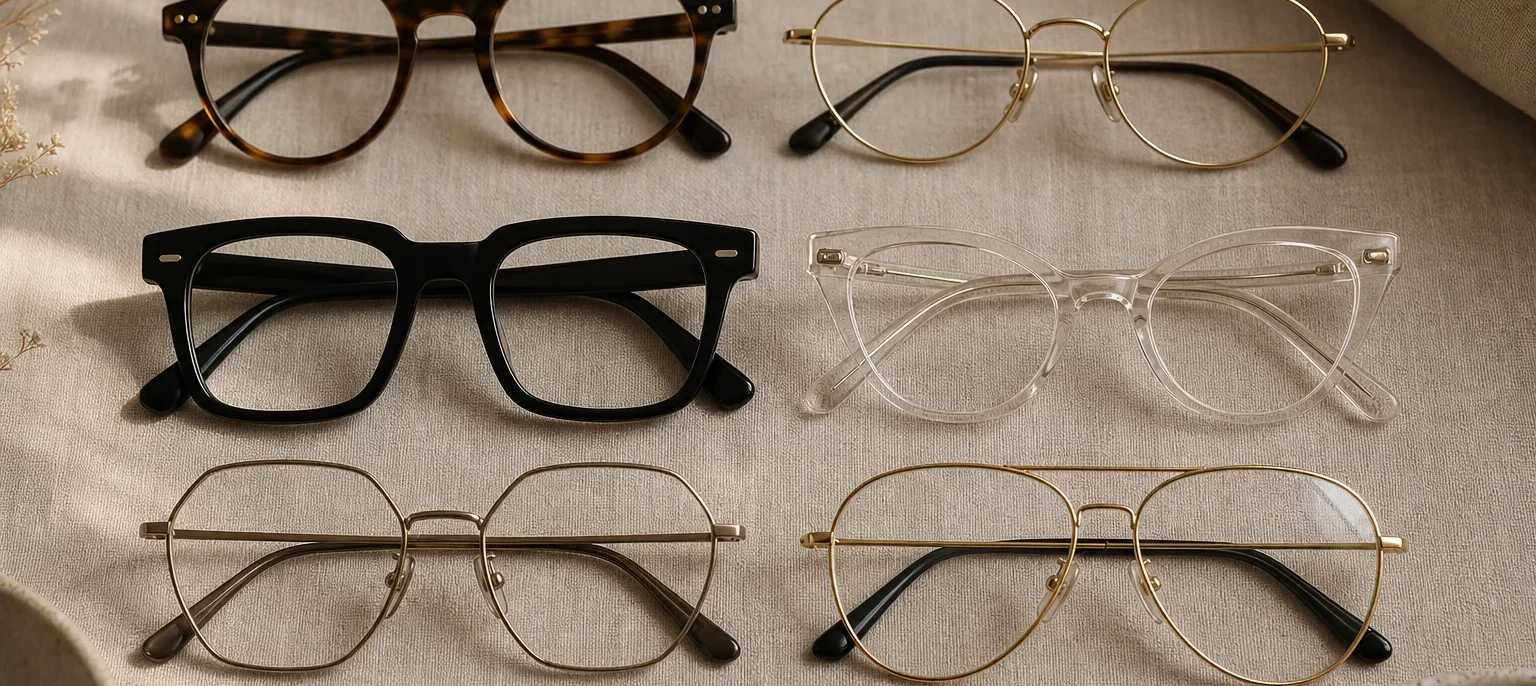
Quick answer: to choose glasses for face shape, use contrast of shape: an angular face calls for curved frames; a rounded face calls for straight ones. Then adjust the width (equal to the face at the temples), the bridge, the brow line, the colour and the thickness. The frame is the strongest line on the face and communicates as much as your haircut.
If you wear glasses every day, you carry an accessory right in the centre of your expression. The frame surrounds the eyes, crosses the brow line, rests on the nose and defines what people see first. Even so, many people choose at the counter, by brand or by what is on offer.
In this visagism guide I explain how to choose glasses for face shape with clear criteria: shape, proportion, colour, visual weight and message.
Why is the frame the strongest line on the face?
In visagism, every line communicates. A frame has a continuous outline, contrast with the skin and a central position. That is why it dominates how a face is read, more than lipstick, earrings or even the haircut.
Philip Hallawell, who systematised visagism in Brazil (see a profile of the author by PUCRS), works with the idea that lines and shapes stir emotions. Applied to glasses:
- straight lines and angles convey firmness, rationality and authority;
- curves convey warmth, softness and friendliness;
- upswept lines (a cat-eye, for example) convey energy and boldness;
- thin frames convey lightness and sophistication;
- thick frames convey presence and personality.
The basics are in what visagism is and how it works.
Contrast or repetition?
The classic rule is contrast: the frame balances the face shape by bringing in the opposite shape. A square face gains softness from a round frame.
But there is also repetition, when the intention is to reinforce a feature. Someone with an angular face who wants to look firmer may choose a rectangular frame on purpose. Visagism does not work with bans. It works with intention.
Glasses for face shape: a practical table
| Face shape | Most common goal | Frames that work | Be careful with |
|---|---|---|---|
| Oval | Keep the balance | Almost all, at the right width | Frames that are too wide |
| Round | Lengthen and add structure | Rectangular, geometric, elongated cat-eye | Small, very round frames |
| Square | Soften angles | Round, oval, aviator, soft cat-eye | Square frames heavy at the base |
| Oblong (long) | Shorten and widen | Deeper frames, strong temples, oversized | Narrow, shallow frames |
| Heart | Balance a wide forehead | Light on top, aviator, rimless bottom | Heavy top rims |
| Triangle (wide base) | Balance the jaw | Emphasis on top, cat-eye, browline | Frames narrow on top |
| Diamond | Soften the cheekbones | Oval, rimless, soft cat-eye | Narrow, very angular frames |
Not sure of your shape? Follow the tape-measure method in how to find your face shape.
Proportion: width, bridge and depth
Width
The frame should be roughly as wide as the face at the temples. Narrower, and the face looks bigger; wider, and it looks like a costume. A simple test: facing the mirror, the sides of the frame should not extend much beyond the outline of your face.
Bridge
The bridge is the part that rests on the nose.
- Long nose: lower, thicker bridges visually "shorten" it.
- Short nose: high, thin or clear bridges lengthen it.
- Wide nose base: wider bridges fit better and avoid marks.
Lens depth
Very shallow lenses can "cut" the gaze. For varifocal lenses, opticians need a minimum depth, usually around 28 to 32 mm, depending on the lens. Check with your optician before falling for a very narrow frame.
The brow line
The top of the frame should follow the brow, sitting just below it or aligned with it. When the frame cuts the brow in half, two competing lines appear and the expression looks confused.
Arched brows go well with frames with a curved top line. Straight brows go well with frames with a straighter top line. If you are thinking about reshaping your brows, do it before choosing your glasses.
Colour and thickness: visual weight
| Feature | Effect | Best for |
|---|---|---|
| Black and dark colours | More presence and contrast | Strong features, dark hair |
| Tortoiseshell | Presence with softness | Almost everyone, especially warm tones |
| Clear and nude | Lightness, discretion | Delicate features, less emphasis |
| Gold metal | Warmth and sophistication | Warm skin undertones |
| Silver metal | Freshness and modernity | Cool skin undertones |
| Bright colours | Creativity, boldness | Expressive personalities |
Personal contrast helps too: people with high contrast between hair, skin and eyes can carry dark, thick frames. People with low contrast look more harmonious in light, thin frames or tones close to their hair colour.
Glasses and message: work, routine and personality
- Law, management, finance: straight lines, sober colours, medium thickness.
- Education, healthcare, customer-facing roles: curves, tortoiseshell, warm tones.
- Creative, fashion, communication roles: geometric shapes, colour, volume.
Many people benefit from owning 2 frames: one for work and one for the weekend. It widens your image without changing your haircut.
Sunglasses, age and when to change
Sunglasses follow the same logic
The rules of shape and proportion also apply to sunglasses. The difference is that they are usually bigger and darker, so their visual weight increases. Choose lenses that block 100% of UV rays, information that should appear on the label or certificate.
Frames change with age
Over the years, features lose some contrast and skin becomes thinner. Very dark, heavy frames can harden the expression. Tortoiseshell, soft metals and translucent acetates usually brighten more. After the age of 40 years, many people start needing reading lenses, and frame depth becomes more important.
When to change
- when your prescription changes and the lenses need replacing;
- when you change your haircut or hair colour a lot;
- when the frame is bent, loose or marking your nose;
- when your stage of life or career calls for a different message.
Many people end up wearing the same frame for 3 or 4 years without noticing that their own image has changed in that time.
The most common mistakes
- Choosing by brand, not by shape.
- A frame that is too narrow for the face.
- A top line that cuts through the brow.
- A colour that clashes with the hair (gold with ashy hair, for example).
- Ignoring the lens: some frames do not suit varifocals or strong prescriptions aesthetically.
- Not looking at your profile: the temples count too, especially with short hair.
How to test at the optician
- go with your hair styled the way you wear it every day;
- take front and profile photos with each option;
- compare the photos calmly at home;
- check with the optician that the frame suits your prescription.
Frequently asked questions
The basic rule is contrast: a face with strong angles calls for frames with curves, and a rounded face calls for straight, angular frames. Then adjust width, bridge, colour and thickness to your face and to the message you want to send.
Rectangular, softened square, geometric and elongated cat-eye frames, as wide as the face or slightly wider. Avoid small, very round frames that repeat the shape.
Round, oval, aviator and soft cat-eye frames, which bring curves to balance the jaw. Square frames that are very wide at the base reinforce the angles.
Generally not. The top of the frame should follow the brow line, sitting just below it or aligned with it. Cutting the brow in half creates two competing lines in the expression.

Find the frame that speaks for you
Well-chosen glasses organise the expression, bring out the eyes and reinforce the image you want to project. When the frame agrees with your haircut, brows and hair colour, the whole look feels natural.
In the Visagism Consultation, I analyse your face, features, colouring and routine and recommend frame shapes, colours and thicknesses, together with haircut, brows and accessories, with the reason for each choice.
Do you work in optics or beauty? The Visagism & Personal Image Course teaches you to read the face and advise clients methodically.
Nelma Faleiro holds a degree in Visagism and Hair Therapy from Universidade Anhembi Morumbi, where she lectured for 10 years, and received the SINVISA 2025 Award.