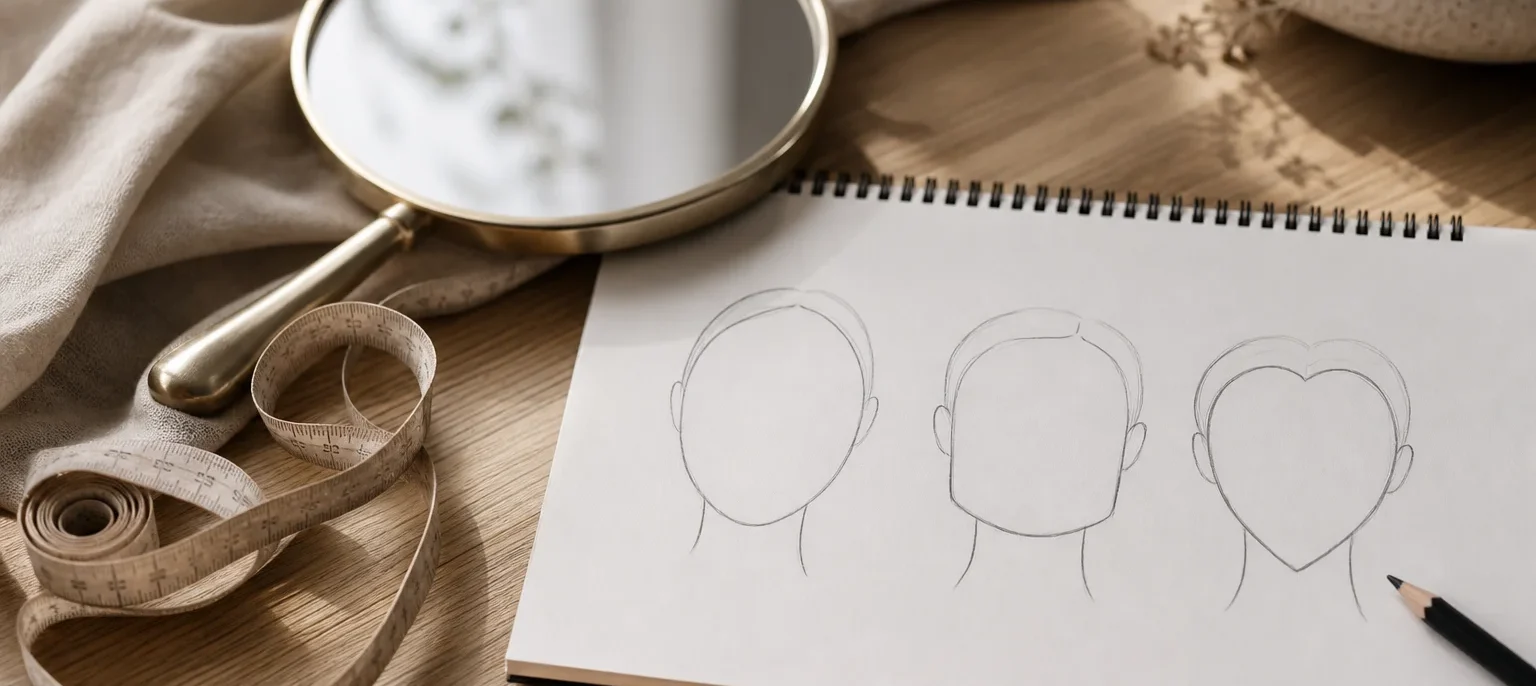
Quick answer: to find your face shape, tie your hair back and use a tape measure on four points — forehead, cheekbones, jaw and length (hairline to chin). Compare them: length about 1.5 times the width with a forehead slightly wider than the chin suggests oval; similar measurements and soft contours, round; defined angles and equal widths, square. Confirm with a front-facing photo.
Knowing how to find your face shape is the first step to choosing a haircut, fringe, glasses and even earrings with more confidence. The problem is that the popular methods — tracing your reflection with lipstick, comparing yourself with celebrity photos, trusting an app filter — often get it wrong. Light, angle and distance distort everything.
In this guide you will learn a simple, reliable method with measurements and proportions, and you’ll see why almost nobody has a "pure" shape.
What you will need
- a soft sewing tape measure;
- a well-lit mirror, ideally with natural light in front of you;
- a phone for a front-facing photo;
- a hair tie or clips to pull all your hair back, including the fringe;
- paper and a pen to note the measurements.
Step by step: how to find your face shape in 5 stages
1. Prepare your face
Pull your hair back so the hairline, ears and jaw are visible. No contour makeup, which creates false shadows.
2. Measure your forehead
Measure across the forehead at its widest point — usually halfway between the eyebrows and the hairline.
3. Measure your cheekbones
Find the most prominent point of the cheekbones, just below the outer corner of the eyes, and measure across.
4. Measure your jaw
Measure from the tip of the chin to the angle of the jaw (just below the ear) and multiply by two. It is the easiest way to do it on your own.
5. Measure the length
Measure from the centre of the hairline to the tip of the chin, over the nose.
Write everything down and compare with the table below.
Table of the 7 face shapes
| Shape | Main proportion | Widest part | Outline |
|---|---|---|---|
| Oval | Length ~1.5 times the cheekbone width | Cheekbones, forehead slightly wider than chin | Soft, gently rounded chin |
| Round | Length ≈ width | Cheekbones | Curved, no angles |
| Square | Length ≈ width | Forehead, cheekbones and jaw similar | Angular jaw |
| Rectangular (long) | Length much greater than width | Widths similar to each other | Straight sides |
| Triangular (pear) | Variable | Jaw | Narrow forehead |
| Heart | Variable | Forehead | Narrow, sometimes pointed chin |
| Diamond | Variable | Cheekbones, very prominent | Narrow forehead and chin |
A useful reference: if the length is more than 1.6 times the cheekbone width, the face tends to be long; below 1.2 times, it tends to be round or square.
A worked example with real measurements
Here is how to read three fictional but typical sets of measurements:
Example A — forehead 13 cm, cheekbones 14 cm, jaw 11 cm, length 20 cm. The length is about 1.4 times the cheekbone width, the forehead is wider than the jaw and the outline is soft: oval.
Example B — forehead 13 cm, cheekbones 14 cm, jaw 13 cm, length 16 cm. Length close to the width (1.1 times) and a jaw as wide as the forehead. If the jaw angle is defined: square; if it is rounded: round.
Example C — forehead 14 cm, cheekbones 13 cm, jaw 10 cm, length 19 cm. The forehead is the widest part and the jaw is much narrower: heart.
Notice that differences of 1 cm already change the result. That is why it is worth measuring twice and, if possible, asking someone to help. A difference of less than 1 cm between forehead, cheekbones and jaw means the widths are "similar".
Confirming with the photo
With your measurements noted, open the front-facing photo and look at the outline from about 2 metres away from the screen (or shrink the image a lot). Away from the details, the overall shape appears more clearly. If the photo and the measurements tell different stories, trust the measurements and retake the photo with the camera at eye level.
The three thirds of the face
Beyond the outline, visagism looks at the vertical division of the face into three thirds:
- Upper — from the hairline to the eyebrows;
- Middle — from the eyebrows to the base of the nose;
- Lower — from the base of the nose to the chin.
In faces considered balanced, the thirds are of similar height. In practice, one is often larger — and that changes the choice of fringe (which "shortens" the upper third) or cut length (which highlights or softens the lower third).
Mixed faces: the most common case
Most people don’t fit neatly into one row of the table. Common examples:
- oval with a strong jaw — an oval base, but careful with cuts that end exactly at the jaw;
- round with a wide forehead — side fringes work better than straight ones;
- long with a pointed chin — a mix of rectangular and heart, calling for side volume at chin level.
When the result falls "between two shapes", notice which feature stands out most when you look at the photo from a distance. That is the one the cut will highlight or balance.
The 6 mistakes that skew the result most
- A photo from above or below. A camera above eye level narrows the chin; below, it widens the jaw. Shoot at eye level, about 1 metre away.
- A wide-angle lens close to the face. A selfie at 30 centimetres distorts the nose and sides. Use portrait mode or ask someone to take the photo.
- Hair down. A fringe and side volume hide the forehead and jaw.
- Tracing the reflection with lipstick. The reflection shifts with every head movement; the outline comes out bigger than the face.
- Confusing cheeks with bone. Measure the cheekbones (bone), not the fullest part of the cheek.
- Thinking shape decides everything. Features, hair texture, lifestyle and personality weigh as much as the outline. Read the full concept in visagism: what it is and how it works.
I’ve found my shape. Now what?
With your shape in hand, you can already make better choices:
- haircut — where the length ends and where the volume sits (see the example of haircuts for round faces);
- fringe — straight, side-swept, curtain or none;
- glasses — frames that contrast with or repeat the lines of the face;
- earrings and necklines — they lengthen or widen the whole look;
- eyebrows — the arch changes the expression of the eyes.
But remember: shape is one piece of data, not a verdict. A square face can choose to soften the jaw — or highlight it, if it wants to convey firmness.
Frequently asked questions
Measure the width of your forehead, cheekbones and jaw and the length of your face with a tape measure, then confirm with a front-facing photo taken at eye level with your hair tied back. Comparing proportions is more reliable than tracing your reflection in the mirror.
Yes, and it is the most common case. Many faces combine features, such as oval with a strong jaw or round with a wide forehead. In those cases, a visagist works with the dominant feature and the message the person wants to convey.
Bone proportions change little in adulthood, but loss of volume in the cheeks, skin laxity and weight changes alter the outline. That is why it is worth redoing the analysis at every major life stage.
They help as a starting point, but depend on photo quality and tend to reduce the face to a geometric shape. They don’t consider features, hair texture or personality, which are essential in visagism.
Want a complete analysis, with the reason behind each choice?
Measuring your face is the beginning. In the Visagism Consultation, I analyse proportions, features, colour, hair texture and your personality and deliver cut, colour, makeup and accessory recommendations with the reasoning for each — in person or online, with standardised photos.
Book your visagism consultation →
A beauty professional? In the Visagism & Personal Image Course you learn to make this reading methodically and turn it into a service — not a guess at cutting time. For the theoretical foundations, look at the work of Philip Hallawell (Portuguese), who systematised visagism in Brazil.
Nelma Faleiro holds a degree in Visagism and Hair Therapy (Universidade Anhembi Morumbi), where she lectured for 10 years, and received the SINVISA 2025 Award.