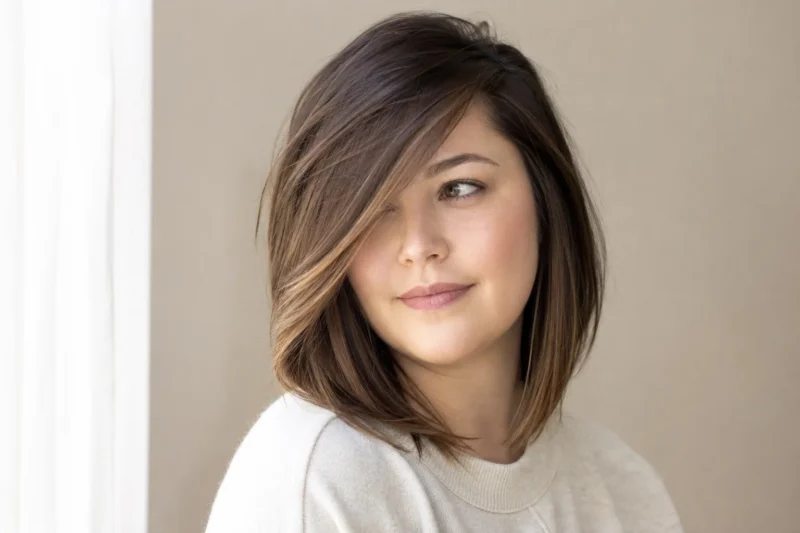

Quick answer: the best haircuts for square faces use curves and movement to balance the angles of the jaw: a wavy long bob, layers from the chin down, a curtain or side fringe and long hair with waves. Avoid straight lines ending exactly on the jawline and volume concentrated at the sides of the face. A strong jaw is strength, not a flaw.
Many people with square faces arrive at the salon asking to "hide the jaw". I usually answer with a question: why hide it? A defined jaw communicates firmness, presence and determination. Visagism does not erase that feature. It balances it, so the strength shows without hardening the expression.
In this guide I explain how to recognise a square face, the visagism principle behind the choices, the best haircuts for square faces at every length and the most common mistakes.
How do you know if your face is square?
A square face has three main features:
- similar widths at the forehead, cheekbones and jaw;
- an angular jaw, with well-defined corners;
- length close to width, with no marked elongation.
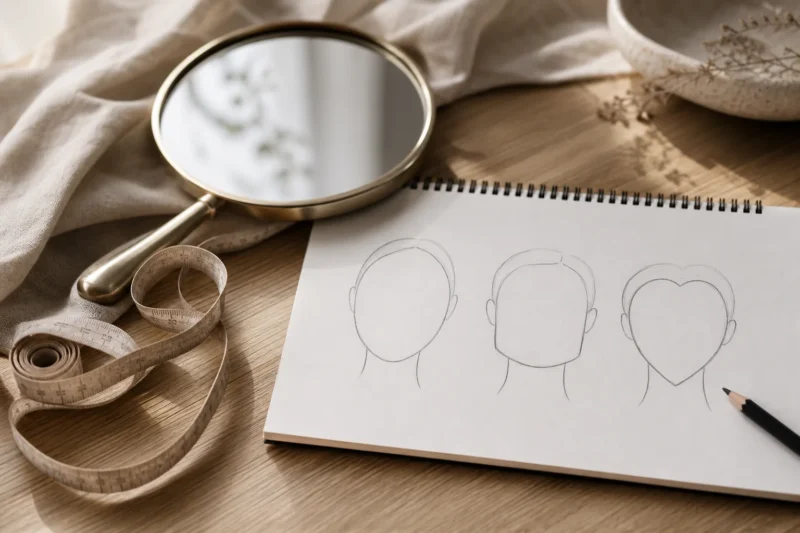
The forehead is often straight and the hairline more horizontal. If you are unsure, follow the tape-measure and photo method in how to find your face shape. Remember that most people have a mixed shape, such as square leaning oval or rectangular.
Square or rectangular?
Both have a defined jaw. The difference is length. A rectangular face is visibly longer than it is wide, with a ratio close to 1.5 to 1. In a square face, the measurements are closer. That distinction changes the cut: a rectangular face needs side volume, while a square face needs curves.
The visagism principle: straight lines versus curves
In visagism, every line carries a message. Straight lines and angles convey stability and strength. Curves convey lightness and warmth. A square face already has many straight lines. If the haircut repeats that language, the expression becomes more rigid.
So the reasoning is:
- Introduce curves with waves, layers and disconnected ends;
- Move the focal point upwards (eyes and cheekbones) or downwards (below the chin);
- Avoid volume at jaw level, which widens the base of the face even more;
- Break the horizontal line of the forehead with a soft fringe or a side parting.
This reasoning comes from the foundations of visagism as systematised in Brazil by Philip Hallawell, who relates shapes, lines and temperament. The author’s website gathers the history of the method.
The best haircuts for square faces
Short
- Pixie with textured top: volume on top lengthens the face; a side fringe softens the forehead. Keep the sides close to the head.
- Disconnected bixie: halfway between a pixie and a bob. Irregular ends break the jawline.
- Short bob with movement: it works if it ends slightly above or below the jaw, never exactly on it.
Medium
- Wavy long bob: the classic for square faces. It ends 2 to 5 cm below the chin, with waves drawing curves at the sides. It needs a trim every 6 to 8 weeks.
- Soft shag: light layers and a curtain fringe add texture and take weight off the base.
- Layers from the chin down: volume moves lower, and the layers frame the face diagonally.
Long
- Long hair with long layers: layers starting at collarbone height create movement without adding width.
- Long hair with loose waves: big waves soften the angles and add a sense of lightness.
- Butterfly cut: short layers around the face with length kept at the back. It works well if the shortest layers sit above the jaw.
Curly and coily hair
In curly hair, volume is the main line. Concentrate volume from the top to the cheekbones and keep the outline narrower at jaw height. A dry cut, curl by curl, lets the stylist draw that shape precisely.
Quick table: what works and what to avoid
| Element | Works | Avoid |
|---|---|---|
| Length | Above or below the jaw | Ending exactly on the jaw |
| Texture | Waves, layers, feathered ends | Heavy, blunt straight ends |
| Fringe | Curtain, side, wispy | Straight, heavy and very short |
| Parting | Side or slightly off-centre | Rigid centre parting, hair flat to the head |
| Volume | On top and below the chin | At the sides, at jaw level |
Which fringes work on a square face?
A fringe is one of the most powerful tools for square faces, because it works on the forehead, which also tends to be straight.
- Curtain fringe: opens in the centre and falls in a curve to the sides, framing the cheekbones.
- Long side fringe: creates a diagonal that breaks rigid symmetry.
- Wispy, light fringe: softens without adding weight.
A heavy, straight fringe is not forbidden. It works for someone who wants a more graphic, striking image. In that case, the choice is about message, not correction.
Beyond the cut: colour, make-up and accessories
The haircut works together with other tools:
- Colour: soft face-framing highlights bring light to the cheekbones.
- Make-up: light contour below the jaw angles and highlighter in the centre of the face.
- Earrings: hoops, drops and rounded shapes repeat curves and balance the angles.
- Glasses: oval or round frames soften; very wide square frames reinforce the base.
When reinforcing the angle is the right choice
Not everyone with a square face wants to soften it. An executive who needs to convey authority can use the jaw to her advantage with a sharp, precise bob. Visagism starts from what you want to communicate. That is why the same rule does not suit everyone.
The most common mistakes with square faces
- A blunt bob on the jawline: creates a horizontal frame that widens the base.
- Side volume at chin level: adds width exactly where the face is already wide.
- Flat, sleek hair with a centre parting: leaves the shape of the face fully exposed, with no curves.
- Layers that are too short at the nape: can create a helmet shape.
- Following a rule without considering texture: fine and coarse hair react differently to the same cut.
What to ask your hairdresser
Take these points into the conversation:
- "I want to soften my jaw without hiding my face."
- "I prefer the length ending below the chin."
- "I want layers that frame my face diagonally."
- "How does my hair behave without a blow-dry?"
To compare with another face shape, also see haircuts for round faces. The logic is similar, but the goal changes: for round faces, lengthen; for square faces, soften.
Frequently asked questions
Cuts with movement and a length below the jaw usually work well: a wavy long bob, layers starting at the chin, a soft shag and long hair with waves. The best choice depends on hair texture and the message you want to send.
Yes. Curtain, side-swept and wispy fringes soften the forehead and break up straight lines. A heavy, straight fringe reinforces angles and needs more careful consideration.
Yes. A pixie with texture on top and a side fringe, or a bob with disconnected ends, work well. What tends to look harsh is a blunt short cut ending exactly on the jawline.
In a square face, forehead, cheekbones and jaw have similar widths, and the jaw has defined angles. Length and width are also close. A front-facing photo with your hair tied back helps confirm it.

Find the cut that balances your face
A square face has natural presence. The right cut keeps that strength and adds lightness, to the degree that makes sense for you. That degree depends on your real face shape, your hair texture, your routine and the image you want to project at work and in life.
In the Visagism Consultation, I analyse your face, your features and your lifestyle and recommend cut, fringe, colour and accessories, with the reason for each choice.
Are you a beauty professional who wants to apply this reading methodically in the salon? The Visagism & Personal Image Course teaches you to read the face and translate lines and shapes into cuts and colours.
Nelma Faleiro holds a degree in Visagism and Hair Therapy from Universidade Anhembi Morumbi, where she lectured for 10 years, and received the SINVISA 2025 Award.