Quick answer: a face shape app uses artificial intelligence to mark points on your face and calculate proportions, and it can get the shape right from good photos. But light, angle, hair and expression distort the measurement, and the app cannot read personality, routine, hair texture or the message you want to send. Use it as a starting point, not a decision.
Open social media and you will find filters that "reveal" your face shape in 3 seconds and simulators that show you with a fringe, blonde or with short hair. It is fun, and sometimes useful. But many people arrive at the salon with an app’s certainty and leave frustrated, because the cut that worked on screen did not work in the mirror.
In this article I explain how these apps work, where artificial intelligence genuinely helps visagism, where it misleads and how to use the technology to your advantage.
How does a face shape app work?
Most apps follow three steps:
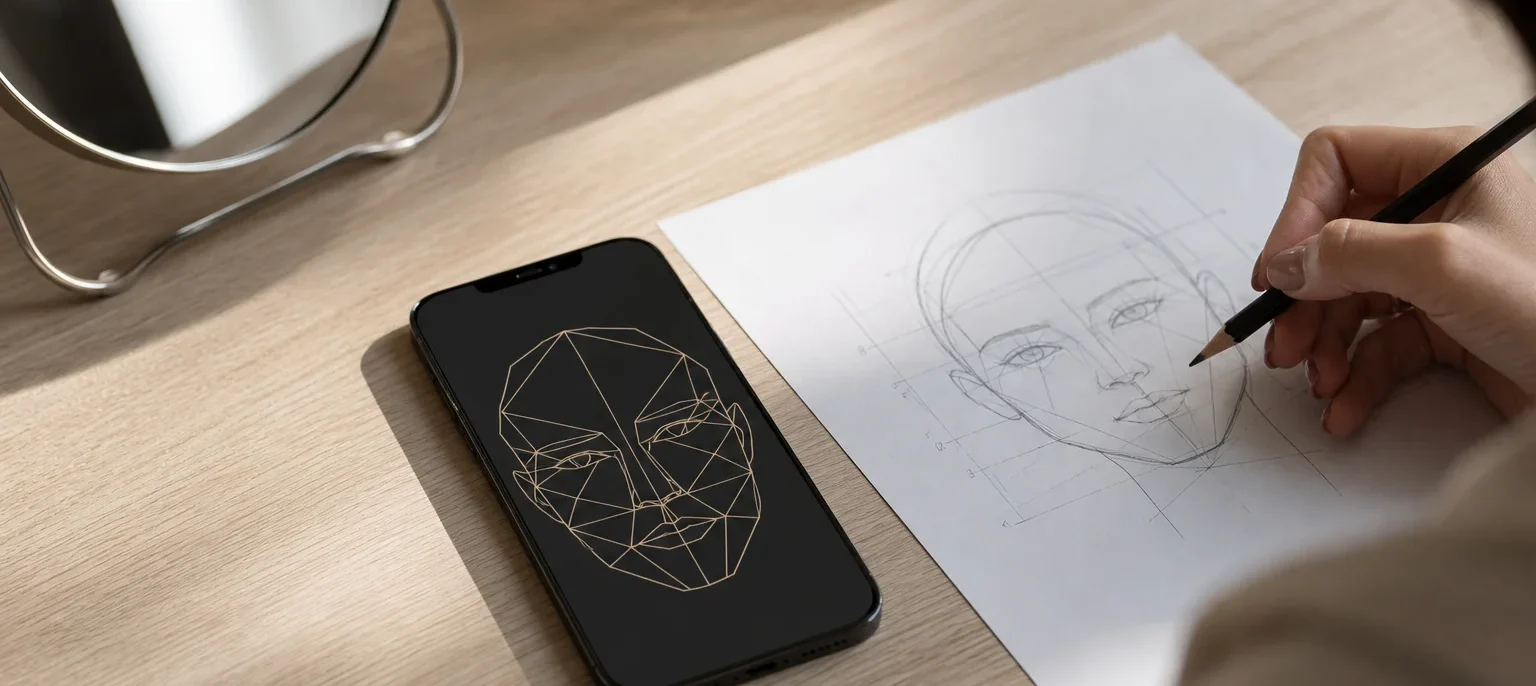
- Detecting the face in the photo or camera.
- Placing landmarks: jawline, chin, cheekbones, forehead, eyes, nose and mouth. Many models use dozens of points.
- Calculating proportions between the width of the forehead, cheekbones and jaw and the length of the face, which are compared with patterns such as oval, round, square, oblong, heart and diamond.
It is the same reasoning as the tape-measure method I teach in how to find your face shape, just automated.
Where AI helps visagism
- Speed: a first idea of your shape in seconds.
- Consistency: it always measures the same way, without guesswork.
- Visualisation: simulators help you imagine length, fringe and colour.
- Records: saved photos and measurements help compare changes over time.
- Education: an app can spark interest in understanding your own face.
Where a face shape app misleads
1. The photo decides the result
- Phone lens: the front camera, very close to the face, distorts proportions. The nose looks bigger and the sides smaller.
- Angle: a slightly tilted head changes how the jaw and forehead are read.
- Light: shadows erase or create contours.
- Hair: a fringe, volume and loose hair hide the hairline and jawline.
- Expression: a smile widens the face; a tense closed mouth emphasises the jaw.
The result: the same face can be given different shapes in different photos.
2. Real faces are mixed
Most people are not a "pure oval" or a "pure square". The app picks a category, but a visagism reading usually works with combinations, such as oval with a strong jaw or round with an elongated chin.
3. Shape is only one part
Visagism considers:
- features: straight or curved lines in the nose, mouth, eyes and brows;
- personality and temperament;
- lifestyle and profession;
- hair texture, density and behaviour;
- the message the person wants to convey.
No app measures that. The basics are in what visagism is and how it works.
4. Simulators do not understand real hair
A simulator pastes an image of hair over your photo. It does not take into account:
- shrinkage in curly and coily hair;
- density (fine hair will not give the volume in the picture);
- cowlicks and growth direction;
- the styling time the cut requires.
5. Built-in beauty standards
Many AI models were trained on image sets with limited diversity. This can lead to less accurate results for some skin tones, features and textures, and to recommendations that reinforce a single beauty standard.
Table: AI versus a visagism analysis
| Aspect | AI app | Visagism analysis |
|---|---|---|
| Face shape | Measures in seconds, sensitive to the photo | Measures, observes in person and confirms |
| Features and lines | Partial | Analyses every feature |
| Personality | Not assessed | Conversation and observation |
| Routine and profession | Not assessed | Central to the recommendation |
| Hair texture | Not assessed | Assessed in person |
| Reasons for the choices | Generic | Individual, with the reason for every choice |
How to use an app to your advantage
- Take the right photo: phone about 1 metre away, at eye level, with 2x zoom if possible; light from the front; hair tied back; neutral expression.
- Repeat 3 times on different days and compare the results.
- Confirm with a tape measure.
- Use the simulator for colour and length, not texture.
- Take the screenshots to the salon as a conversation starter, not as an order.
Beauty filters and self-image
There is another point worth attention. Many apps do not only measure: they alter the face. They slim the nose, enlarge the eyes, smooth the skin and "correct" the jaw. When the filter becomes the reference, the mirror starts to look wrong.
In visagism, the starting point is the opposite. The real face is the working material, and the features a person considers "flaws" are often exactly what gives the image personality. A strong jaw conveys firmness. A nose with strong lines conveys presence. The goal is not to erase, but to organise.
If you notice you spend a lot of time comparing your real face with the filtered one, it is worth taking a break. And if that discomfort affects your daily life, talking to a mental health professional is a legitimate form of care.
A quick test to check the app
Take 3 photos in different conditions: one with the front camera, about 30 cm away; another with the rear camera, about 1 metre away with 2x zoom; and a third with your hair down. If the app gives you 3 different shapes, you know how much the photo interferes. In that case, trust the tape measure and your own observation in the mirror more.
What about the privacy of your photo?
A photo of your face can generate biometric data. Laws such as the EU’s GDPR (article 9) and Brazil’s LGPD treat biometric data as a special or sensitive category of personal data. Before using an app:
- read the privacy policy;
- check whether the image is processed on the device or sent to servers;
- confirm you can delete your data;
- avoid apps that ask for access to your whole gallery without need.
The future: AI as a professional’s tool
The trend is for artificial intelligence to become a support tool in the salon: measuring, recording, simulating colour and organising a client’s history. The human eye remains responsible for the most important part: understanding who the person is and translating that into an image.
Professionals who master face reading and know how to use technology as support tend to offer clearer, more visual consultations.
Frequently asked questions
It depends. Apps measure proportions from points on the face, but the photo, light, angle, hair and expression change the result. They are a starting point, not a visagism diagnosis.
They help you picture length and colour, but usually do not reproduce texture, density, shrinkage and how hair really behaves. The salon result is often different.
No. AI is good at measuring and simulating. Visagism also considers personality, routine, profession, hair texture and the message the person wants to convey, which requires conversation and human reading.
Read the privacy policy. Biometric data is treated as sensitive personal data under laws such as Brazil’s LGPD and the EU’s GDPR. Prefer apps that process images on the device and let you delete your data.

An analysis that goes beyond the algorithm
An app can tell you your face is oval. A visagism analysis explains why a cut works for you, considering your features, your hair, your routine and what you want to communicate.
In the Visagism Consultation, I carry out that full reading, in person or online, and recommend cut, colour, make-up, glasses and accessories with the reason for each choice.
Are you a professional who wants to combine the visagism method with new tools? The Visagism & Personal Image Course teaches you to read the face and lead the consultation.
Nelma Faleiro holds a degree in Visagism and Hair Therapy from Universidade Anhembi Morumbi, where she lectured for 10 years, and received the SINVISA 2025 Award.