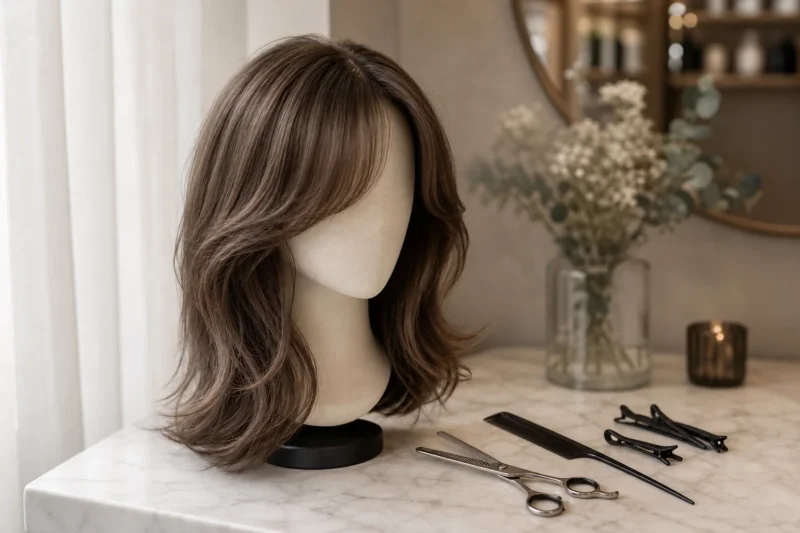
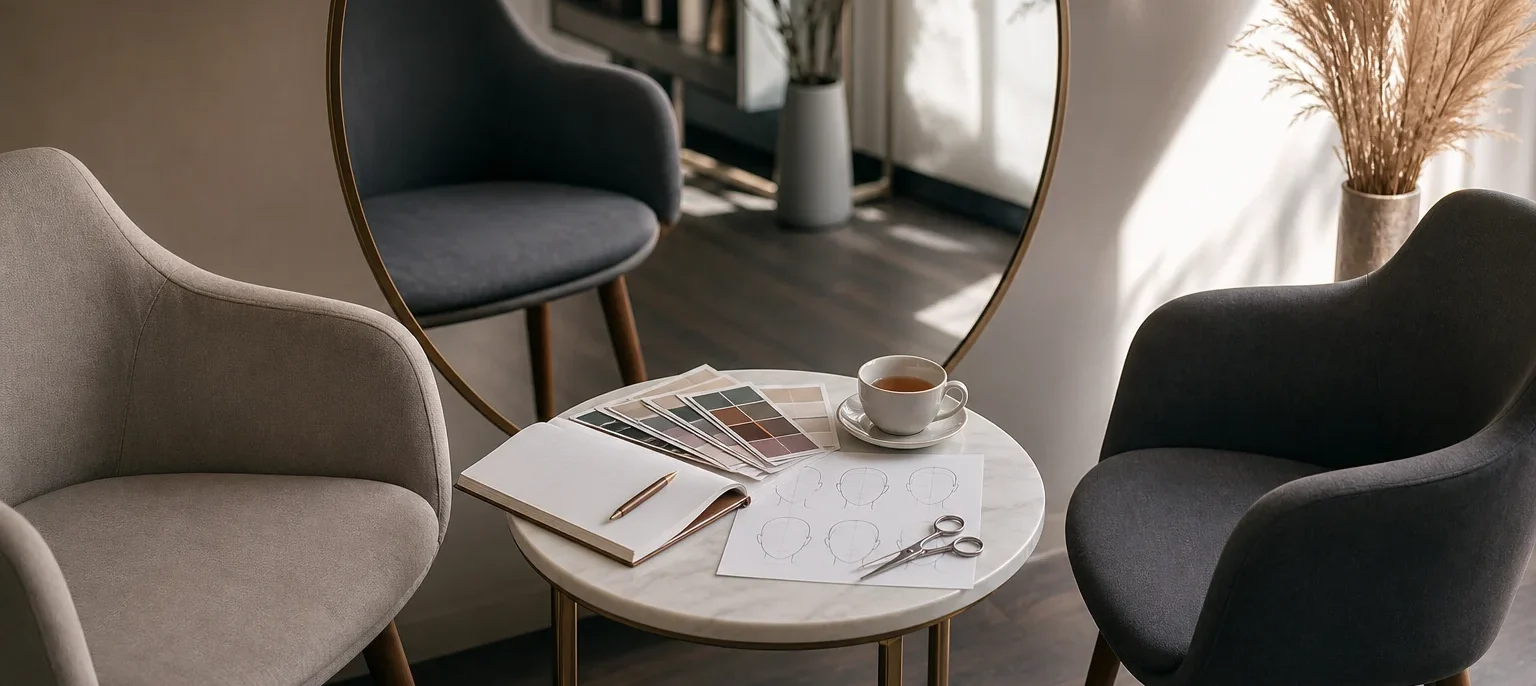
Quick answer: to know how to run a visagism consultation, follow six stages: a pre-session (form and photos), an interview about personality and goals, a reading of face and style, a reasoned proposal, carrying out or guiding the cut and colour, and aftercare with a report and follow-up. The difference lies in explaining the reason for each choice — that is what turns a haircut into a consultation.
Many professionals practise "visagism" intuitively: they look at the face, suggest a cut and get it right most of the time. A consultation is something else. It has a method, starts before the client sits in the chair and ends after she leaves the salon. Understanding how to run a visagism consultation step by step is what lets you repeat good results, charge fairly and build a reputation.
This guide shows the complete method, with timings, questions, deliverables and the most common mistakes.
What is a visagism consultation?
It is a structured service in which the professional analyses a person’s face, personality, style and routine to propose a coherent image — cut, colour, make-up, accessories — explaining the reason for each choice. Visagism starts from the idea that lines, shapes and colours communicate feelings, as I explain in what is visagism and how it works.
Stage 1: pre-session
Before the meeting, send a simple form and ask for photos:
- basic details and routine (work, time to get ready, sports);
- history of cuts, colours and chemical services;
- what the person likes and what they absolutely do not want;
- goal: what prompted the consultation (career change, fresh start, wedding, dissatisfaction);
- standardised photos: front, profiles, back, with the hair as worn day to day and tied back;
- visual references they love and ones they hate.
Estimated time to analyse the material: 30 to 60 minutes.
Stage 2: interview
This is the heart of the consultation. Set aside at least 30 to 45 minutes. Useful questions:
- "How would you describe yourself in three words?"
- "How would you like people to see you?"
- "What do you feel when you look in the mirror today?"
- "What would you never wear? Why?"
- "How much time do you spend on your hair each day?"
Listen more than you speak. Note words that repeat — they become the image keywords. This is also where the reading of temperaments in visagism comes in, always as a language, never as a label.
Stage 3: reading face, hair and style
Face
- shape and proportions (facial thirds, width of forehead, cheekbones and jaw);
- distinctive features (eyes, nose, mouth, brows);
- predominant lines: straight or curved;
- symmetries and asymmetries.
Hair
- texture, strand thickness, density, cowlicks;
- condition of hair and scalp (when there are signs of a problem, refer);
- natural behaviour, without styling.
Colouring and style
- contrast between skin, eyes and hair, undertone;
- the predominant style in clothes and accessories;
- coherence between what the person wears and what they said in the interview.
Stage 4: a reasoned proposal
The proposal brings everything together: interview keywords, face and hair reading, real routine. For each recommendation, explain the why:
| Recommendation | Visagism reason | Practical reason |
|---|---|---|
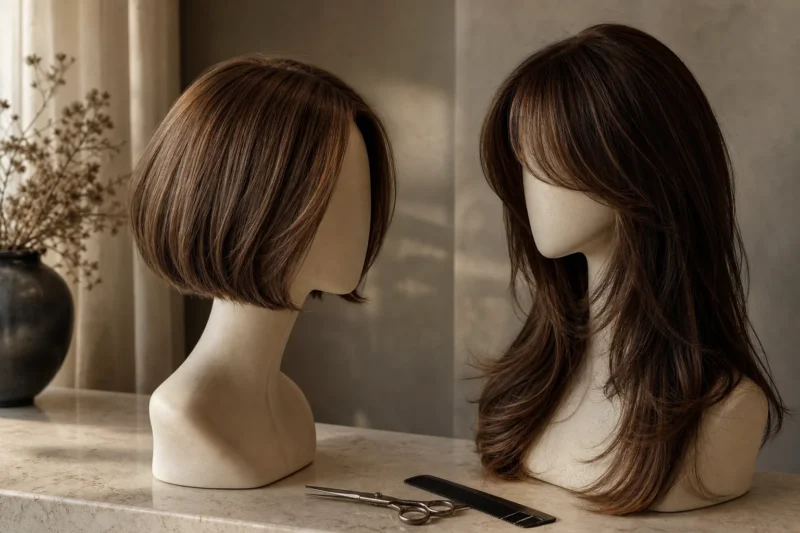
| Long bob ending 2 cm below the chin | Lengthens a round face and adds lightness | Works without a daily blow-dry |
| Curtain bangs | Softens a wide forehead | Easy to grow out if she dislikes them |
| Soft face-framing highlights | Warms the undertone and adds luminosity | Touch-up every 3 months |
Present the proposal with reference images and, when possible, simulate it with the hair pinned up or with clip-in bangs. Ask: "Does this feel like you?". If the answer is hesitant, adjust.
Stage 5: execution
If you carry out the cut and colour:
- record the technique on a sheet — see the template in haircut record sheet;
- decide the length with the client looking in the mirror, with dry hair;
- teach the styling during the appointment, with the products she will use.
If someone else will carry it out, the report must be clear enough to guide whoever cuts.
Stage 6: aftercare and the report
The report is what the client takes home. A good report includes:
- a summary of the interview and keywords;
- analysis of face, hair and colouring, with the client’s own photos;
- recommendations for cut, colour, make-up and accessories;
- the reason behind each choice;
- maintenance guidance and how to ask for the cut at another salon.
Deliver it within 7 days and schedule a follow-up in 30 to 60 days to adjust anything necessary. To set fees and packages, see visagism consultation pricing.
A consultation example, from start to finish
To visualise the method, a brief fictional case:
- Pre-session: 38-year-old lawyer, wavy hair, medium strands, no chemicals; always wears her hair tied back; wants to "look lighter without losing seriousness".
- Interview: recurring words — "practical", "confident", "approachable". A routine with 10 minutes to get ready.
- Reading: oval face with a defined jaw; predominantly straight lines; medium contrast; choleric trait with a secondary phlegmatic one.
- Proposal: a long bob with natural waves, ending 3 cm below the chin; soft layers only at the front; natural colour with discreet face-framing brightness; medium rounded earrings.
- Reason: the length and waves soften the jaw and add lightness; the cut’s outline keeps the firmness she wants at work; styling takes under 10 minutes.
- Aftercare: report delivered in 5 days; follow-up in 6 weeks to adjust the length.
Notice that every decision connects to something the client said. That traceability is what separates a consultation from a salon opinion.
Online consultations: what changes?
- photos need rigorous standardisation (natural light, neutral background, no filters);
- the interview can be done by video;
- the proposal is sent in writing and explained in a second call;
- the cut and colour are done by a local professional, guided by the report.
Ethics in visagism consultations
- Do not impose standards: the aim is to express who the person is, not to "correct" features towards a single ideal;
- Respect identity and natural texture: coily, curly and grey hair are starting points, not problems;
- Do not promise a life transformation: image helps, but it does not solve everything;
- Refer when there are signs of a scalp health problem or significant emotional distress.
This is the foundation of the method created by Philip Hallawell, presented on the Visagismo Hallawell website: image as an expression of identity.
Common beginner mistakes
- Skipping the interview and going straight to the cut;
- Choosing the cut from face shape alone;
- Ignoring routine and texture;
- Not explaining the reasons behind choices;
- Delivering a generic report, the same for every client;
- Not following up;
- Forgetting to get written permission to use photos.
Frequently asked questions
An in-person session usually lasts 1.5 to 3 hours, not counting preparation and producing the report. If it includes the cut and colour, it can run past 4 hours or be split into two appointments.
There is no legal requirement for a specific diploma, but solid visagism training is what provides method, repertoire and confidence in the reading and proposal. Without a method, the consultation becomes an opinion.
Yes. With standardised photos, video and a good interview, the analysis and proposal can be done remotely. The cut and colour are carried out by a local professional, guided by the report.
A report with a summary of the interview, the analysis of face and style, recommendations for cut, colour, make-up and accessories and the reason for each choice, plus maintenance guidance.
Learn the complete method
A visagism consultation is method, repertoire and listening. In the Visagism & Personal Image Course, you learn to run every stage — pre-session, interview, face reading, visual language, temperaments, proposal and report — and turn your service into a consultation.
I want to learn to run visagism consultations →
Want to experience it from the client’s side first? Discover the Visagism Consultation.
Nelma Faleiro holds a degree in Visagism and Hair Therapy Technology from Anhembi Morumbi University, where she taught for 10 years, and received the SINVISA 2025 Trophy at the 3rd International Visagism Seminar for "education, ethics and intention through Visagism".