Quick answer: everyday makeup for beginners fits into 10 minutes and five products when you follow the right order: prep the skin with moisturiser and sunscreen, even it out with a light foundation or concealer, define the brows, add colour with blush, open the eyes with mascara and finish the lips. Creams and liquids go on before powders. Everything else is detail.
In class, the most common complaint is not a lack of products — it is a lack of method. Many people have a full makeup bag and still leave home feeling "I don’t know what I’m doing". Makeup for beginners does not require runway technique: it requires order, small amounts and the right products for your skin.
In this step-by-step guide you will do a complete work look in 10 minutes.
What do you need to start?
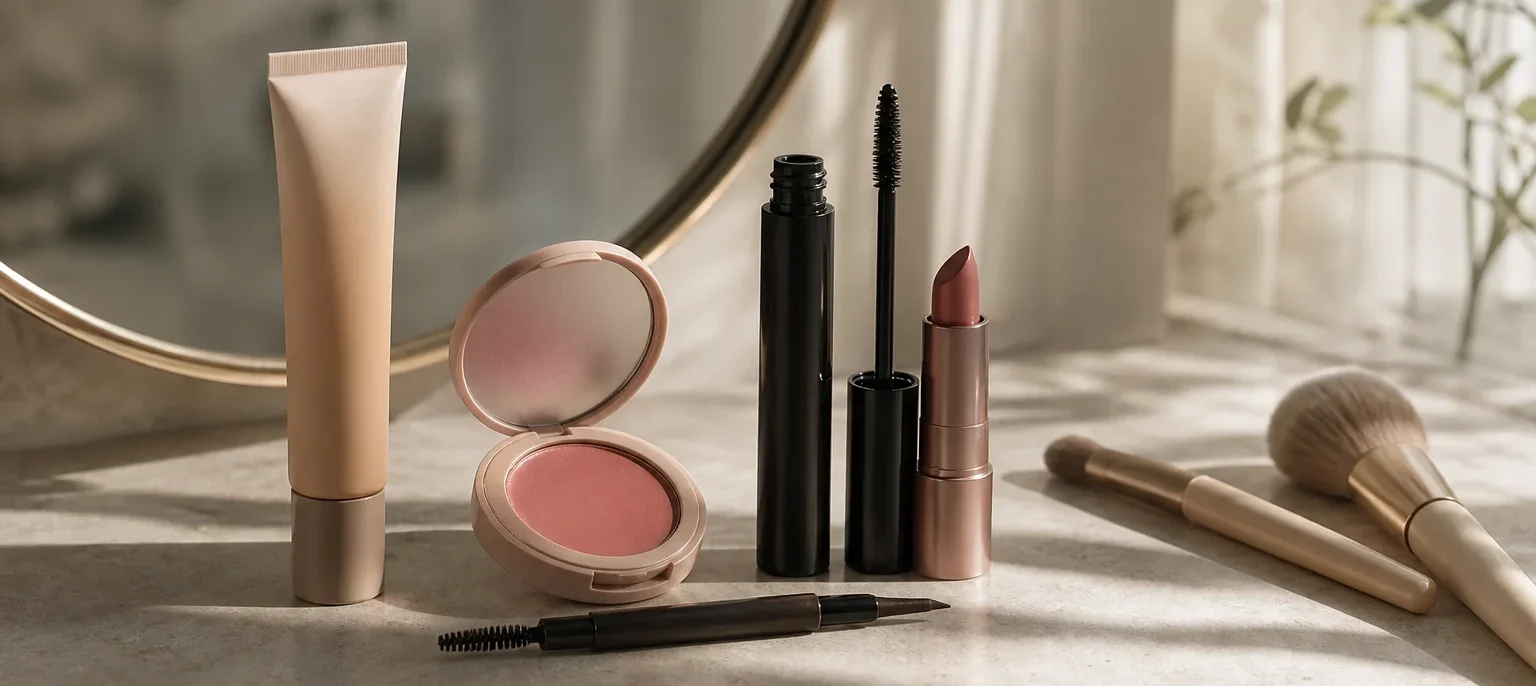
A lean kit covers the routine. The essentials:
| Product | Job | Multi-use alternative |
|---|---|---|
| Sunscreen | Protect and prep the skin | Tinted sunscreen (replaces a light foundation) |
| Light foundation or concealer | Even out skin tone | Concealer only, where needed |
| Brow pencil or gel | Frame the eyes | Brown shadow with an angled brush |
| Cream blush | Bring the face to life | Also works on the lips |
| Mascara | Open the eyes | — |
| Comfortable lipstick | Finish the look | Cream blush on the lips |
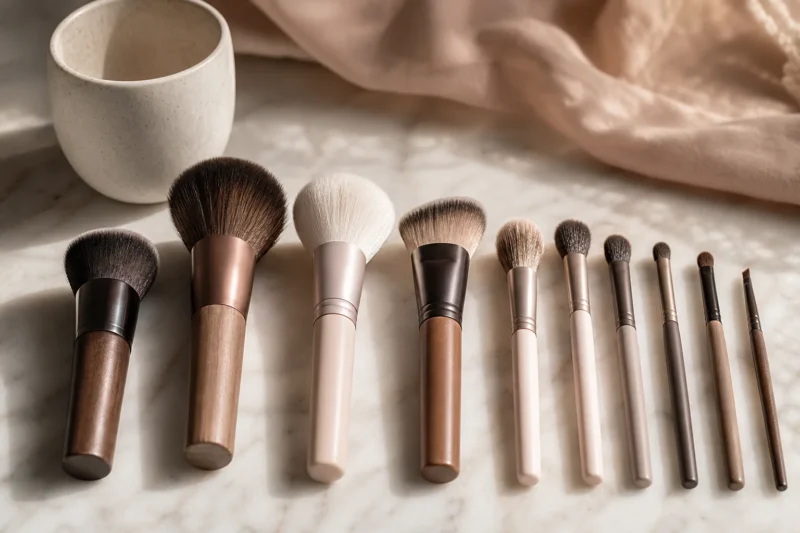
Plus two or three brushes. If you are not sure which, see the types of makeup brushes and the essential kit.
A 10-minute makeup routine, step by step
1. Prep the skin (2 minutes)
Wash your face, apply a moisturiser suited to your skin type and wait 1 minute. Then sunscreen. The American Academy of Dermatology recommends a broad-spectrum sunscreen with SPF 30 or higher, applied generously to all exposed skin. Makeup with SPF does not replace sunscreen, because we use very little of it.
2. Even it out (2 minutes)
Less is more. Put a light foundation only in the centre of the face — nose, cheeks, chin and forehead — and blend outwards with a brush or damp sponge. If your skin is even, skip the foundation and use only concealer:
- under the eyes, in an inverted triangle;
- at the sides of the nose, where redness is common;
- on individual blemishes, tapping it in.
Oily skin? Set the T-zone with a thin layer of powder.
3. Define the brows (1 minute)
Brows frame the face and change your expression. Brush the hairs upwards, fill only the gaps with short, hair-like strokes and brush again. Use a shade that matches or is slightly lighter than your hair.
4. Add colour with blush (1 minute)
Smile, apply cream blush on the apples of your cheeks and blend towards the temple with your fingers or a brush. A touch of the same product on the eyelids unifies the face.
5. Open the eyes (2 minutes)
For everyday wear, a neutral shadow (beige, taupe or light brown) on the lid, blended into the crease, is enough. Then mascara: start at the root, zigzag, and pull through to the tips. One coat for the day, two for the evening.
6. Finish the lips (1 minute)
A comfortable lipstick, a tinted balm or the cream blush itself. Shades close to your natural lip colour are the easiest to touch up without a mirror.
7. Check in natural light (1 minute)
Look at the result near a window. Bathroom light is deceptive: what looks blended there may look harsh outside. Check the jawline and the hairline, where foundation most often leaves a visible edge.
How do you adapt the routine to your face?
Small changes in placement change how proportions read:
- Round face: blush swept diagonally upwards and brows with a slightly defined arch.
- Long face: blush placed horizontally on the apples and straighter brows.
- Square face: rounded blush and brows with a soft curve.
To find your shape, take the test in how to find your face shape.
Which makeup routine suits each skin type?
The same routine calls for different products depending on your skin:
- Oily skin: a gel moisturiser, a matte or semi-matte foundation and translucent powder on the T-zone. Avoid very creamy blush and highlighter in the centre of the face, which increase shine through the day.
- Dry skin: a richer moisturiser, a luminous foundation and cream products. Powder only where essential, with a very soft brush.
- Combination skin: mix both strategies — a light moisturiser all over and powder only on the forehead, nose and chin.
- Sensitive skin: fewer products, fragrance-free formulas and a 48-hour patch test on the inner arm before using something new on the face.
- Mature skin: thin layers, creamy textures and little powder, which tends to settle into lines. Blush placed slightly higher on the cheek adds freshness.
If you are not sure of your skin type, look at your face 2 hours after washing without applying anything: shine all over suggests oily skin; tightness suggests dry skin; shine only on the T-zone, combination skin.
Quick variations: from work to evening
With the same products, you can change the effect in 3 to 5 minutes:
- Important meeting: more defined brows and a lipstick one shade darker convey firmness.
- After-work drinks: brown shadow smudged along the lower lash line and a second coat of mascara.
- Evening: a thin liner, highlighter on the high points of the face and a bold lip.
Common beginner mistakes
- Too much foundation. Excess settles into lines and pores and looks like a mask. A pea-sized amount is usually enough for the whole face.
- Powder on dry skin. It makes flakiness more visible; use it only where you shine.
- The wrong foundation shade. Test it on your jaw, not your hand, and check it in natural light.
- Block brows. Filling everything with a dark colour hardens the expression.
- Skipping sunscreen. It is the most important long-term step for your skin.
- Sleeping in makeup. Remove everything at night with a suitable remover and a gentle cleanse.
How do you make makeup last?
A few habits extend wear over an 8- to 10-hour day:
- let moisturiser and sunscreen absorb before foundation;
- use thin layers instead of one thick one;
- set the T-zone with translucent powder;
- choose waterproof mascara and liner on hot days;
- carry blotting paper and your lipstick for touch-ups.
Makeup hygiene
Makeup products have a shelf life once opened, usually shown by a small open-jar symbol with a number and the letter "M" (for months). Mascaras typically last 3 to 6 months after opening. Do not share eye products and wash your brushes often.
Frequently asked questions
Moisturiser and sunscreen, foundation or skin tint, concealer, powder (if needed), brows, blush, eyes (shadow, liner and mascara) and lips. Liquids and creams go on before powders.
Five products cover everyday life: a light foundation or concealer, a cream blush that also works on the lips, a brow pencil or gel, a mascara and a comfortable lipstick. Sunscreen comes before everything.
It is not essential. Primer helps on very oily skin (to control shine) or with visible pores. For most skin types, a good moisturiser and sunscreen already prepare the skin.
Prep the skin, use little foundation, set the T-zone with a thin layer of powder and choose long-wear products for the eyes. Carry a lipstick and blotting paper for touch-ups.

Learn with your own hands and products
A step-by-step guide helps, but nothing replaces guided practice. In the Self-Makeup Class, a 3-hour hands-on session, you learn skin prep, a work look, a smoky eye and highlighter with your own products, and find out what is worth keeping in your makeup bag.
I want to take the Self-Makeup Class →
Want to understand which makeup, hair and clothing colours work with your face? The Visagism Consultation provides that complete reading.
Nelma Faleiro holds degrees in Visagism and Hair Therapy Technology and in Aesthetics and Cosmetics from Anhembi Morumbi University, where she taught for 10 years.