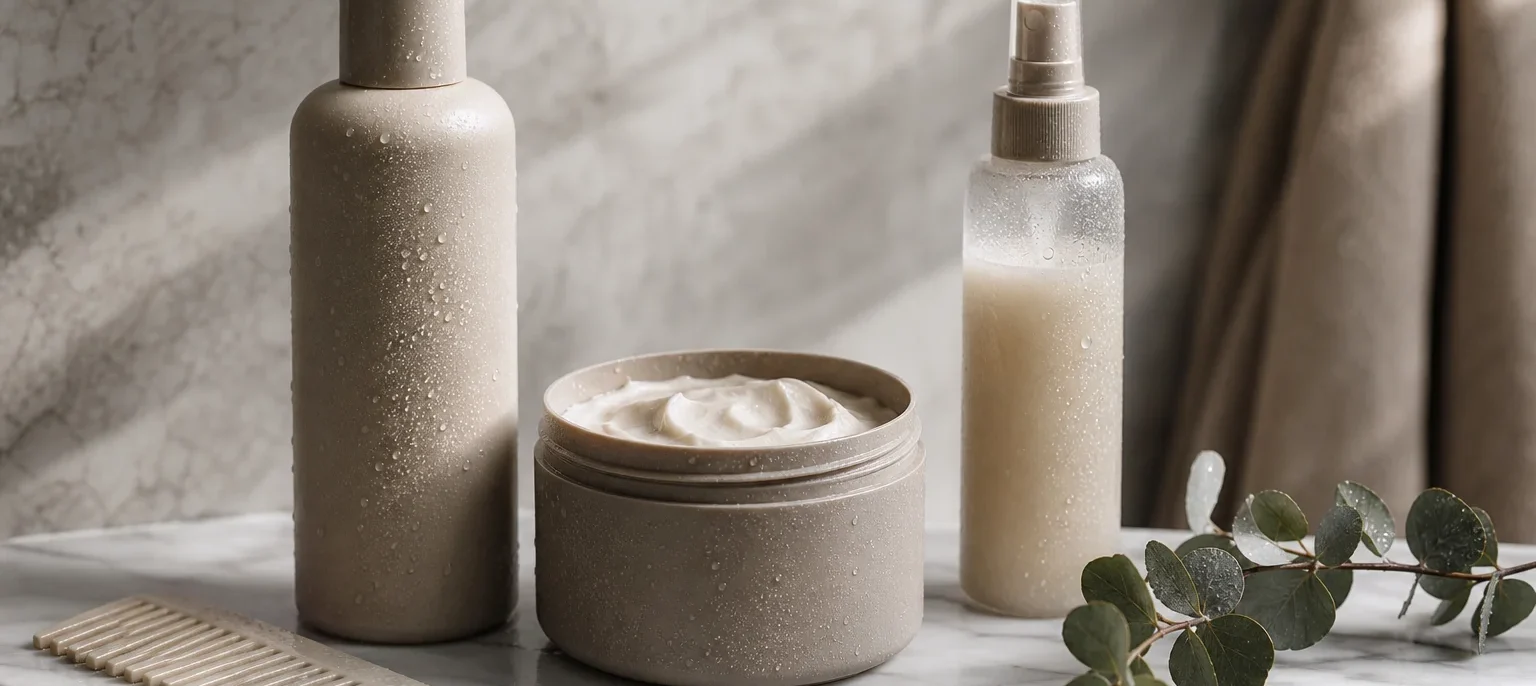
Quick answer: in the hair mask vs conditioner question, both share the same family of ingredients but have different jobs. Conditioner is light, works in 1 to 3 minutes and is for every wash: it detangles and smooths the cuticle. A mask is more concentrated, works in 5 to 20 minutes and treats 1 to 2 times a week. Leave-in stays in after the shower and protects through the day. One does not replace the other in every case.
On the shelf, everything is "intense hydration", "deep nourishment", "repair". No wonder many people use conditioner, mask and leave-in with the same promise, paying three times for the same effect — or thinking they are treating their hair when they are only detangling it. Understanding hair mask vs conditioner (and where leave-in fits) is the simplest way to build a routine that works.
Hair mask vs conditioner: what does each product do?
| Conditioner | Mask | Leave-in | |
|---|---|---|---|
| When to use | Every wash | 1 to 2 times a week (or more for dry hair) | After the shower, on damp or dry hair |
| Contact time | 1 to 3 minutes | 5 to 20 minutes | Stays in |
| Rinse | Yes | Yes | No |
| Concentration | Lighter | More concentrated | Light to medium |
| Main job | Detangle, smooth the cuticle, reduce static | Treat: restore water, lipids or protein | Protect from friction, control frizz, prep styling |
Conditioner
After shampoo, the cuticle is more open and the hair carries a negative charge. Conditioner, with cationic (positively charged) agents, binds to the hair, reduces static and friction and closes the cuticle. The review Hair cosmetics: an overview, in the International Journal of Trichology, describes this mechanism as the basis of conditioning products.
Mask
In practice, a mask is a more concentrated conditioner, with more emollients, oils, humectants or proteins, depending on its purpose. That is why it needs more contact time and is usually used less often. Masks generally fall into three functions: hydration, nourishment and reconstruction — see how to alternate them in does a hair treatment schedule work?.
Leave-in
A no-rinse product that protects hair through the day and prepares it for styling. It does not replace conditioner, because it does not do the same job in the shower. See the right amount and texture in leave-in conditioner: how to use it.
Can you swap one for another?
- Mask instead of conditioner: works well on dry, curly, coily and chemically treated hair. On fine, straight hair, it can weigh it down if used at every wash.
- Conditioner instead of a mask: leaving conditioner on longer helps a little, but it does not have the same concentration of actives.
- Leave-in instead of conditioner: no. Hair is rougher to detangle and more exposed to friction in the shower.
- Conditioner as a leave-in: with curls and coils, some people leave a little conditioner in. It works with light formulas and small amounts; on fine hair, it weighs it down.
How do you build a routine without doubling up?
A minimal routine (no chemical treatments, medium strands)
- Shampoo on the roots;
- Conditioner from mid-lengths to ends at every wash;
- A mask once a week, instead of conditioner;
- A light leave-in on the ends if there is frizz.
A routine for dry, curly or coily hair
- Pre-poo with oil or conditioner (optional);
- Mild shampoo on the roots;
- A mask at almost every wash, alternating functions;
- More leave-in, followed by cream or gel.
A routine for fine hair with an oily scalp
- Shampoo for oily scalps;
- A light conditioner on the ends only;
- A light mask every 10 to 15 days;
- Spray leave-in, a small amount, or none.
How much of each should you use?
A practical starting point to adjust:
| Length | Conditioner | Mask | Leave-in |
|---|---|---|---|
| Short (up to the chin) | 1 teaspoon | 1 teaspoon | Pea-sized |
| Medium (to the shoulders) | 1 to 2 teaspoons | 2 teaspoons | Hazelnut-sized |
| Long (below the shoulders) | 1 tablespoon | 1 to 2 tablespoons | 1 to 2 teaspoons |
Thick, curly and coily hair usually needs more; fine hair, less. If your hair dried heavy, use less next time; if it felt rough, use a little more or leave it on 2 to 3 minutes longer.
How long does each pack last?
With proper use, a 300 ml conditioner usually lasts 4 to 8 weeks for medium hair, and a 250 g mask 6 to 10 weeks if used 1 to 2 times a week. If bottles run out very quickly, you may be using too much.
What about porosity?
Porosity — how easily hair absorbs and loses water — changes the choice. Low-porosity hair, with a tighter cuticle, gets weighed down by very rich masks and responds better to light formulas with gentle heat. High-porosity hair, common with chemical treatments or lots of sun, absorbs quickly and loses water quickly: it benefits from more frequent masks and a leave-in that seals in moisture. Learn to identify yours in hair porosity.
How do you read labels to avoid paying twice?
Compare the first ingredients of the conditioner, mask and leave-in you already own. If they are almost the same, you are buying the same product in different packaging. See the step by step in hair product labels.
How do you apply them correctly?
- Squeeze out excess water before conditioner or mask: the product spreads better and does not run off;
- Apply from ear level down, never on the roots;
- Detangle with your fingers or a wide-tooth comb with the product in;
- Respect the time on the label: longer does not always mean more effect;
- Gentle heat, such as a thermal cap, can help a mask work;
- Rinse well, without leaving excess residue.
See the full sequence in how to wash your hair properly.
Signs you are overdoing it
- Heavy, flat, greasy-looking hair: too much nourishing mask or conditioner on the roots;
- Limp, "mushy" hair and undefined curls: too much hydration;
- Rough, stiff, breaking hair: too many protein masks;
- An itchy or flaky scalp: product on the roots or insufficient rinsing.
Common myths
"The longer the mask stays on, the better." Past the recommended time, the gain is small.
"An expensive mask fixes damaged hair." Masks improve appearance and behaviour, but very damaged ends need a trim.
"Conditioner makes hair fall out." No. The hairs that come out when rinsing were already loose.
"I need the whole line from the same brand." No. What matters is each product’s function.
Frequently asked questions
In many cases, yes, especially for dry, curly or chemically treated hair. But masks are usually richer and, used at every wash on fine hair, they can weigh it down. Conditioner is lighter and designed for daily use.
Usually not. The mask already does the conditioning job. Some people use a little conditioner afterwards to help detangling, but it depends on the product and the hair.
As a reference, 1 to 2 times a week for most hair, and more often for very dry, curly, coily or chemically treated hair. Too much can make hair heavy or, with protein masks, stiff.
No. Conditioner works in the shower and is rinsed out; leave-in stays in the hair and protects it through the day. They complement each other.
Fewer products, better results
If your bathroom holds ten bottles and your hair still is not how you would like, the problem may not be a lack of products. In the Hair & Scalp Therapy Consultation, I assess your scalp and hair with trichoscopy and build a lean routine with the right amount and frequency for each product — no duplication and no waste.
I want a simple, effective routine →
A beauty professional? The Practical Trichology e-book explains hair structure and the logic of cosmetics so you can guide clients confidently.
Nelma Faleiro holds a specialisation in Cosmetic Trichology (Faculdades Oswaldo Cruz) and degrees in Visagism and Hair Therapy Technology and in Aesthetics and Cosmetics from Anhembi Morumbi University, where she taught for 10 years.