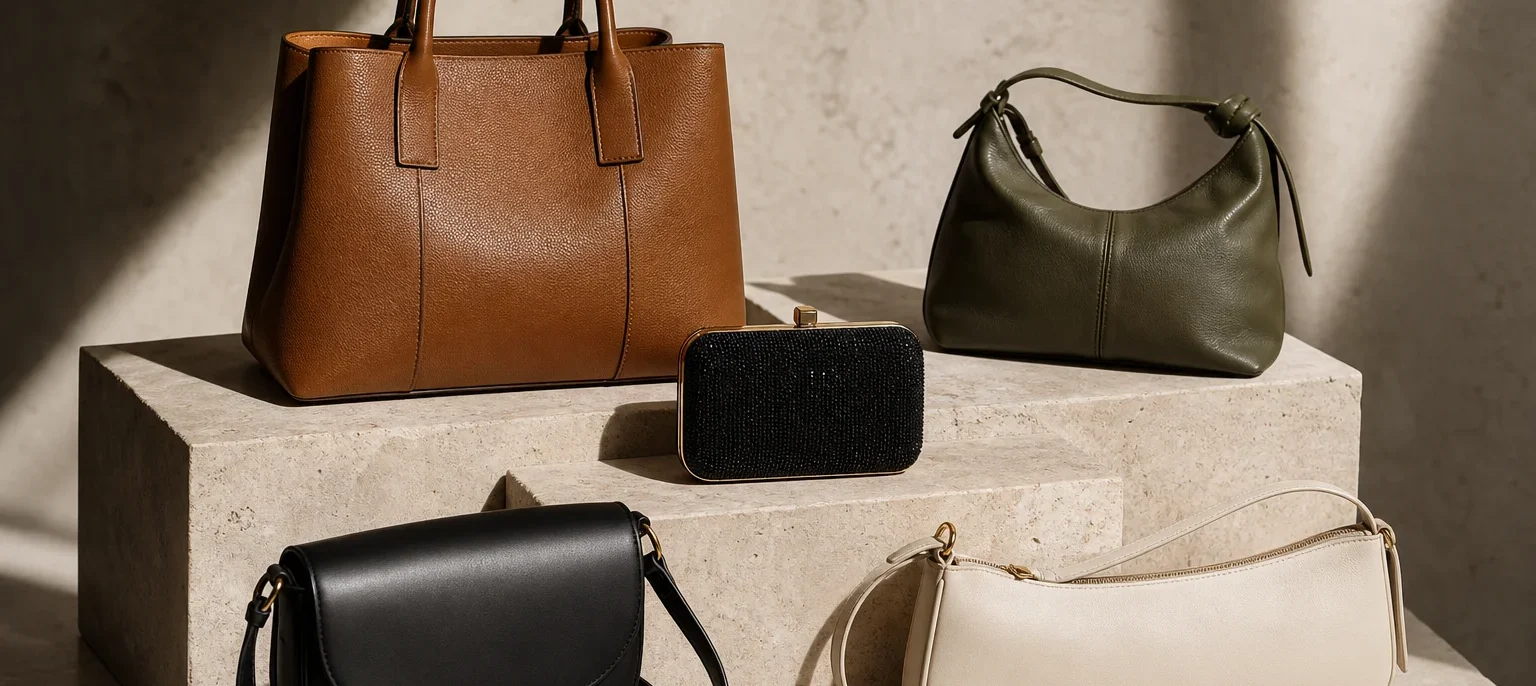
Quick answer: the main types of bags are the tote, shopper, satchel (structured top-handle bag), clutch, crossbody, baguette, hobo and backpack. The choice depends on three factors: occasion, how much you need to carry and proportion to your body. A big bag on a small frame weighs the silhouette down; a tiny bag on a tall frame disappears. The height at which the bag sits also changes how the outfit reads.
The bag is the accessory we use most and analyse least. We buy it for the colour, the brand or the sale, and later find it does not fit the laptop, disappears against the body or clashes with half the wardrobe. Knowing the types of bags — and understanding scale, line and occasion — solves much of that.
In this guide you will see the main models, when to use each one and how to choose by your proportions.
What are the main types of bags?
| Type | What it looks like | Occasion | Capacity |
|---|---|---|---|
| Tote | Large, open or zipped, two shoulder straps | Work, travel, everyday | High (fits a laptop) |
| Shopper | A soft tote, usually canvas or soft leather | Casual, beach, shopping | High |
| Satchel | Structured, top handle and long strap | Work, meetings | Medium |
| Clutch | No strap or a thin chain, carried in the hand | Parties, weddings, evening | Minimal |
| Crossbody | Small to medium, long strap across the body | Commuting, travel, leisure | Low to medium |
| Baguette | Elongated, short strap under the arm | Dinners, outings | Low |
| Hobo | Soft, half-moon shape, slouches on the shoulder | Casual, weekends | Medium to high |
| Backpack | Two straps on the back | Walking commutes, travel | High |
| Belt bag | Worn at the waist or across the chest | Outdoor events, travel | Minimal |
Structured versus soft bags
Beyond the model, structure matters. Structured bags, which hold their shape even when empty, have straight lines and convey organisation, formality and firmness. Soft bags, which follow the body, have curved lines and convey lightness and ease. It is the same language of lines that visagism applies to haircuts, as I explain in what is visagism and how it works.
When should you use each type of bag?
- Formal work: a satchel or structured tote in a neutral colour. The structure reinforces an organised image.
- Creative work: a tote or hobo in soft leather, with texture or colour.
- Walking or public transport: a crossbody or backpack, which frees your hands and sits in front of the body.
- Dinner: a baguette, a small shoulder bag or a mini crossbody.
- Wedding, graduation, black tie: a clutch or minaudière (the rigid clutch, usually metallic or embellished).
- Travel: a large tote for the flight and a small crossbody for sightseeing.
- Weekend and beach: a shopper, a straw basket, a hobo.
A practical rule: the more formal the occasion, the smaller and more structured the bag. The more casual, the larger and softer it can be.
How do you choose a bag by body proportion?
A bag has scale — and scale is always measured against something. In this case, your body.
Petite women
- Choose small to medium bags, around 20 to 30 cm wide.
- The bag should end at the waist or high hip. Very long straps that drop the bag to mid-thigh cut the leg and shorten the silhouette.
- Short crossbody bags and baguettes work very well.
Tall women
- Medium to large bags, such as totes and hobos, look proportionate.
- Mini bags can look "toy-like" if they are the only small piece in the outfit — wear them intentionally, as a detail.
Wider hips
- Avoid bags that end exactly at hip level, because they add volume there.
- Choose short straps (a bag under the arm, above the waist) or straps that place the bag a little below the hip.
Broad shoulders
- Soft bags with curved lines soften the upper body.
- Very structured bags tucked under the arm emphasise shoulder width.
Colour, material and hardware: what to look for
A well-chosen bag serves many outfits. When investing, consider:
- Colour: black, camel, cognac, off-white and grey are the most versatile neutrals. A coloured bag works as a highlight in monochrome outfits.
- Material: leather and good-quality materials age better. Canvas and nylon are light and practical for everyday use.
- Hardware: gold metals warm a look; silver cools it. Match the jewellery you wear most.
- Lining and pockets: a bag with no compartments becomes a "black hole". At least one inner zip pocket makes a difference.
- Empty weight: a bag that already weighs 1 kg empty will be too heavy when full. Hold it before buying.
Bags, style and personality
The bag talks to your dominant style. The classic dresser picks satchels and structured totes in smooth leather; the romantic, bags with chain straps, bows and pale tones; the boho, straw, fringe and raw leather; the rock, black leather, studs and visible hardware; the minimalist, geometric shapes with no logo. If you are still discovering yours, read fashion styles: which one is yours.
Heavy bags and health: practical care
Carrying a lot of weight on the same shoulder every day can cause discomfort in the neck, shoulders and back. Writing about backpacks, the American Academy of Orthopaedic Surgeons recommends wide, padded straps and using both shoulders to spread the load — a logic that also applies to large bags. A few simple habits:
- switch shoulders during the day;
- prefer wide straps to thin ones;
- empty your bag once a week;
- on long commutes, use a backpack or crossbody.
Persistent pain calls for assessment by a doctor or physiotherapist.
How many bags do you really need?
For most routines, 4 bags cover around 90% of occasions:
- a neutral, structured medium bag (work and appointments);
- a tote or backpack (heavy-load days and travel);
- a small crossbody (leisure and commuting);
- a clutch or party bag.
Beyond that, extra bags are an expression of style — and that is fine, as long as they work with your wardrobe.
How do you make a bag last for years?
A good leather bag, well looked after, stays with you for 10 years or more. A few habits:
- Store it stuffed (with ink-free paper or a small cushion) so it keeps its shape;
- Use the dust bag, which protects from dust and light;
- Condition the leather every 3 to 6 months with a suitable product;
- Let the bag rest one or two days a week, rotating with another;
- Avoid direct sun and damp, which dry out and stain leather.
Check straps and hardware at least 1 time a year: a small repair at a cobbler costs far less than a new bag.
Frequently asked questions
A structured medium bag in leather or a similar material and a neutral colour, with a top handle and a removable long strap. It goes from work to dinner and can be worn crossbody on commuting days.
Small to medium bags that end at waist or high-hip level. Very large bags, or straps that drop the bag to mid-thigh, shorten the silhouette.
A clutch or a small handbag with a refined finish such as satin, metallic leather or embroidery. It should hold the essentials: phone, ID, lipstick and a key.
Carrying a lot of weight on the same shoulder every day can cause discomfort in the neck, shoulders and back. Switch sides, choose wide straps and carry less. If pain persists, see a doctor or physiotherapist.
Your image, piece by piece
A bag is only part of the message. When haircut, colours, clothes and accessories speak the same language, the image gains coherence. In the Visagism Consultation, I analyse face, proportions, style and routine to guide choices of hair, colour and accessories, explaining the reason behind each one.
I want an image that matches who I am →
An image consultant or beauty professional? The Visagism & Personal Image Course teaches you to read proportion, line and scale to guide clients.
Nelma Faleiro holds a degree in Visagism and Hair Therapy Technology from Anhembi Morumbi University, where she taught for 10 years, and received the SINVISA 2025 Trophy at the 3rd International Visagism Seminar.