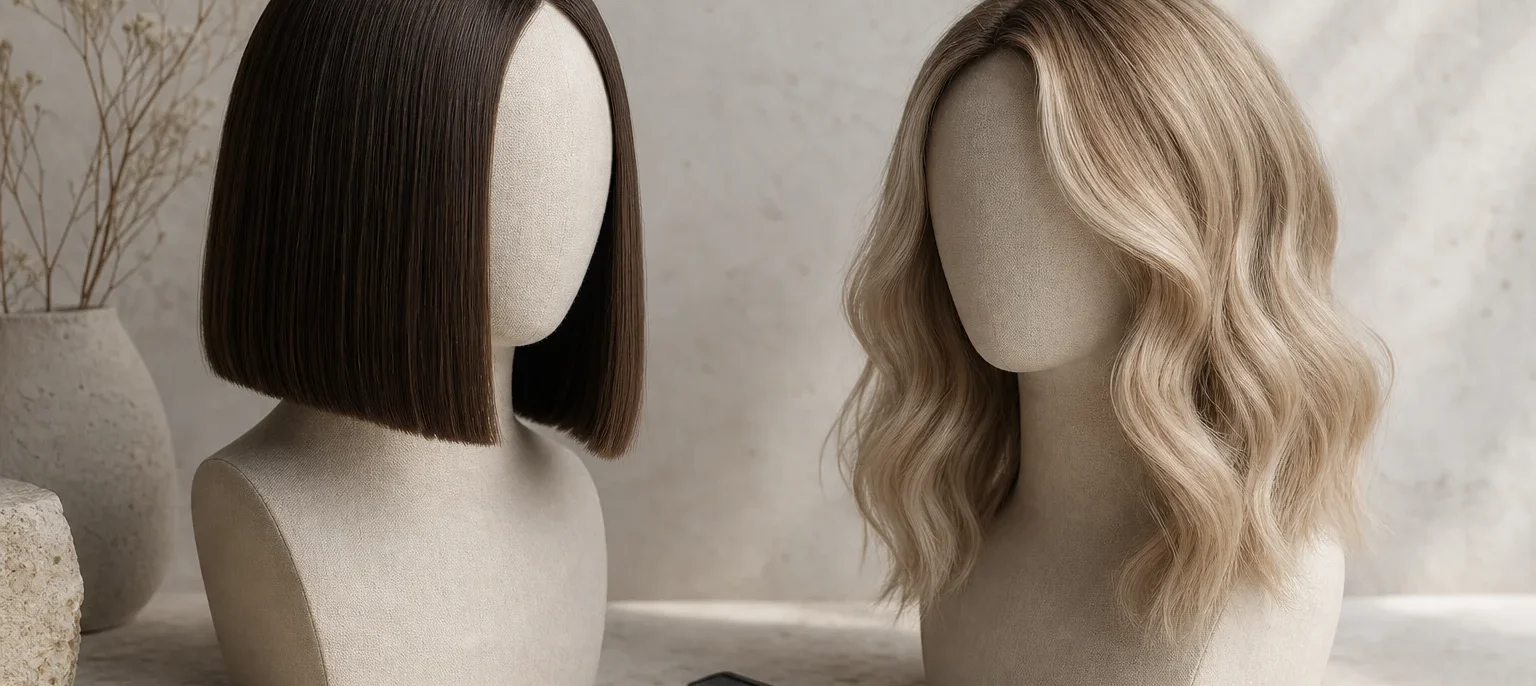
Quick answer: in visagism, visual language is the set of signals that lines, shapes, colours and textures send before you speak. Straight lines and defined outlines communicate seriousness and firmness; curves and waves, lightness and warmth; angles and asymmetry, dynamism. By adjusting cut, volume, colour and styling, you choose the message for each occasion — without ceasing to be yourself.
Before you say "good morning" at a job interview, the recruiter has already formed a first impression. Hair frames the face and is one of the first things the eye registers. Visagism works with this visual language consciously: instead of letting your hair speak by accident, you decide what it communicates.
In this guide you will understand how line, volume, colour and texture convey seriousness, credibility or lightness — and how to adjust them for each situation.
What is visual language in visagism?
Visual language starts from a principle of perception: the brain associates shapes with feelings. The artist and researcher Philip Hallawell, one of the main references in visagism, organised these associations to apply them to personal image. Learn more about his method on the Visagismo Hallawell website.
The basic associations:
| Element | Most common feeling | In hair |
|---|---|---|
| Horizontal straight line | Stability, calm | Blunt fringe, chin-length cut |
| Vertical straight line | Strength, authority, elegance | Long straight hair, high ponytail |
| Curved line | Softness, warmth | Waves, curls, rounded layers |
| Diagonal line | Movement, dynamism | Side fringe, asymmetric cut |
| Sharp angle | Boldness, energy | Choppy ends, textured pixie |
| High contrast | Impact, presence | Dark base with strong light streaks |
| Low contrast | Discretion, harmony | Colour close to skin and eyes |
This is not a fixed rule: it is a tendency in how we read images. Cultural context and each person’s personality change the result — which is why visagism always starts with a conversation, as I explain in what is visagism and how it works.
How do you convey seriousness with your hair?
Seriousness is linked to stability, control and precision. In hair, that translates into:
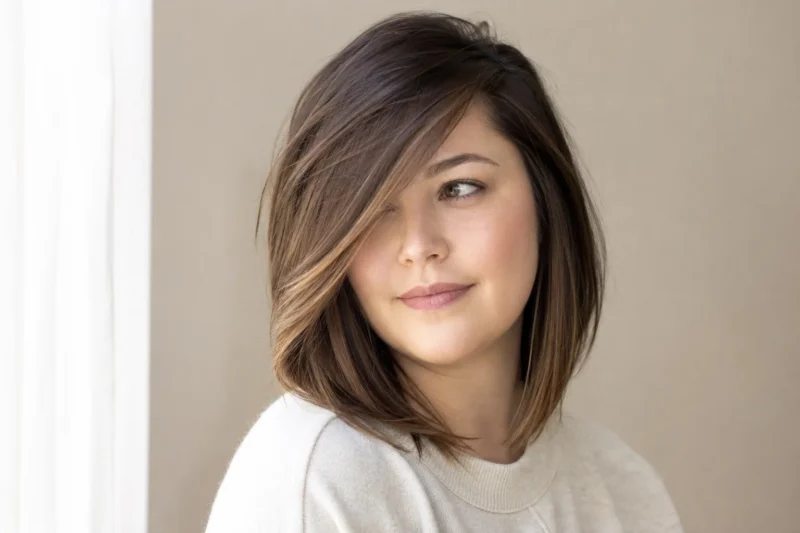
- Straight lines and defined outlines: a blunt bob, a chin-length cut with aligned ends, long hair cut straight;
- A polished finish: aligned strands, no visible frizz;
- Controlled volume: nothing too high on top or spread wide at the sides;
- Sober, even colours: browns, blacks, natural blondes without excessive contrast;
- Low updos: a low bun, a ponytail at the nape.
Beware of overdoing it
Too much seriousness becomes rigidity. Hair pulled very tight, tied firmly and with no movement can convey coldness and distance. A small curve — a soft wave at the ends, a side fringe — keeps the firmness without closing the image off.
How do you convey credibility?
Credibility is not the same as seriousness. It depends on coherence: the image has to match what the person says and does. The elements that help most:
- Visible care. An up-to-date cut, touched-up roots, healthy ends. Neglect reads as a lack of attention to detail.
- Harmony with the face. A cut that respects the face’s proportions looks natural. Find yours in how to find your face shape.
- Authenticity. Well-kept natural texture conveys more confidence than a chemical treatment that does not fit your routine.
- Fit with the setting. A lawyer, a doctor and a designer can be equally credible with very different images.
How do you convey lightness and approachability?
Lightness and warmth come from curves and movement:
- Defined waves and curls, with balanced volume;
- Layers that add movement to the ends;
- Curtain bangs or a light fringe, which soften the forehead;
- Colours with luminosity: soft reflections, face-framing highlights;
- Loose or half-up styles, with a few free strands.
This is the most suitable language for caring and client-facing professions, such as health, education and therapies — or for anyone who wants to look more approachable.
Which message suits each occasion?
The same person can adjust the language to the moment without changing their cut:
Job interview
Research the company’s environment. In more formal fields, aligned hair worn low or loose and polished. In creative environments, well-defined natural texture and a personal detail show authenticity.
Talk or stage
A visible face is essential: avoid strands falling over the eyes. A little volume on top adds presence, and the contrast between hair and background needs thought under strong lighting.
Negotiation meeting
Defined lines and a controlled finish reinforce firmness. Save the looser waves for drinks afterwards.
Serving clients and patients
Curves, movement and soft colours bring people closer. Hair tied up with a few loose strands conveys care without distance.
Colour, contrast and message
Colour speaks too. In general terms:
- High contrast between hair and skin (very dark hair on fair skin, for example) tends to convey presence and authority;
- Low contrast conveys softness and discretion;
- Warm tones (golden, copper) warm up and bring people closer;
- Cool tones (ash, platinum) communicate modernity and a certain distance.
Colour changes call for an analysis of skin undertone and realistic upkeep. A colour that needs a touch-up every 3 weeks does not suit someone short on time.
How long does a new image take to "settle"?
Changes in visual language need an adjustment period, for you and for the people around you:
- First 7 days: feeling strange in the mirror is normal, even when the change was right;
- From 2 to 4 weeks: the cut settles, you learn to style it and people get used to it;
- Up to 3 months: colour and length changes show their real result, with upkeep built into your routine.
That is why it is best to avoid big changes on the eve of an important event. If the interview or talk is 10 days away, adjust styling and updos and leave the new cut for later. A good practice is to test the event hairstyle 1 week ahead, photographing it from the front and in profile, in the light you will be seen in.
The limits of visual language
Two important caveats:
- Visual language is not a stereotype. There is no "serious person’s hair" that applies to everyone. The reading depends on culture, setting and, above all, coherence with the person.
- Image does not replace substance. Visagism aligns appearance and message, but credibility is confirmed through behaviour and competence.
An ethical point: visagism should never be used to hide someone’s identity or impose a standard. Coily, curly, grey or coloured hair can convey seriousness — it all depends on shape, care and intention.
Frequently asked questions
It is the idea that every element of an image — line, shape, colour, texture, volume — conveys a feeling. Straight lines communicate firmness; curves, softness; diagonals, dynamism. Visagism uses this language so that appearance expresses what the person wants to communicate.
Cuts with defined lines and a careful finish, such as a blunt bob, a chin-length cut with aligned ends or long, polished hair, tend to convey organisation and seriousness. Most important, though, is coherence with personality and the professional setting.
No. Natural texture does not reduce credibility. What conveys seriousness is a well-defined shape, care and coherence. Curls with a structured cut, balanced volume and definition convey firmness and authenticity.
Yes. Styling, updos and accessories change the reading a lot. The same hair in a low, polished bun communicates formality; worn loose with waves, lightness.
Discover what your hair is communicating
Sometimes the image you project is not the one you want to project — and it is hard to see that on your own in the mirror. In the Visagism Consultation, I talk with you about personality, goals and routine, analyse your face and hair and recommend the cut, colour and styling that communicate what you want, with the reason behind each choice. In person or online.
I want my image to match my message →
A beauty professional? The Visagism & Personal Image Course teaches visual language applied to cut and colour, turning a service into a consultation.
Nelma Faleiro holds a degree in Visagism and Hair Therapy Technology from Anhembi Morumbi University, where she taught for 10 years, and received the SINVISA 2025 Trophy at the 3rd International Visagism Seminar for "education, ethics and intention through Visagism".