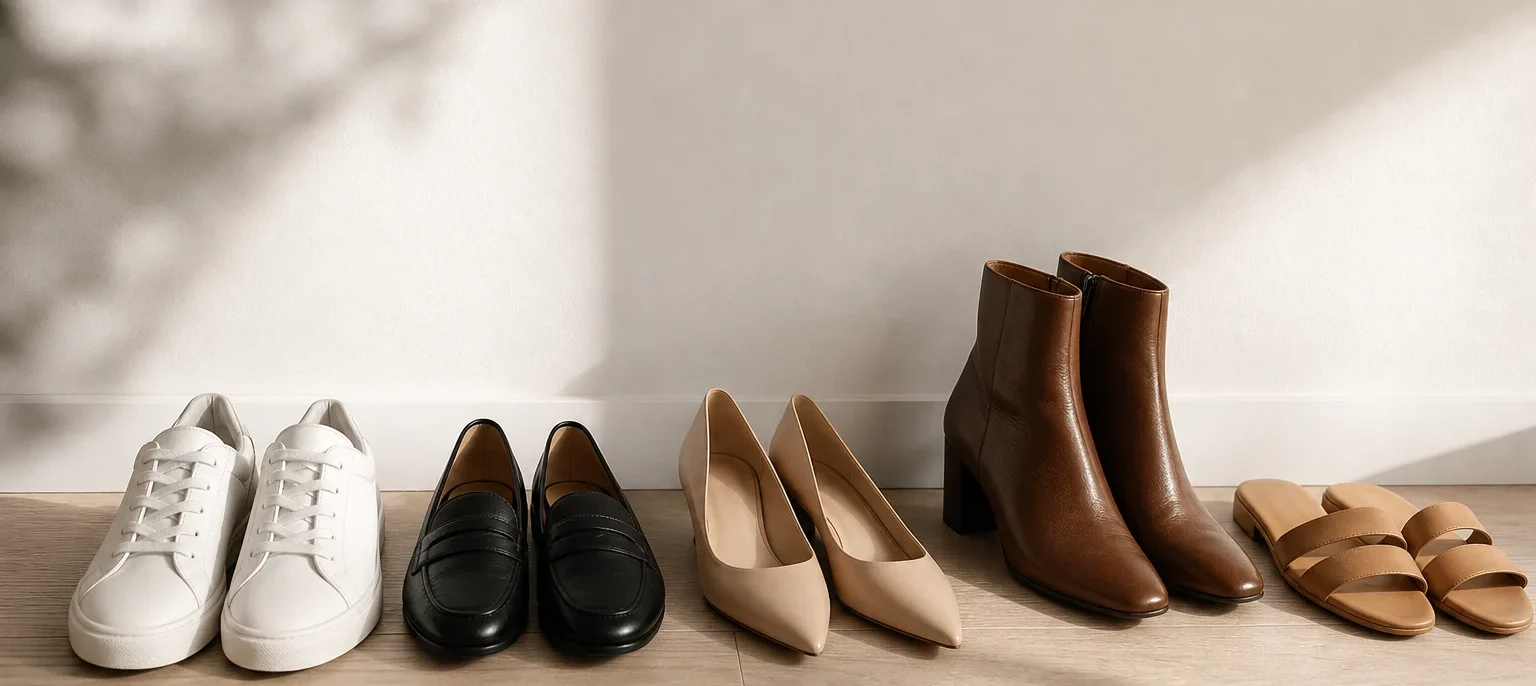
Quick answer: to know how to choose shoes, start from your real routine, not an imagined one. Five pairs usually cover 90% of occasions: clean trainers, a closed flat shoe, a mid heel, ankle boots and a comfortable sandal. When buying, check comfort (toe box, heel, insole), proportion with your body and a colour that works with your wardrobe.
Open your wardrobe and count: how many pairs do you actually wear? Most people own shoes that have never left the house — bought for a party that never happened, for a style that is not theirs or in an irresistible sale. Knowing how to choose shoes starts with understanding why we buy so many.
In this guide you will see the essential pairs, how to choose by proportion and comfort and how to avoid purchases that stay in the box.
Why do we collect so many shoes?
- We buy for the life we imagine, not the one we live. The 12 cm heel is beautiful, but the routine involves the underground, stairs and 8 hours on your feet.
- Shoe size does not change with the body, so we feel less guilty buying shoes than clothes.
- Sales and novelties encourage impulse buys.
- No defined style: without knowing what suits you, every trend seems like a good idea. If that is you, start with fashion styles: which one is yours.
The 5 pairs that cover almost everything
| Pair | For what | Buying tip |
|---|---|---|
| Clean trainers (white, beige or black) | Everyday, travel, casual looks and even relaxed tailoring | Simple lines, no excess logos |
| Closed flat shoe (loafer, ballet flat, oxford) | Work, commuting | Soft leather and a roomy toe box |
| Mid heel (pump or slingback, 4 to 6 cm) | Meetings, events, dinners | A heel you can wear for 3 to 4 hours |
| Ankle boots | Transitional seasons, cold weather, looks with trousers | Low block heel, neutral colour |
| Comfortable sandal | Hot weather, weekends, travel | Straps that hold the foot securely |
Beyond those five, the next pair should fill a real gap: a party shoe, running trainers, rain boots.
How do you choose by body proportion?
Shoes have scale and line, like any other piece. Some guidelines from visagism applied to the body:
- To lengthen the leg: shoes in a shade close to your skin, a pointed or almond toe and a "V" cut on the instep.
- Ankle straps and horizontal straps cut the leg line and shorten it — they suit long legs best.
- Platforms and chunky soles need clothes with proportional volume; with very delicate pieces, the foot looks heavy.
- Small feet suit shoes with delicate lines; larger feet look balanced with almond toes and medium or dark colours.
- Shoes in the same colour as your trousers or tights create continuity and lengthen, the same principle as the monochrome outfit.
Comfort: what to check in the shop
- Try shoes on at the end of the day, when feet are most swollen;
- Wear the socks or tights you would wear with them;
- Walk around the shop for a few minutes, including on a hard floor;
- Room for your toes: they must not be squeezed;
- A firm heel counter, with no slipping;
- Heel height: up to 5 cm or a block heel for everyday wear;
- An insole with some cushioning;
- Material: leather and breathable fabrics mould better to the foot.
If a shoe hurts in the shop, it will hurt at home. "It’ll stretch" is true only for some materials, and only a little.
MedlinePlus, from the US National Library of Medicine, gathers guidance on foot health and suitable footwear. Persistent pain, calluses and deformities call for assessment by a doctor or podiatrist.
Shoes for each occasion
Work
In formal settings, closed leather shoes with a low to mid heel convey care. Loafers and block-heel pumps are safe choices. In creative environments, clean trainers with tailoring work well.
Weddings and parties
Follow the dress code. For long events, a sandal or pump with a stable mid heel, ideally already broken in. Bring a spare pair if there is a dance floor.
Travel
Take three pairs at most: trainers for walking, a versatile shoe for dinner and a sandal or boot depending on the weather. Travel wearing the heaviest pair.
Everyday life with lots of commuting
Prioritise cushioning and stability. Good trainers or a loafer with a rubber sole will save your evening. Keep the smarter shoe in your bag or at the office if needed.
High heels: how to wear them without suffering
- Save very high heels for occasional events;
- Choose block heels or wedges for long events;
- Carry a flat pair in your bag if the party is long;
- Gel insoles under the ball of the foot help reduce pressure;
- Alternate heels with flat shoes during the week.
Shoes and personal style
Shoes speak to your dominant style:
- Classic: loafers, pumps, riding boots;
- Elegant: slingbacks, pointed pumps, fine-strap sandals;
- Minimalist: plain white trainers, unadorned flats;
- Romantic: bow ballet flats, delicate sandals;
- Boho: flat sandals, raw-leather sandals, suede boots;
- Rock: combat boots, buckled boots, high-top trainers;
- Sporty: technical and casual trainers.
Like a bag, a shoe is an inexpensive way to try a secondary style — see the logic in types of bags and when to use them.
How do you avoid purchases that stay in the box?
- Before buying, think of three outfits in your wardrobe that go with the shoe;
- Ask yourself: "would I wear this next week?";
- Avoid buying uncomfortable shoes "to make my feet look smaller" or "for a future occasion";
- Keep a list of what is missing, not what you want;
- Review your shoes every 6 months and donate what you have not worn in 1 year.
How much should you spend on each pair?
A simple way to decide is cost per wear: divide the price by the number of times you will wear the shoe in 1 year. A good-quality loafer worn 3 times a week costs much less per wear than a party shoe worn twice. So it is worth spending more on everyday pairs — trainers, flats and boots — and saving on the ones for rare occasions.
How do you make them last?
- Rotate pairs so they rest for a day or two;
- Use shoe trees or paper to keep their shape;
- Take them to a cobbler to replace heels and soles before damage reaches the structure;
- Condition leather every 2 to 3 months;
- Store them in fabric bags, away from sun and damp;
- Clean off mud and salt as soon as possible.
Frequently asked questions
There is no universal list, but five styles usually cover most occasions: clean trainers, a closed flat shoe (loafer or ballet flat), a mid-heel pump, ankle boots and a comfortable sandal. Colour and style depend on your wardrobe.
Look for a toe box with room for your toes, a heel of up to 5 cm or a block heel, a cushioned insole, a material that moulds to your foot and a shape that suits your style. Try them on at the end of the day, when feet are most swollen.
Shades close to your skin tone (nude) lengthen the leg and go with almost everything. Black, camel, cognac and white are also versatile, depending on your clothing palette.
Frequent, prolonged wear of high, thin heels can cause pain and strain in the feet, knees and back. Choose mid or block heels for everyday wear and save the higher ones for occasional events.

An image that starts from the feet
The right shoes suit your body, your style and your routine — and let the rest of your image work. In the Visagism Consultation, I analyse proportions, style and routine and guide choices of hair, colour and accessories, including shoes and bags, explaining the reason behind each choice.
I want a coherent image, head to toe →
An image professional? The Visagism & Personal Image Course teaches you to read proportion, line and scale to guide clients.
Nelma Faleiro holds a degree in Visagism and Hair Therapy Technology from Anhembi Morumbi University, where she taught for 10 years, and received the SINVISA 2025 Trophy at the 3rd International Visagism Seminar.