Quick answer: postpartum hair loss is a telogen effluvium caused by the drop in oestrogen after birth. It starts 2 to 4 months after delivery, peaks around month 4 and, for most women, ends by the baby’s first birthday. It is expected, does not cause baldness and improves on its own. Shedding beyond that, or with bald patches, needs a medical check.
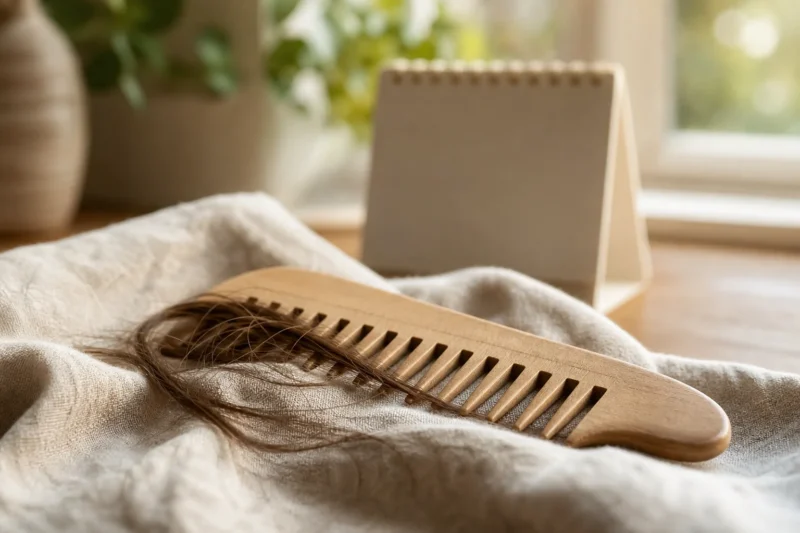
You have just come through pregnancy and birth. The baby finally sleeps a few hours in a row. Then, in the shower, your hair starts coming out in clumps. Postpartum hair loss is very common, but "normal" does not mean it is not frightening.
In this article I explain why it happens, walk you through a month-by-month timeline and separate what is expected from what deserves attention. I also share what genuinely helps in the routine of a mother with very little time.
Why does hair fall out after giving birth?
During pregnancy, oestrogen stays high. This hormone extends the growth phase of the hair (anagen). That is why many pregnant women feel their hair is fuller and shinier: the hairs that should have fallen stay in place.
After birth, oestrogen drops sharply. All the hairs that were held back enter the resting phase (telogen) together. About 3 months later, they fall out. This mechanism has a name: it is a telogen effluvium, which I explain in telogen effluvium: how long it lasts.
In other words, much of the hair you lose after birth is hair that did not fall during pregnancy. The account is simply being settled.
Postpartum hair loss: a month-by-month timeline
Every woman has her own pace, but the most common pattern is this:
| Time after birth | What usually happens |
|---|---|
| 0 to 2 months | Hair still has its pregnancy volume; little shedding |
| 2 to 4 months | Shedding starts, often suddenly; hair in the shower and on the brush |
| 4 to 6 months | Peak shedding; temples and hairline look thinner |
| 6 to 9 months | Shedding slows; short hairs appear along the hairline |
| 9 to 12 months | Volume recovering; the new hairs are still short |
| 12 to 18 months | New hairs gain length and visual volume returns |
The American Academy of Dermatology describes the same pattern: a peak around month 4 and, for many women, a return to normal fullness by the baby’s first birthday.
What about the little flyaways on the hairline?
They are the good news. The short, spiky hairs along the hairline are new growth. Since hair grows about 1 cm per month, they take months to blend in with the rest.
What is normal and what is not?
Expected:
- diffuse shedding across the whole scalp;
- more hair lost at the temples and hairline;
- hairs that come out with a tiny white bulb at the root;
- shedding that starts 2 to 4 months after birth and eases after month 6.
Needs a medical check:
- shedding that is still heavy after 12 months;
- smooth bald patches;
- progressive thinning on the crown and parting (it may be androgenetic alopecia revealed);
- shedding with extreme tiredness, palpitations, intolerance to cold or heat, or unexplained weight changes;
- intense itching, pain or significant flaking.
These signs may point to postpartum thyroiditis, iron-deficiency anaemia or another condition. Diagnosis belongs to the doctor.
Does breastfeeding change how long postpartum shedding lasts?
Breastfeeding does not cause the shedding. The trigger is the hormonal shift of childbirth, and it happens whether you breastfeed or not.
What breastfeeding changes is nutritional demand. Lactation requires energy, protein and iron. If meals are chaotic, regrowth may be slower. That is not a reason to stop breastfeeding; it is a reason to look after yourself too.
What really helps with postpartum hair loss?
No product can stop postpartum hair loss: those hairs are already programmed to fall. What does exist is care that protects the new hair and makes this phase lighter.
1. Food and tests
- include protein at every meal (eggs, meat, pulses, dairy);
- ask your doctor about continuing your prenatal multivitamin;
- ask for ferritin, full blood count and thyroid tests if shedding is heavy;
- do not take supplements on your own, especially while breastfeeding.
2. Wash without fear
Washing does not increase shedding. The hairs that come out in the shower were already loose. Washing as often as your scalp needs prevents oiliness and itching.
3. Less tension, less heat
- swap tight ponytails for low, loose buns;
- choose fabric scrunchies or claw clips;
- cut back on flat irons and very hot dryers;
- postpone relaxers and bleaching until after the peak.
4. A strategic haircut
A cut with slightly less length and a few layers brings back visual volume and makes the routine easier. You do not need to go short. Small changes to length and parting already disguise the temples.
5. A balanced scalp
Cosmetic tonics with caffeine or peptides can be used as helpers. Before using any active ingredient, check with your doctor that it is safe while breastfeeding. Concentrated essential oils also call for caution at this stage.
A realistic 10-minute routine
With a newborn at home, a long routine will not last. This sequence fits into a shower and a nap window:
- Shampoo on the scalp only, massaging with your fingertips for 1 to 2 minutes.
- Conditioner on the lengths only, detangling in the shower with a wide-tooth comb.
- Towel without rubbing: squeeze the lengths instead of scrubbing.
- A supportive tonic, if your doctor approves it, applied to a damp scalp.
- Dry the roots with warm air, so you do not sleep with a wet scalp.
How to track progress without panicking
Counting hairs every day only feeds anxiety. Take one photo a month instead, always in the same light, showing the parting and the temples. Compare month 3 with months 6 and 9. That is how you see the recovery, which happens slowly and almost unnoticed in the everyday mirror.
Common myths about hair loss after birth
"Cutting your hair short stops the shedding." Myth. A haircut does not change the hair cycle. It changes weight and appearance.
"If I do not breastfeed, I will not shed." Myth. The hormonal shift happens either way.
"My hair will be thin forever." In the vast majority of cases, no. If volume has not returned in 12 to 18 months, investigate other causes with a dermatologist.
"A home-made tonic will fix it." Home recipes can irritate the scalp and do not affect the hormonal cycle.
To understand other causes of hair loss that may appear at the same time, read female hair loss: the 9 most common causes.
Frequently asked questions
It usually starts 2 to 4 months after birth, peaks around month 4 and then slows down. For most women, volume is back to normal by the baby’s first birthday.
Breastfeeding is not the main cause of postpartum shedding. It happens because oestrogen drops sharply after birth. Still, the nutritional demand of breastfeeding calls for attention to iron and protein.
Do not take any vitamin on your own. Many doctors keep the prenatal multivitamin during breastfeeding. Specific supplements only with tests and a prescription.
It does not usually leave permanent gaps. The temples often look thinner for a few months. Smooth bald patches or shedding lasting more than a year need a dermatologist.
Look after your hair in this phase with support
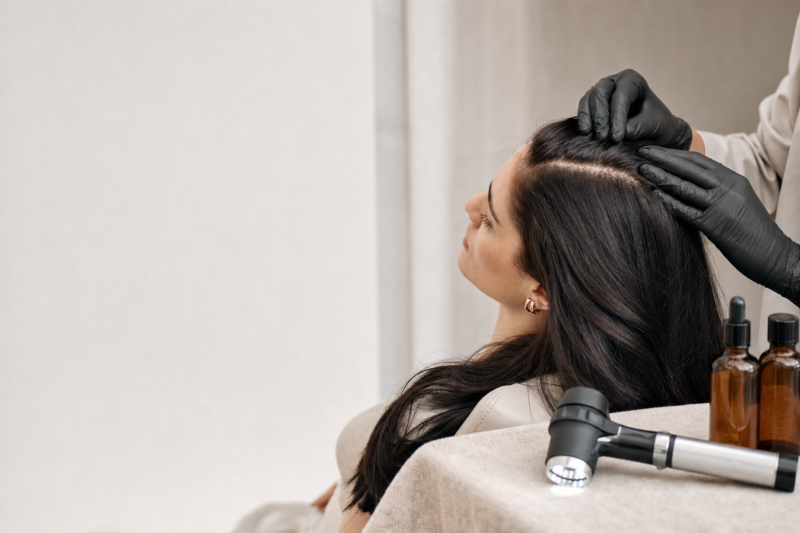
The postpartum period already brings plenty of challenges. Having someone follow your scalp with photos and trichoscopy brings peace of mind: you know whether the shedding is on track or needs investigation.
In the Hair & Scalp Therapy Consultation, I carry out a consultation, trichoscopy and a support protocol that is compatible with breastfeeding. When the signs call for it, I refer you to a dermatologist or to your obstetrician.
If you are a beauty professional who sees many new mothers, the Practical Trichology e-book helps you advise safely and recognise when to refer.
Nelma Faleiro holds a postgraduate specialisation in Cosmetic Trichology (Faculdades Oswaldo Cruz) and a degree in Visagism and Hair Therapy from Universidade Anhembi Morumbi, where she lectured for 10 years. Educational content: it does not replace medical advice.