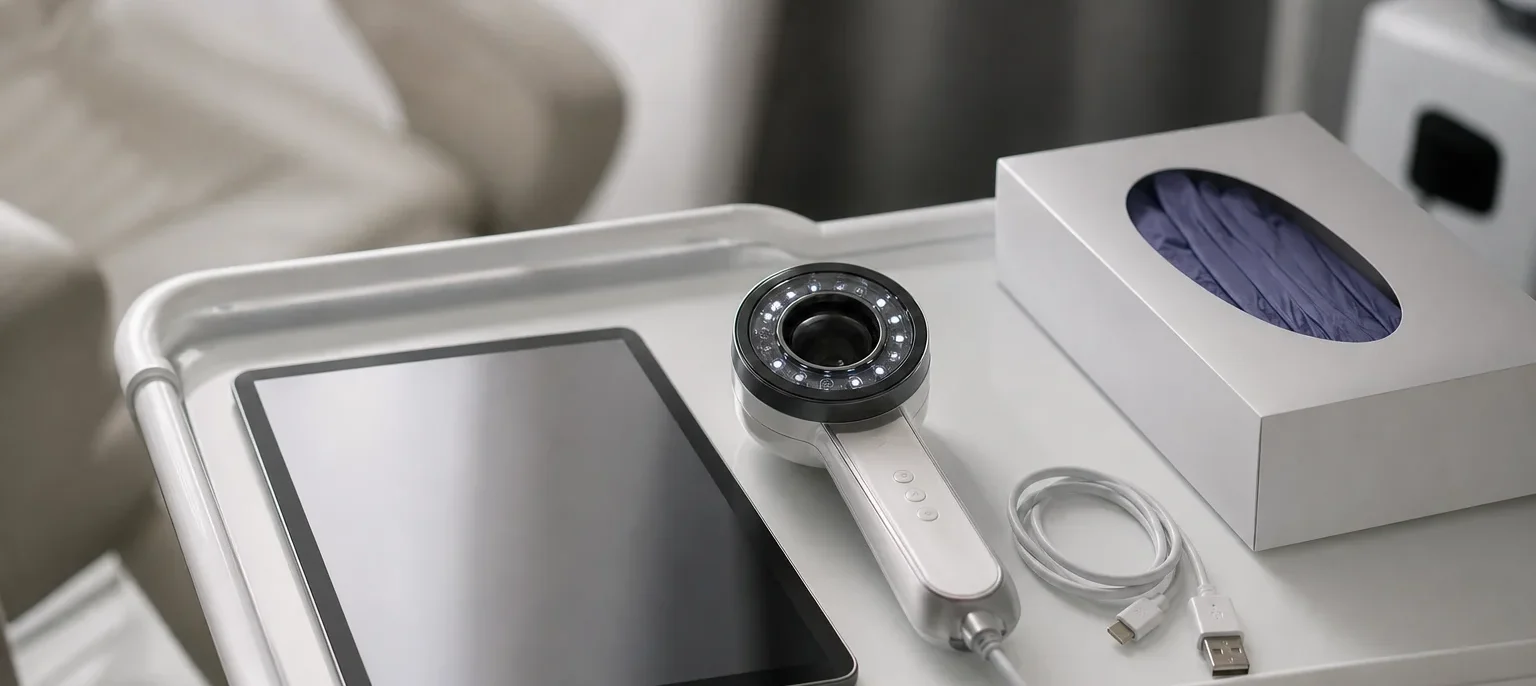
Quick answer: a good professional trichoscope combines 20x to 70x lenses (with a higher-magnification option for the hair shaft), polarised and non-polarised light, at least 2 to 5 megapixels of resolution, stable focus and software that saves images by client and lets you compare sessions. More than the price, standardisation matters: same light, same magnification, same points at every assessment.
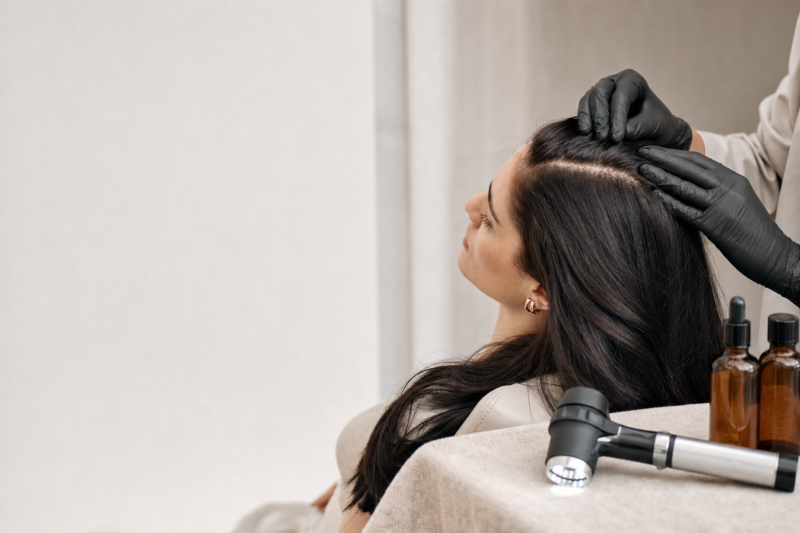
Trichoscopy has changed hair therapy. Instead of saying "your scalp is oily", you show the client, on screen, the blocked follicular openings, the flaking and hairs of different thicknesses. The image makes the assessment more precise, builds trust and improves adherence to the protocol. Choosing the right professional trichoscope is therefore one of the most important decisions when setting up or expanding your service.
In this guide you will see what to look for when buying, price tiers and how to use the device in a standardised way.
What is a trichoscope and what does it show?
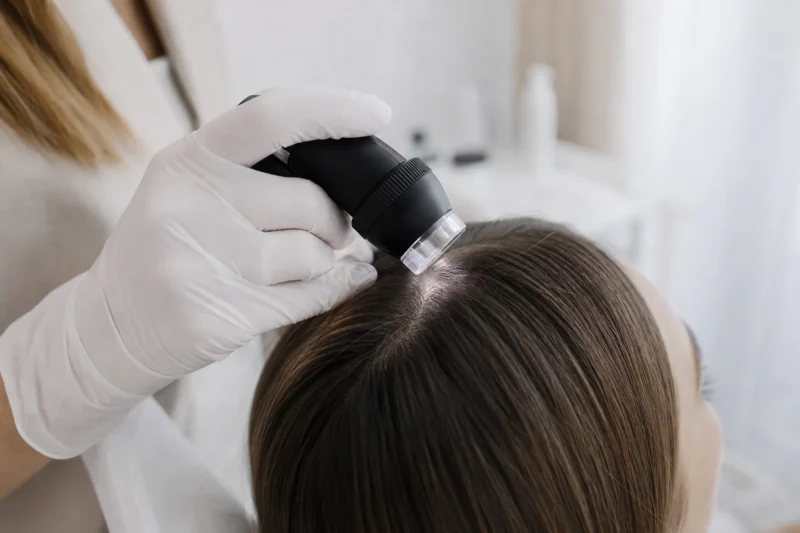
A trichoscope is a dermatoscope adapted for the scalp and hair: a magnifying lens with its own lighting, usually connected to a computer, tablet or phone. It lets you observe:
- follicular openings, whether open, blocked or empty;
- hair thickness, identifying miniaturised hairs;
- the number of hairs per follicular unit;
- flaking, oiliness and erythema (redness);
- vascular patterns;
- hair-shaft changes, such as broken hairs, split ends and chemical damage.
To understand the technique itself, read trichoscopy: what it is and what it is for. Medical literature, such as the review Trichoscopy update 2011 by Rudnicka and colleagues, describes the trichoscopic patterns of the main hair diseases — useful knowledge for a hair therapist to recognise when to refer.
How do you choose a professional trichoscope?
1. Magnification
| Magnification | What it is for |
|---|---|
| 1x to 10x (overview camera) | Global photos of the top, part and crown |
| 20x to 70x | Routine assessment: openings, density, flaking, vessels |
| 150x to 200x | Hair-shaft detail: cuticle, fractures, chemical damage |
Devices with interchangeable lenses or optical zoom are more versatile. Be wary of high numbers advertised as "digital zoom": enlarging the image without gaining detail does not help.
2. Lighting
- Polarised light: reduces surface shine and shows structures underneath, such as vessels and pigment.
- Non-polarised light: shows flaking and the surface better.
- UV light (on some models): can highlight residue and some microorganisms, but is not essential to start.
Ideally you can switch between lights at the press of a button.
3. Resolution and focus
Look for at least 2 real megapixels; 5 megapixels or more give sharper images for comparison. Focus needs to stay stable when the lens touches the scalp. Devices with a spacer or contact tip help keep the same distance.
4. Connectivity and software
This is where many professionals go wrong. The software should:
- create a folder per client;
- record the date, area and magnification of each image;
- let you compare images side by side;
- offer measurement tools (hair thickness, counts);
- export images securely.
Remember that client images are personal data. Store them with a password, get written consent and follow data-protection law (such as Brazil’s LGPD or Europe’s GDPR).
5. Ergonomics and hygiene
Weight, handle, how easy the tip is to clean and the availability of disposable or washable tips all matter day to day. A tip that cannot be cleaned between clients is a biosafety problem.
Is a phone-mounted trichoscope worth it?
Models that clip onto a phone camera are light, handy for home visits and often have good optics. There are three things to watch: the image depends on your phone’s camera (and changes when you switch phones), storage gets mixed with personal photos and there is not always software to organise by client. If you choose this format, create a protected folder per client and note the area and magnification on each image.
Checklist before you buy
Take this list to the demonstration:
- Does the device have polarised and non-polarised light, with quick switching?
- Which real (optical) magnifications are available?
- Is the image still sharp on dark hair and on a light scalp?
- Does the software run on the computer or tablet you already own?
- Can you compare two sessions side by side?
- Can the tip be cleaned with 70% alcohol?
- Is there local technical support and a warranty of at least 12 months?
- Does the manufacturer offer training?
If the answer is "no" to more than two items, keep looking.
How much does a professional trichoscope cost?
Prices vary widely with brand, exchange rate and accessories. As a general guide:
- Generic USB microscopes: the cheapest option; fine for getting started, with limits on light and focus.
- Entry-level professional trichoscopes: with polarisation and their own software, typically a significant step up in price.
- Complete systems: with several lenses, measurement software and automated analysis, they can cost many times more.
Before buying, ask for a demonstration, test on different hair and skin types, and check technical support and warranty in your country.
How do you use a trichoscope with clients?
An image only has value if it can be compared. A simple standardisation protocol:
- A clean, dry scalp, with no products, always under the same conditions.
- The same assessment points each session: for example, front hairline, top (vertex), crown, temples and nape.
- The same magnification and light for each point.
- A global photo before the close-ups, with the client in the same position.
- Notes on the form about what you observed — use a template like the trichology consultation form.
- Reassessment intervals of 30 to 90 days, depending on the protocol.
How to show images to the client
Show the images calmly and in plain language. Compare with a healthy area on the client’s own scalp (usually the nape). Avoid terms that sound like a diagnosis. A useful sentence: "Here we see finer hairs than at the nape. It is a sign worth checking with a dermatologist."
Common trichoscope mistakes
- Buying for the highest magnification rather than image quality;
- Not standardising points, light and magnification — comparisons lose value;
- Using images to "scare" clients into buying packages;
- Drawing medical conclusions from the image;
- Storing images without consent or without security.
When does a trichoscope pay for itself?
An assessment with trichoscopy usually justifies a higher fee for the first consultation and improves adherence, because the client sees progress. With a simple calculation — the device’s price divided by the extra you charge per assessment — you can estimate how many months it takes to pay off. For many professionals, that happens within the first 6 to 12 months of regular use.
Frequently asked questions
For routine hair therapy, lenses between 20x and 70x cover most of the assessment: follicular openings, hair thickness, flaking and vessels. Magnifications of 150x to 200x are useful for hair-shaft detail but show only a small area.
It is highly recommended. Polarised light reduces surface glare and better shows vessels, pigmentation and structures below the surface layer. Ideally the device switches between polarised and non-polarised light.
To get started and record simple images, yes, but they usually have uneven lighting, unstable focus and no polarisation. To track progress with reliable comparisons, a professional trichoscope makes a difference.
In a hair therapist’s hands, the trichoscope is a tool for cosmetic assessment and follow-up. Findings that suggest disease should be referred to a dermatologist, who makes the diagnosis.
Turn images into protocols
The trichoscope shows; you interpret. To read images confidently, recognise patterns and know when to refer, the Practical Trichology e-book organises assessment, scalp disorders and protocol building in 109 pages, drawing on ten years of teaching trichology.
I want the Practical Trichology e-book →
Not a professional and want an assessment with trichoscopy? Discover the Hair & Scalp Therapy Consultation.
Nelma Faleiro holds a specialisation in Cosmetic Trichology (Faculdades Oswaldo Cruz) and a degree in Visagism and Hair Therapy Technology from Anhembi Morumbi University, where she taught for 10 years. Educational content for professionals; always respect the legal limits of your practice.