Quick answer: visagism for men reads face shape, features, personality and routine to choose haircut, beard, brows and glasses. The beard is a drawing tool: volume on the chin lengthens, volume at the sides widens and rounded outlines soften. Glasses follow the rule of contrasting lines with the face.
Men tend to change their image very little. They keep the same haircut for years, let the beard grow without direction and choose glasses by brand. Yet on a man’s face, these three elements do almost all the image work. A few millimetres on the beard change how strong, old or approachable someone looks.
In this guide to visagism for men, I explain the principles, show what works for each face shape and point out the most common mistakes made in barbershops and opticians.
What is visagism for men?
Visagism is the art of creating a personal image that expresses each person’s identity. The method, systematised in Brazil by Philip Hallawell (see a profile of the author by PUCRS), relates lines, shapes and colours to emotions and temperaments. The basics are in what visagism is and how it works.
In visagism for men, the analysis considers:
- face shape and the proportions of the facial thirds;
- hairline, receding areas and density;
- beard growth and density;
- features: jaw, chin, nose, brows;
- personality, profession and grooming routine.
The language of lines on a man’s face
Every line communicates something. This logic applies to hair, beard and frames.
| Line | Most common message | Example |
|---|---|---|
| Horizontal straight | Stability, firmness | Beard with a straight base |
| Vertical straight | Authority, elegance | High quiff, goatee |
| Diagonal | Dynamism, energy | Sharp fade, side parting |
| Curve | Warmth, lightness | Rounded beard, wavy hair |
An executive who wants to convey firmness can reinforce straight lines. A psychologist or teacher who wants to look approachable can soften with curves. There is no absolute right: there is consistency between image and message.
The beard as a drawing tool
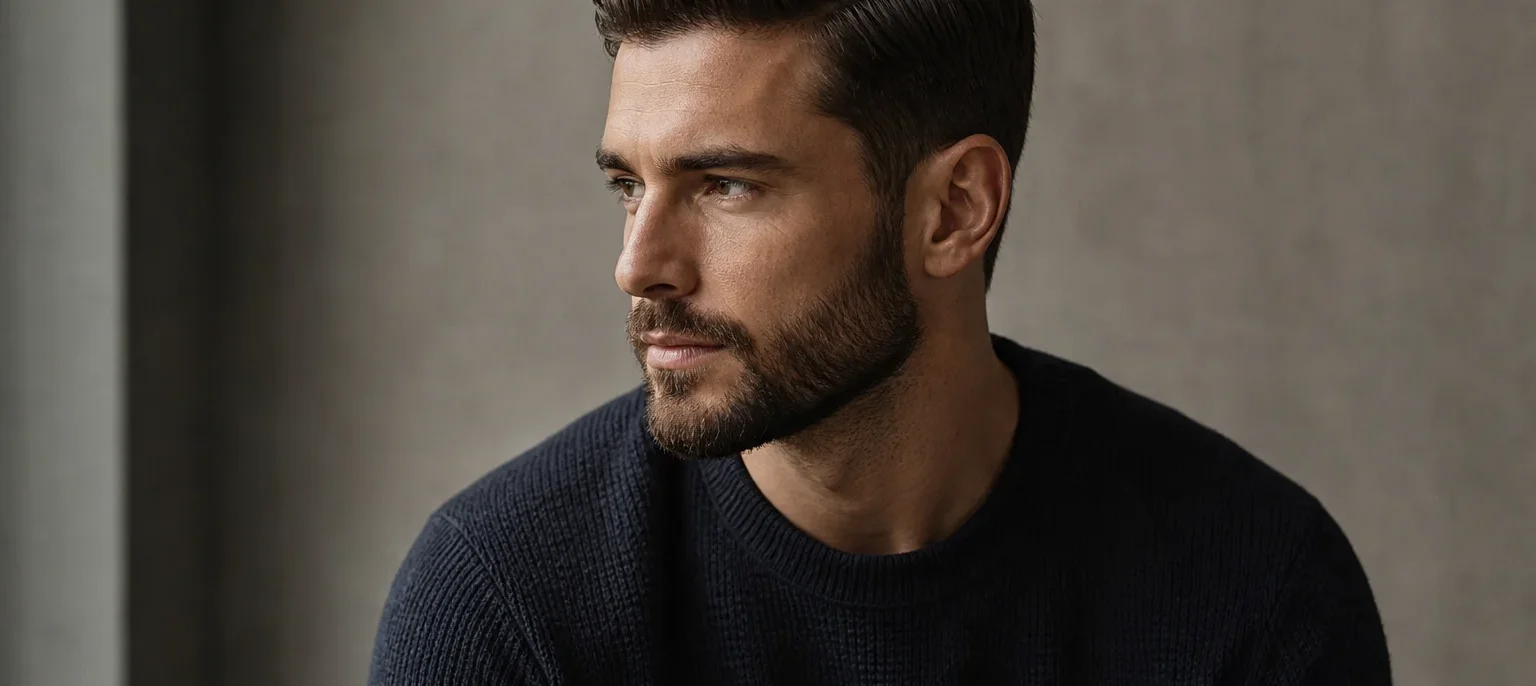
The beard is the most powerful resource in visagism for men, because it changes the outline of the lower third of the face.
- Volume on the chin lengthens the face.
- Volume at the sides widens the face.
- Close-cut sides slim the face.
- A rounded base softens angles.
- A straight base emphasises the jaw.
The neckline and the cheek line
Two lines decide whether a beard looks groomed:
- Neckline: it should sit about 2 fingers above the Adam’s apple. Lower looks careless; higher "eats" the jaw.
- Cheek line: follow the natural shape and only remove stray hairs above it. Very straight, low lines age and harden the face.
Patchy or thin beards
Not every beard grows evenly. In these cases, short beards (3 to 6 mm) or styles that highlight the chin and moustache usually work better than trying for a full beard. Localised gaps, smooth hairless patches or persistent itching need a dermatologist.
Visagism for men by face shape
| Shape | Goal | Haircut | Beard | Glasses |
|---|---|---|---|---|
| Oval | Keep the balance | Almost all; careful with very high quiffs | Short to medium, natural outline | Almost all; proportional width |
| Round | Lengthen | Volume on top, short sides | More length on the chin, close sides | Rectangular and angular |
| Square | Soften or embrace strength | Texture on top, side parting | Rounded or short; avoid a very straight, wide base | Round, oval, aviator |
| Oblong (long) | Shorten and widen | Moderate side volume, low fringe or quiff | Fuller sides, short chin | Frames with depth and strong temples |
| Triangle (wide jaw) | Balance the base | More volume on top and at the temples | Short at the sides | Frames with emphasis on the top |
| Heart (wide forehead, narrow chin) | Add weight to the chin | Not much volume on top, side fringe | Fuller on the chin and jaw | Light at the bottom, rimless lower edge |
| Diamond | Soften the cheekbones | Moderate volume on top, sides not shaved too close | Full on the chin | Oval and rimless |
To identify your shape with measurements, follow the step by step in how to find your face shape.
Men’s haircuts: what to look at beyond face shape
Receding hairline
A receding hairline calls for cuts that do not "draw" the front line: texture on top, a short choppy fringe or length that falls slightly forward. High quiffs and slicked-back styles expose the temples more.
If your hairline is receding, it is worth keeping an eye on your scalp early. Male hair loss is slow, and time is on the side of medical treatment.
Fades and sides
Very short sides slim the face and increase the sense of length. They are great on round faces and risky on long ones. On a long face, prefer scissor-cut sides with a little more volume.
Hair texture
Coily and curly hair has its own volume and shape. The cut must respect shrinkage and shape the silhouette with the hair dry. Fine hair needs fewer layers; coarse hair needs internal weight removed.
Glasses: the strongest line on the face
The frame sits right in the centre of your expression. That is why it weighs so much in your image.
Practical rules:
- Contrast of shape: angular face, frames with curves; rounded face, angular frames.
- Width: the frame should be roughly as wide as the face at the temples.
- Brows: the top of the frame should follow the brow line, not cut it in half.
- Visual weight: thick, dark frames increase presence; thin metal frames bring lightness and sophistication.
- Colour: tones that relate to hair and beard create unity.
Men’s brows: the forgotten detail
Men’s brows do not need to be shaped, but they can be tidied. Removing only the hairs between the brows and the very long ones already cleans up the expression. Over-thinning feminises and ages; very arched shapes completely change the message.
The most common mistakes
- Copying a celebrity’s beard without considering face shape and density.
- A neckline that is too low, creating a "second chin" of hair.
- A very high fade on a long face, which lengthens it even more.
- Glasses in the same shape as the face, reinforcing what you wanted to balance.
- A sharp beard with messy hair (or the other way round): the image loses consistency.
- Ignoring the skin under the beard. Flaking and itching call for proper cleansing and, if they persist, an assessment.
A minimal routine to keep the shape
- trim the beard every 5 to 7 days to keep the outline;
- haircut every 3 to 5 weeks for fades, 6 to 8 weeks for longer cuts;
- wash the beard with a dedicated or mild shampoo and condition the hair;
- comb the beard in the direction of growth;
- review your glasses whenever you change your haircut or beard a lot.
Frequently asked questions
It is visagism applied to the male image: analysing face shape, features, personality and routine to choose a haircut, beard, brows and glasses that convey the desired image.
Beards that lengthen: more volume on the chin and short, neatly trimmed sides, such as an extended goatee or a beard with a slightly longer point. Avoid volume on the cheeks.
It can help. A beard with more length on the chin and a well-defined neckline creates a stronger jawline. The neckline should sit about two fingers above the Adam’s apple.
Use contrast: an angular face calls for frames with curves; a rounded face calls for straight, angular frames. The frame width should follow the width of the face at the temples.

An image that tells your story
Haircut, beard and glasses form a set. When all three agree, the image looks natural and you convey exactly what you intend, whether firmness in a meeting or closeness with clients and students.
In the Visagism Consultation, I analyse your face, features, routine and the message you want to send, and recommend haircut, beard, brows and glasses with the reason for each choice. In person or online.
Barber or hairdresser? The Visagism & Personal Image Course teaches you to read the face methodically and turn every appointment into a consultation.
Nelma Faleiro holds a degree in Visagism and Hair Therapy from Universidade Anhembi Morumbi, where she lectured for 10 years, and received the SINVISA 2025 Award.